


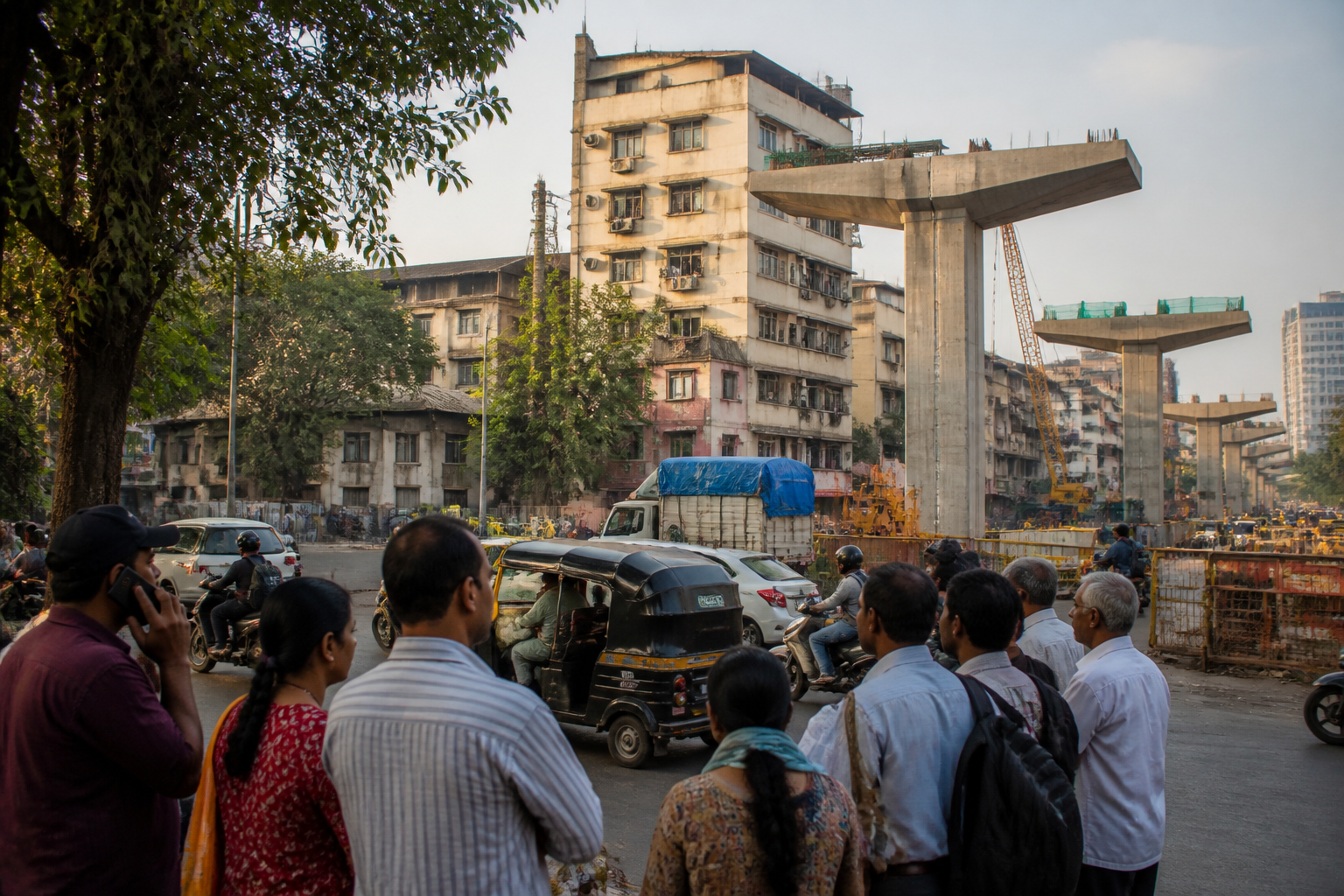
The dispute over Thane’s proposed internal metro route through Lokmanya Nagar has exposed a larger question facing infrastructure projects in built-up cities: how should authorities expand mass transit without displacing existing communities or leaving rehabilitation plans unresolved?
A report by Loksatta – Thane said residents opposing the proposed alignment have formed the Lokmanya Nagar Bachav All-Party Action Committee. At a meeting in Dawlenagar, Maharashtra Transport Minister Pratap Sarnaik expressed opposition to taking the route through densely inhabited parts of Lokmanya Nagar, while Thane Municipal Corporation’s House Leader Hanmant Jagdale continued to support the project. The disagreement has also revealed different positions within the Shinde-led Shiv Sena.
The immediate project issue is linked to a proposed road between Lokmanya Nagar and Upvan. Thane Municipal Corporation recently passed a resolution in its general body meeting to develop the road identified in the development plan. The metro alignment is expected to run along this route. According to the report, several homes could be affected by the road and metro works, while residents say there is no clear explanation of how their rehabilitation would be carried out.
That uncertainty has become the central point of opposition. Residents have not rejected urban development in principle, but are questioning whether the project can be implemented without destroying homes and disrupting established neighbourhoods. The distinction matters. In a dense city, the social cost of a transport corridor is determined not only by its engineering design or travel benefits, but also by the number of properties affected, the quality of resettlement and the transparency of the acquisition process.
Sarnaik’s position, as reported by Loksatta, was that development should not mean the displacement or destruction of citizens. He said alternative routes that would affect fewer residents and benefit more people should be examined seriously. He also said he would discuss the issue with Deputy Chief Minister Eknath Shinde and seek a positive solution. Sarnaik further referred to the possibility of taking the alignment through Upvan, where, according to his statement, there is less habitation.
This argument places route optimisation at the centre of the dispute. A metro line cannot be assessed only by the shortest distance between two points. Its alignment must also account for existing roads, built-up density, stations, construction feasibility, land requirements, environmental conditions and access to the communities it is intended to serve. A route through a low-density area may reduce immediate displacement, but it must still demonstrate that it will provide meaningful access and passenger demand. Conversely, a route through a heavily populated area may serve more residents while creating significant rehabilitation obligations.
The material available in the report does not establish the final alignment, the number of affected structures, the land requirement, the project cost, the proposed station locations or the rehabilitation package. These gaps are important because public disagreement is currently being conducted without a complete publicly cited account of the project’s social and technical consequences. The absence of such details makes it difficult for residents to evaluate the proposal and for authorities to demonstrate that the chosen route is the most suitable one.
Jagdale has rejected the suggestion that there is a split within the party, saying that both sides want development and that misunderstandings may have contributed to the disagreement. He said representatives would approach residents to address those misunderstandings. His support is also connected to a longer-standing demand for development in the informal settlements of Lokmanya Nagar, according to the report.
That position points to another layer of the issue. Lokmanya Nagar is not being described only as a settled residential neighbourhood resisting change. The report also refers to efforts over several years to improve the area’s slums. For communities living in informal or insecure housing, infrastructure can represent both an opportunity for better services and a threat of eviction. Whether a project is seen as beneficial therefore depends heavily on tenure security, rehabilitation terms and the ability of residents to participate before decisions become irreversible.
Local leaders who attended the residents’ meeting also opposed the proposed alignment. Shinde Sena divisional head Santosh Dhamale said development should not be built on the destruction of Lokmanya Nagar. Local corporator Rakesh Shinde alleged that some people were attempting to use Eknath Shinde’s image to generate support for the ring metro. These claims are political assertions and are not independently established in the supplied material, but they illustrate how infrastructure alignment has become entangled with local representation and competing claims over who speaks for the neighbourhood.
The project has also attracted questions from Jitendra Awhad, an MLA from the Sharad Pawar faction of the Nationalist Congress Party, during a presentation at the municipal headquarters. According to the report, Awhad raised concerns about rehabilitation, asked when the metro would run through the Kalwa-Mumbra area and questioned whether the project was being advanced for the benefit of a particular builder. The report does not provide evidence supporting that allegation, so it cannot be treated as an established fact. It does, however, show that the debate extends beyond one route and includes broader questions about the distribution of metro investment across Thane.
The reference to Kalwa-Mumbra is significant because metro planning is rarely experienced as a single corridor decision. Residents compare which neighbourhoods receive connectivity, which areas bear construction impacts and which communities remain outside the network. A project may be presented as a citywide transport intervention, but its legitimacy is often tested locally—at the point where a road is widened, a building is affected or a settlement is asked to make way for a future station or viaduct.
The dispute also highlights the institutional complexity of the proposal. The municipal corporation is involved in road development and local planning decisions. State ministers and the deputy chief minister have political authority over broader transport priorities. Local elected representatives claim responsibility for neighbourhood development, while residents demand information and protection from displacement. A workable decision would require these institutions to publish a common account of the alignment, affected properties, construction method, rehabilitation process and decision timeline.
At present, the supplied report confirms political disagreement and organised resident opposition, but not a final decision to cancel, alter or approve the Lokmanya Nagar alignment. It also does not establish whether a formal social-impact assessment, detailed project report or rehabilitation plan has been made public. Those documents would be necessary to move the debate from competing statements to an evidence-based assessment of alternatives.
The immediate urban question is therefore not whether Thane needs better public transport. The competing statements in the report indicate broad support for development in principle. The question is whether the metro can be aligned and implemented in a way that protects existing residents while producing a credible transport benefit. In a city where redevelopment, informal housing and infrastructure expansion overlap, route selection is also a decision about who bears the cost of mobility.
The next stage of the dispute will depend on the authorities’ response to the residents’ objections and on whether alternative alignments are formally examined. Until the alignment, affected households and rehabilitation arrangements are clearly disclosed, the public debate will remain divided between the promise of improved connectivity and the fear of irreversible displacement.
