


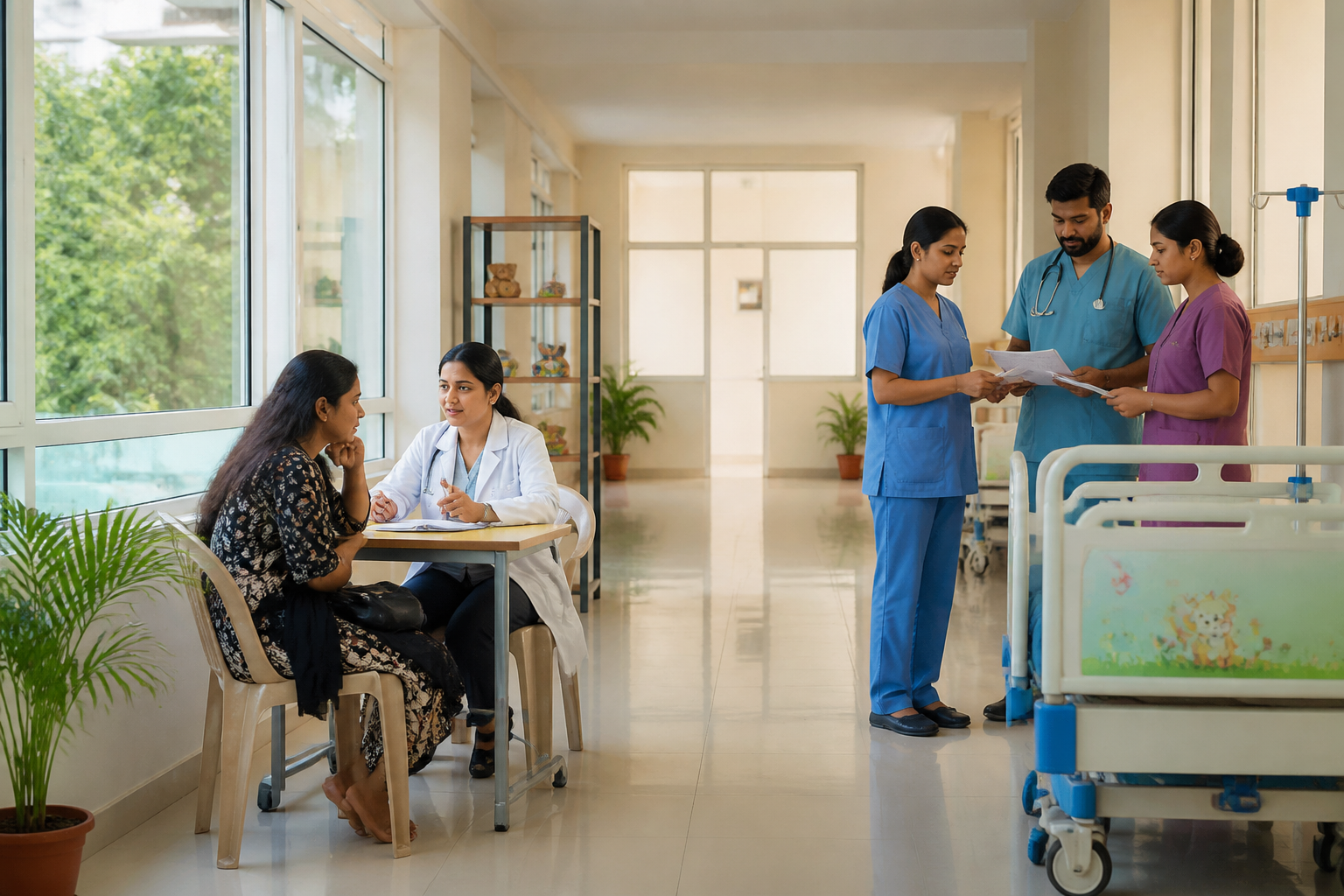
The launch of Punaschethana at Bengaluru’s Indira Gandhi Institute of Child Health marks an important institutional shift in the treatment of children with serious, life-limiting conditions. The centre, inaugurated on September 5 and scheduled to become functional from September 15, is described by Deccan Herald as the first such facility in an Indian government institution. Its significance lies not only in the creation of 10 inpatient beds, but in the attempt to place pain relief, counselling, symptom control and home-based support within a public paediatric hospital.
Palliative care is often associated with the final stage of illness. The model being established at IGICH is broader. The centre is intended to support children who require relief from severe symptoms while continuing to receive curative or life-prolonging treatment. Its stated services include pain and symptom control for cancer-related pain, post-amputation pain, mucositis, dystonia and spasticity associated with serious neurological illness. The facility will also provide psychosocial support for families, outpatient follow-up and home care.
That combination matters because the needs of children with serious illnesses extend beyond a single hospital visit. Symptoms may change between admissions, treatment can impose financial and emotional pressure on households, and families may require guidance after returning home. IGICH’s planned home-care programme, supported by a dedicated vehicle, is intended to extend continuity of care beyond the hospital. The outpatient department will provide follow-up care and counselling, while counsellors and therapists will offer age-appropriate support to children and their families.
The institutional case for the service comes from the patient profile at IGICH itself. A study conducted at the hospital examined 450 admissions to its neonatal intensive care unit over a six-month period and identified 52 neonates, or 12.2 per cent, who could potentially have benefited from palliative care. The finding does not establish the total demand across the hospital or the wider public-health system. It does, however, indicate that the requirement for such care can be present within routine hospital activity and may be identifiable before families reach an end-of-life crisis.
This is one of the central challenges in integrating paediatric palliative care into public hospitals: identifying patients early enough for support to become part of their treatment pathway. The information released about Punaschethana does not specify a universal referral protocol, eligibility criteria or staffing numbers beyond the leadership and professional roles named by the hospital. It does show that the proposed unit is being designed as a multidisciplinary service, combining medical symptom relief with psychological and social support.
The centre is headed by Dr Anuradha Ganigara, associate professor of paediatric anaesthesiology at IGICH. Saranam India and the Pain Relief and Palliative Care Society, Hyderabad, are serving as capacity-building and implementation partners. Their involvement suggests that the hospital is not treating the facility as an isolated ward, but as a service requiring specialised skills, institutional training and an implementation framework.
The role of external partners is particularly relevant in a specialised area such as paediatric palliative care. A hospital may have paediatricians, anaesthesiologists and nursing staff, but the delivery of palliative care also requires expertise in symptom assessment, communication with children and families, counselling, social support and coordination across settings. The supplied report does not detail the training curriculum, staffing model or funding arrangement. Those elements will determine how the centre functions once it becomes operational.
The 10-bed inpatient ward is planned for children requiring intensive symptom relief, stabilisation and coordinated multidisciplinary support. Bed capacity provides a concrete starting point, but it is not the same as total service capacity. The proposed home-care programme and outpatient department could allow IGICH to support more families than those admitted to the ward, provided the hospital has sufficient personnel, transport and follow-up systems. The report does not state how many home visits are planned, which areas will be covered or how referrals from outside Bengaluru will be managed.
That geographic question is important because IGICH sees patients from across Karnataka, according to the statement from Dr Gayatri Palat, professor of pain relief and palliative care and founder of the Pain Relief and Palliative Care Society, Hyderabad. A centre located in Bengaluru may therefore serve patients who live far from the hospital and whose families face difficulties returning for repeated consultations. Home-based care can reduce some travel requirements, but the available information does not establish whether the planned vehicle and team will operate beyond the city or how continuity will be managed for families who return to other districts.
The hospital’s public-sector role gives the initiative a wider institutional dimension. IGICH is a government teaching hospital and receives a high volume of complex paediatric cases. Establishing palliative care within such a setting can make the service part of ordinary hospital practice rather than a separate charitable or private arrangement. Dr Megan Doherty, director of paediatric palliative care at an international organisation, described the hospital as demonstrating how palliative care can be embedded alongside curative and life-prolonging treatment rather than reserved for the final days of life.
The evidence supplied with the announcement supports that description in several ways. Punaschethana is linked to inpatient care, outpatient follow-up, counselling and home-based support. The service is also being placed within a hospital that already treats seriously ill children and newborns. Together, these features point to a model in which palliative care is connected to clinical decision-making and long-term family support. They do not yet show how consistently the model will be applied across departments or whether it can be replicated elsewhere.
The 12.2 per cent figure from the neonatal intensive care unit study also needs to be read carefully. It relates to 52 out of 450 admissions during a six-month period and identifies children who could potentially have benefited from palliative care. It is not a prevalence estimate for all children in Karnataka, nor does it measure the number of children who will use Punaschethana. The study nevertheless provides an internal basis for planning: a defined share of critically ill patients may require a form of care that conventional treatment pathways do not fully provide.
The family-support component addresses another dimension of serious childhood illness. The report says families will receive coordinated psychosocial support intended to reduce emotional and financial strain. It also records that families of children with serious conditions can experience distress alongside the child’s symptoms. Counselling and therapy are therefore presented not as optional additions, but as part of the service structure. The report does not provide information on the number of counsellors or therapists, the languages available or the process through which families will be assessed.
The next test will be implementation. The centre is scheduled to become functional on September 15, and its initial performance will depend on whether the planned services operate together. A 10-bed unit without effective referrals may not reach the children identified through the hospital’s own study. Conversely, a functioning outpatient and home-care system could extend the centre’s reach well beyond its inpatient ward. The available announcement does not include utilisation targets, outcome measures or a timeline for capacity expansion.
Anish Ramachandran of the Saranam Foundation said the capacity and infrastructure could be expanded in the future according to need. That statement identifies expansion as a possibility, not a confirmed plan. Whether expansion is required will depend on patient volumes, referral patterns, staff availability and the centre’s ability to support families after discharge. These are among the operational questions that remain open as the facility moves from inauguration to service delivery.
Punaschethana therefore represents both a new hospital facility and a test of how public paediatric institutions define treatment. Its stated approach recognises that relief from pain and distress, family counselling and continuity at home can exist alongside curative care. The hospital’s own neonatal intensive care data provides an indication of unmet need within its patient population, while the planned ward, outpatient service and home-care vehicle provide the initial response.
What the launch confirms is limited but significant: IGICH has established a dedicated paediatric palliative care centre, partnered with specialist organisations, planned 10 inpatient beds and committed to outpatient and home-based support. What remains to be established is how many children and families the service will reach, how it will coordinate referrals and whether the model can be sustained and expanded. Those implementation details will determine whether the centre becomes a one-off institutional initiative or a workable template for paediatric palliative care in India’s public hospitals.
