


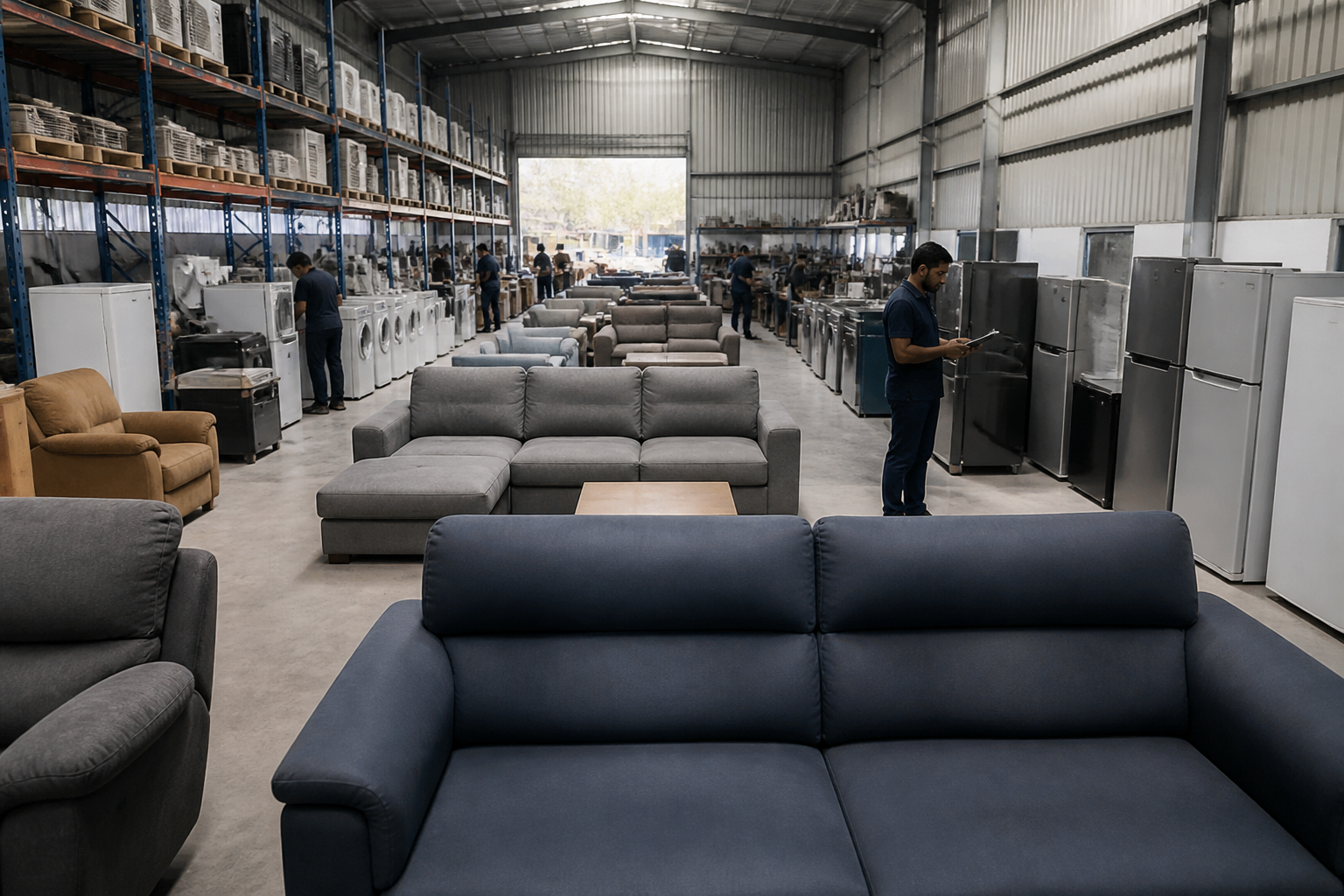
Rentomojo’s proposed ₹1,256-crore initial public offering puts a rental company’s physical asset base under public scrutiny. The immediate event is financial: the company is seeking a market listing comprising a ₹150-crore fresh issue and a ₹1,106-crore offer for sale. But the more consequential question for urban markets is operational. Can furniture and appliances generate returns across several customer cycles, while the company expands to more cities without allowing warehouses, logistics and idle inventory to absorb the gains?
The company’s red herring prospectus, as cited in the report, offers one answer. Its FY2017 asset cohort has generated revenue equivalent to 5.12 times its original cost. That figure shifts attention away from the first rental transaction and towards the entire life of an asset. A sofa, refrigerator or other household product is not treated as a single-use sale. It can be refurbished, redeployed and rented again, creating a recurring revenue stream from the same physical item.
That model is closely linked to how urban households are changing. Rental demand is particularly relevant where residents move frequently, where upfront ownership costs are high, or where a household’s future location and size are uncertain. The supplied material does not establish the relative importance of these factors across cities, but it does show that Rentomojo is positioning rental as an alternative to ownership and is following some existing customers into newer locations such as Indore and Lucknow.
The company had 2.54 lakh live subscribers across 29 cities as of March 2026. Its operating revenue rose 45.5 per cent to ₹387 crore in FY26, while profit after tax more than doubled to ₹104.3 crore from ₹43.1 crore a year earlier. These numbers indicate rapid expansion and improving reported profitability. They do not, by themselves, establish that the model will perform uniformly across every market. The company’s own geographic concentration points to the challenge ahead: its top 10 cities accounted for 89.51 per cent of FY26 revenue.
The concentration matters because rental businesses are not purely digital platforms. Their economics depend on where inventory is stored, how far it must travel, how often it requires repair, and whether there is enough local demand to keep assets deployed. A customer can sign up online, but the service still requires warehouses, delivery networks, maintenance operations and processes for collecting and refurbishing goods.
Rentomojo reported asset occupancy of around 83-84 per cent in FY26. Managing director, chairperson and chief executive Geetansh Bamania described that level as a useful balance. Higher occupancy could leave the company with insufficient inventory for customers, while excessive inventory could tie up capital in under-utilised assets. The issue is therefore not simply to maximise occupancy. It is to keep enough stock available while ensuring that assets are generating revenue for most of their usable life.
This distinction is important for understanding the company’s capital requirements. In a conventional retail transaction, revenue is generally realised when a product is sold. In Rentomojo’s model, the company retains ownership or control of the rental asset and continues to incur costs after deployment. Delivery, repair and maintenance expenses arise before the full stream of rental payments has been collected. Bamania described the business as a “front-ended cash flow business”, while also noting that rapid growth can put pressure on the EBITDA margin.
The model’s strength and its constraint are therefore connected. Retaining an asset creates the possibility of repeated revenue, but it also requires capital, operational discipline and reliable demand. A poorly utilised item remains a balance-sheet commitment. A heavily used item may require more frequent maintenance or replacement. The revenue potential of reuse depends on the cost and speed of refurbishment, the availability of a new customer and the ability to move the product economically.
The IPO structure provides a partial view of how the company intends to manage those pressures. Of the ₹150-crore fresh issue, ₹70 crore is earmarked for repayment or prepayment of borrowings. Another ₹42.5 crore is intended for lease rentals or licence fees for warehouses and experience stores, with the balance allocated to general corporate purposes. The stated use of funds suggests that lowering financing costs and supporting physical operations are both part of the listing strategy.
The offer is being presented at a valuation of about ₹4,246 crore at the upper end of the price band. The supplied material does not provide the full price band, issue timetable beyond the September 9 opening date, or a comparison with other rental businesses. It therefore cannot establish whether the valuation reflects a premium for recurring revenue, an expectation of city-level expansion, or confidence in the company’s reported profitability. What it does show is that investors are being asked to assess an operating model in which the productivity of physical goods is central to growth.
That productivity is also shaped by geography. Rentomojo’s established markets include Bengaluru, Delhi-NCR and Hyderabad, where the company sees further room to increase awareness of renting. At the same time, it is entering Indore and Lucknow, partly because existing customers have relocated there. Following customers can reduce some of the uncertainty involved in entering a new market, but it does not remove the need to establish local inventory, warehouse capacity, servicing arrangements and delivery economics.
The company’s revenue concentration makes replication a central test. A model that performs well in a small number of large cities may benefit from dense demand, greater customer awareness and more efficient logistics. New markets may offer less predictable utilisation and require upfront investment before a sufficient subscriber base develops. The supplied report does not provide city-level occupancy, subscriber acquisition costs or warehouse utilisation figures, so the extent of this difference remains unestablished.
There is also a broader urban question behind the business model. Rental can change the way household goods circulate through cities. Instead of each household purchasing, owning and eventually disposing of an appliance or furniture item, a rental operator can retain responsibility for redeployment. In principle, repeated use could extend the economic life of assets and make access more important than ownership. The available material confirms Rentomojo’s refurbishment and redeployment approach, but it does not quantify its environmental benefits or establish how much waste is avoided.
The model’s relevance to housing is similarly practical rather than purely financial. Furniture and appliances are part of the cost and flexibility of urban living, particularly for residents who may not remain in one home for long periods. A rental service can reduce the need for a large initial purchase, but it also creates dependence on the operator’s delivery, repair and collection systems. The quality of the customer’s experience therefore depends on an urban service network as much as on the digital transaction.
For policymakers and city planners, the available evidence does not support broad claims about the future of rental consumption. It does, however, highlight the infrastructure required for such services to scale: warehouses, experience stores, roads, delivery capacity and systems for repair and reuse. As more urban businesses operate through distributed physical networks, their growth becomes tied to land, logistics and access within cities.
Rentomojo’s IPO consequently offers two different stories. The first is a public-market transaction involving fresh capital, debt repayment and a partial sale by existing shareholders. The second is a test of whether repeated use of physical assets can support profitable urban growth. The company’s reported 5.12-times revenue generation from its FY2017 asset cohort, 83-84 per cent occupancy and presence in 29 cities provide evidence of an operating model with measurable asset productivity.
They do not resolve the next question: whether those economics can be reproduced beyond the company’s most established markets. The developments to watch are occupancy in newer cities, the pace of inventory expansion, warehouse and logistics costs, margin performance during growth and the extent to which the company can reduce its dependence on its top 10 markets. The September 9 IPO opening will bring the model into public markets, but its longer-term test will remain operational: what happens to each asset after the first customer leaves.
