


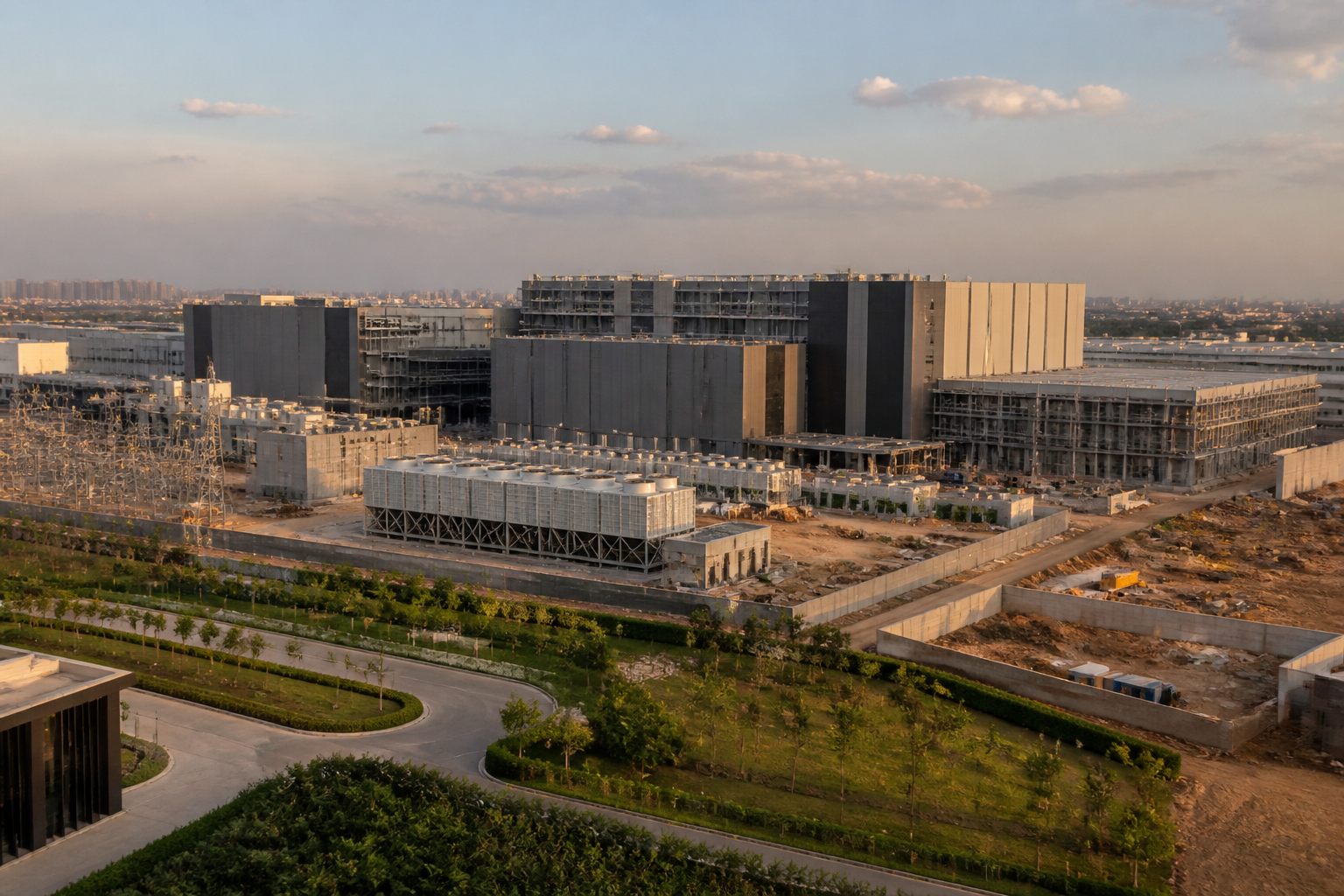
Hyderabad AI data centre plans are moving from the language of digital services into the physical geography of the city. HyperVault, the data centre subsidiary of Tata Consultancy Services (TCS), has secured 264 acres in Hyderabad for a campus with up to 1 GW of capacity. The company and its partners are expected to invest as much as ₹70,000 crore in developing and operating the infrastructure.
The announcement is significant not simply because of the size of the proposed campus. It places land, power, cooling, water, construction and specialised engineering at the centre of India’s artificial intelligence expansion. HyperVault says the facility will be designed for frontier AI companies and hyperscalers, with high-density GPU deployments for training, inference and advanced computing workloads. In practical terms, the project suggests that the next phase of the digital economy will be shaped as much by urban infrastructure as by software and algorithms.
The campus will be built in phases, with the pace of development tied to customer demand and technology requirements. That qualification matters. The 1 GW figure describes the campus’s potential capacity at full build-out, not an immediately operational facility. The source material does not provide a construction schedule, commissioning date, power allocation, water requirement, number of buildings or details of the customers expected to use the campus. Those details will determine how the proposal translates from an investment announcement into a functioning urban asset.
Still, the scale of the land and investment commitments marks a departure from the conventional image of an IT project. A 264-acre data centre campus requires a coordinated physical system: large power blocks, high-capacity electrical infrastructure, cooling equipment, fibre and network connectivity, access roads, construction supply chains and operating teams. HyperVault’s chief executive Deepesh Kiran Nanda said the company was building for higher density, liquid cooling, larger power blocks and faster deployment. These features point to a facility whose central design challenge is the concentration of computing capacity rather than the accommodation of conventional office workers.
That distinction changes the way the project should be understood within Hyderabad’s urban economy. Traditional technology campuses have often been assessed through office space, commuting patterns, employment and commercial real estate. An AI data centre adds a different set of urban demands. Its most important connections may run through substations, energy procurement, cooling systems, fibre routes, industrial construction and equipment maintenance. The company said the project would catalyse activity across power, cooling, networking, construction, engineering and operations, while generating several thousand direct and indirect jobs.
The employment claim is material, but the source does not provide a breakdown by occupation, construction phase or operating phase. Data centres are capital-intensive facilities, and the pattern of jobs they create may differ substantially between the building period and long-term operations. The immediate construction ecosystem could involve contractors, engineers, equipment suppliers and logistics providers, while the later campus may require a smaller but more specialised workforce. Without a project schedule and employment assessment, the scale and distribution of these benefits remain unquantified.
The project also exposes the resource question behind AI infrastructure. HyperVault and TCS say the campus will use green energy and water-neutral design principles. These commitments are important because the environmental profile of a data centre depends on how it sources electricity, how it manages heat and how it accounts for water use. However, the supplied announcement does not specify the source or proportion of green energy, the definition of water neutrality, the cooling technology to be deployed or the targets against which performance will be measured.
That absence does not invalidate the proposal, but it limits what can be concluded about its environmental performance. “Green energy” and “water-neutral” are design commitments rather than independently demonstrated outcomes at this stage. Their urban significance will depend on future disclosures, approvals, technical plans and operating data. The same is true of the campus’s effect on local utilities. The announcement establishes the intended direction, but not the infrastructure balance sheet required to support a 1 GW build-out.
Telangana’s role in the project is another important part of the story. Chief Minister A Revanth Reddy described the development as historic and said that access to AI models and compute was becoming public infrastructure. IT and Industries Minister D Sridhar Babu said the agreement followed a conversation between the chief minister and Tata Sons Chairman N Chandrasekaran in Davos in January, followed by negotiations over the subsequent months.
These statements show how the project is being positioned by the state: not merely as a private real estate or technology investment, but as a strategic infrastructure partnership. The government’s role appears to have included negotiations and support for the development. The source, however, does not specify the incentives, land-transfer terms, utility commitments, approvals or public expenditure involved. Those are essential elements for evaluating the public value of the arrangement and its implications for state and city administration.
The investment structure also signals the financial scale of the proposed business. TCS announced its entry into the data centre segment last year through the creation of HyperVault, while private equity investor TPG is investing $1 billion in the business. The Hyderabad campus is therefore part of a broader corporate platform rather than an isolated facility. TCS brings an existing technology and enterprise-services base, while HyperVault is being developed as a dedicated infrastructure business. The source does not establish how the $1 billion commitment is allocated between Hyderabad and other activities, so it should not be treated as the funding amount for this campus alone.
The larger policy question is whether Indian cities are prepared to treat computing capacity as infrastructure that requires the same degree of planning scrutiny as transport, housing or utilities. The Telangana chief minister’s description of compute as public infrastructure is politically and economically consequential, but the announcement does not explain how that principle would operate. It is unclear whether the proposed campus will primarily serve private hyperscalers, public-sector needs, research institutions or a combination of users. It is also unclear how its capacity will connect to wider digital infrastructure or whether any portion will be reserved for public applications.
What the evidence confirms is narrower but still substantial. Hyderabad has been selected as the location for a major AI-focused data centre campus. HyperVault has secured 264 acres. The potential capacity is up to 1 GW, the stated investment by the company and partners is up to ₹70,000 crore, and construction is planned in phases. The campus is intended to support high-density computing and is expected to draw activity into power, cooling, networking, construction, engineering and operations. The project is being backed publicly by the Telangana government and is linked to TCS’s wider infrastructure strategy.
What remains uncertain is equally important. The source does not establish the project’s approval status, construction start date, commissioning timeline, power demand at each phase, water-use profile, financing schedule, customer commitments or final employment numbers. It also does not provide an independent assessment of the claimed environmental design or explain how the campus will be integrated with Hyderabad’s existing utility and transport systems.
For Hyderabad, the next stage will therefore be less about the announcement’s headline capacity than about the documents and milestones that follow it. Land acquisition or allocation, planning approvals, energy and water arrangements, construction tenders, phased capacity disclosures and operating standards will show how the proposed AI infrastructure is being incorporated into the city. The project confirms that the competition for AI investment is also a competition to assemble reliable urban systems. Its ultimate significance will be determined by whether those systems can expand at the pace, scale and resource efficiency promised by the proposal.

