


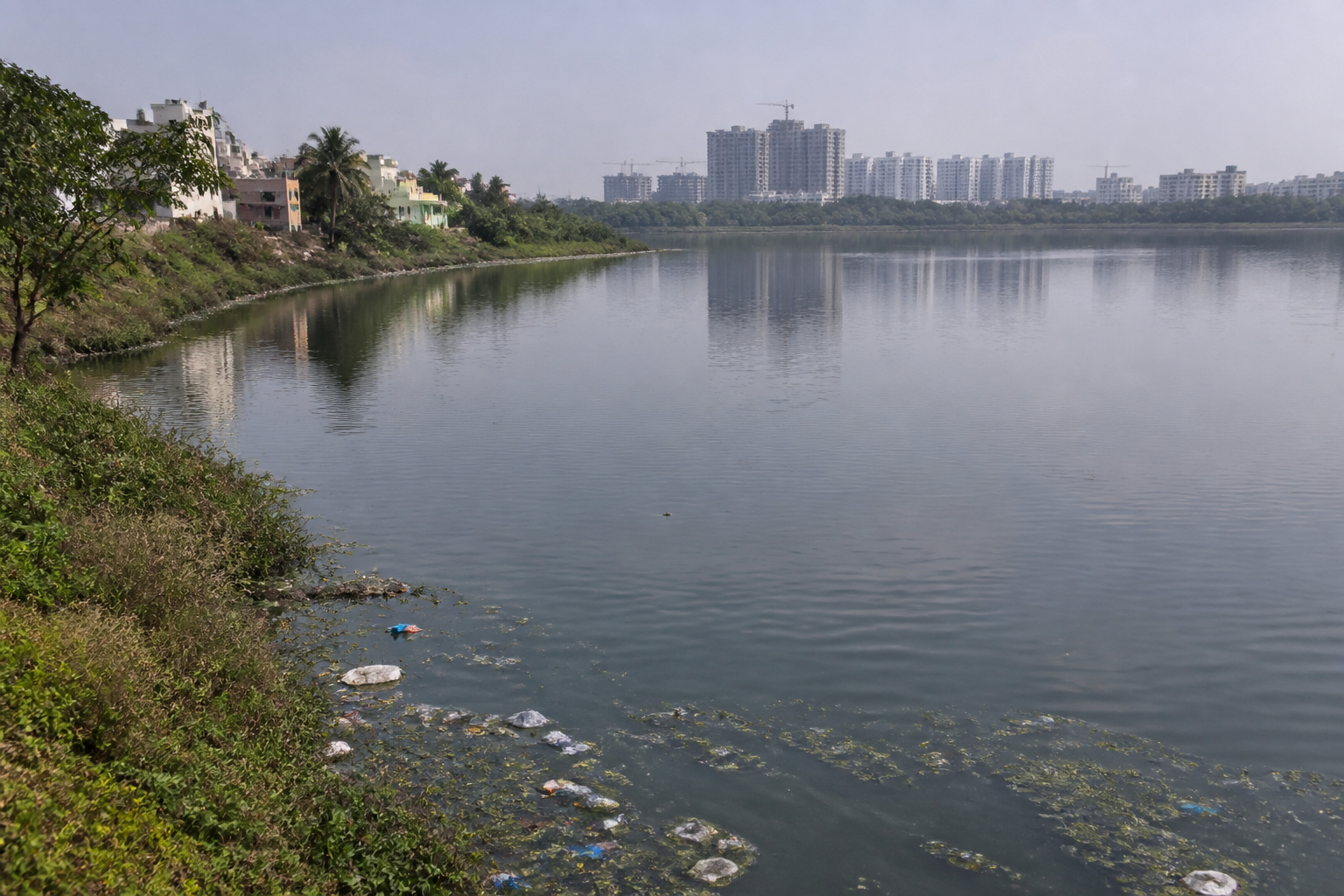
Three north Bengaluru lakes are showing different forms of ecological stress, but the pattern identified by Bangalore University researchers points to a common urban problem: the city’s expansion is moving faster than the systems needed to manage wastewater, solid waste and runoff. The assessment of Dasarahalli, Madavara and Chikkabanavara lakes found elevated pollution indicators at some locations, with the findings raising questions about how urban growth is affecting water bodies connected to the Arkavathi River and, eventually, the Tippagondanahalli Reservoir.
The study examined the three lakes during April and May 2026. Researchers tested pH, turbidity, electrical conductivity, total dissolved solids, hardness, nutrients, dissolved oxygen, biochemical oxygen demand and chemical oxygen demand. The results did not show that every parameter had crossed permissible limits. pH, electrical conductivity, chloride, fluoride and nitrate were reported to be within permissible limits. But several other indicators, including turbidity, total dissolved solids, hardness, phosphate, biochemical oxygen demand and chemical oxygen demand, were elevated at some locations.
That distinction matters. Water quality deterioration does not appear in a single uniform form across an urban lake system. Different pollution indicators can point to different pressures, and the results from the three lakes suggest that the sources and intensity of stress vary from one water body to another. Madavara showed the strongest signs of nutrient enrichment and the highest chemical oxygen demand levels. Dasarahalli recorded the highest levels of several other indicators, including electrical conductivity, total dissolved solids, hardness, turbidity, chloride, fluoride, sodium and biochemical oxygen demand. Chikkabanavara performed relatively better in comparison, but its condition was affected by encroachment and waste accumulation.
Madavara’s results indicate a substantial nutrient load. Researchers identified elevated phosphate, sulphate and nitrate levels, along with the highest chemical oxygen demand among the three lakes. Chemical oxygen demand measures the oxygen required to chemically break down material in water. In this context, the combination of nutrient enrichment and high chemical oxygen demand indicates severe organic pollution, according to the report.
The pattern at Dasarahalli points to a different form of pressure. Its high electrical conductivity, total dissolved solids, hardness, turbidity, chloride, fluoride, sodium and biochemical oxygen demand levels were interpreted by the researchers as signs of a high inflow of domestic sewage. Biochemical oxygen demand reflects the oxygen consumed as organic matter decomposes. Higher levels can therefore indicate a heavier organic load entering the water body.
The findings expose the limits of treating lakes as isolated environmental assets. The three water bodies are part of the Madavara Lake Series, and their outlet water joins the Arkavathi River. The river eventually reaches the Tippagondanahalli Reservoir, which supplies drinking water to some parts of Bengaluru. This downstream connection makes the condition of the lakes relevant beyond their immediate neighbourhoods. Pollution entering a lake is not necessarily contained within its boundary; it can move through connected channels and affect larger water systems.
Dr Raghavendra M of Bangalore University’s Department of Environmental Science said the researchers selected the three lakes partly because of this connection. He also described north Bengaluru as a largely peri-urban area undergoing rapid urbanisation, while lacking an underground drainage system in several parts. In the researchers’ assessment, much of the waste generated in these areas enters the water bodies because wastewater infrastructure has not kept pace with development.
This is the central governance issue revealed by the study. Lake pollution is often visible at the point where waste accumulates, but the causes may lie across a wider urban catchment. A lake can receive sewage from homes, runoff from roads and developed areas, nutrients from waste, and solid material carried into its margins. If enforcement begins only after pollutants have reached the water, the response is likely to remain corrective rather than preventive.
The report therefore shifts attention from lake cleaning alone to source-level controls. Researchers have called for stronger sewage treatment, prevention of direct wastewater discharge, removal of solid waste and invasive weeds, control of encroachment, regular water-quality monitoring and community participation. These measures address different parts of the same system. Sewage treatment concerns the quality of inflows; waste removal addresses material already accumulating around the lake; encroachment affects the physical extent and functioning of the water body; and monitoring determines whether interventions are working.
The policy landscape described in the report is consequently less about a single lake-restoration project than about coordination between drainage, sanitation, environmental enforcement and land management. The study does not establish which agency is responsible for each intervention, nor does it provide cost estimates, implementation deadlines or a quantified restoration plan. It does, however, make clear that lake protection cannot be separated from the availability of underground drainage and effective waste-management arrangements in the surrounding urban area.
The evidence also shows why a single headline assessment of the three lakes would be misleading. Chikkabanavara’s relatively better water quality does not mean that it is secure. Its encroachment and waste accumulation problems indicate physical and management pressures that can worsen over time. Similarly, the comparatively poor results at Madavara and Dasarahalli do not necessarily point to identical sources. The study’s value lies partly in distinguishing the forms of stress rather than treating all pollution as one category.
At the same time, the supplied findings have limits. They cover observations made during April and May 2026, but the report does not provide the exact readings for each parameter, historical comparisons, sampling locations, sample sizes or seasonal results. It therefore establishes a warning signal and identifies likely pollution pressures, but it does not by itself quantify the full long-term trajectory of each lake. Regular monitoring would be needed to determine whether the recorded conditions are persistent, seasonal or changing in response to urban activity.
The absence of detailed measurements also matters for public accountability. Without publicly accessible readings and a consistent monitoring framework, residents may know that a lake is polluted without being able to track the source, severity or progress of remediation. A regular system of water-quality checks could connect environmental conditions to specific inflows, discharge points and enforcement actions. It could also help distinguish between temporary improvement and durable recovery.
The report’s broader message is that urban water security begins well before water reaches a reservoir. North Bengaluru’s lakes are functioning within a connected landscape shaped by settlement growth, drainage infrastructure, waste disposal and land-use change. When those systems fail, ecological damage appears in the lake, but the underlying problem is distributed across the city’s planning and administrative framework.
For Bengaluru, the immediate question is not only how to remove pollution already present in Dasarahalli, Madavara and Chikkabanavara. It is whether the city can prevent additional sewage, nutrients and solid waste from entering them. The available evidence confirms significant stress and identifies source-level management as the researchers’ preferred direction. What remains uncertain is the scale of the required intervention, the responsibilities of the agencies involved and whether monitoring will show sustained improvement. Those are the developments that will determine whether the three lakes become isolated restoration projects or indicators of a wider change in how Bengaluru manages its urban water system.
