


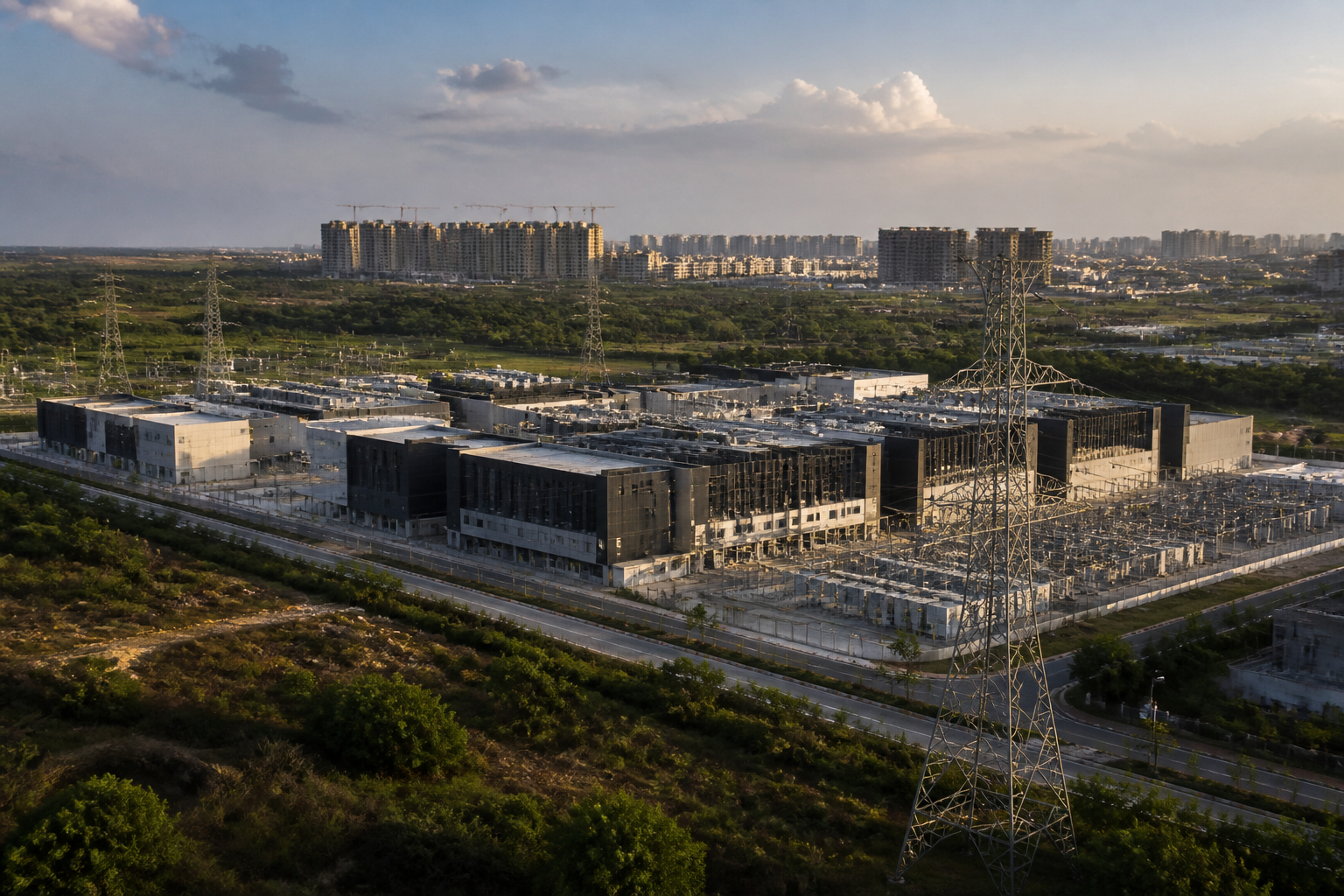
Subheadline: HyperVault’s planned 1 GW campus brings power, water, land, construction and employment questions to the centre of Telangana’s AI strategy.
Standfirst: HyperVault, a subsidiary of Tata Consultancy Services, has announced plans to develop a 1 GW artificial intelligence data centre campus in Hyderabad’s Future City with an investment of Rs 70,000 crore. The project is positioned as a large-scale platform for frontier AI companies and hyperscalers, with phased construction, high-density GPU deployments, liquid-cooled systems, green energy and water-neutral design principles. Its significance extends beyond the proposed facility itself. The campus would add a major new demand centre for power, cooling, networking, construction and engineering services while reinforcing Telangana’s effort to position Hyderabad as a hub for advanced digital infrastructure. This analysis examines what the announcement establishes, which urban systems it will draw upon and what remains unresolved about delivery, resource use and implementation.
HyperVault’s announcement places Hyderabad at the centre of an infrastructure race shaped by artificial intelligence. The TCS subsidiary plans to build a 1 GW AI data centre campus on 264 acres in Future City, with a stated investment of Rs 70,000 crore. The facility is intended to serve frontier AI companies and hyperscalers, supporting high-density GPU deployments for training, inference and other advanced computing workloads.
The announcement is significant because the proposed campus is not simply an office or conventional technology park. It is a large industrial-scale digital infrastructure project. Its physical requirements will include land, electrical capacity, cooling systems, water management, high-capacity networking and specialised construction. The project therefore connects Hyderabad’s technology ambitions with the more practical question of whether the city can provide the urban systems required by increasingly power- and cooling-intensive computing facilities.
HyperVault has said the development will be delivered in phases, depending on customer demand and technology requirements. That approach means the full 1 GW capacity is a build-out objective rather than an indication that the entire campus will become operational at once. The distinction matters for understanding the project’s likely development pattern. Construction, equipment deployment and operations can be scaled over time, while the land and supporting infrastructure must be planned for the larger campus.
The company has described the campus as one of India’s largest and most advanced AI infrastructure facilities once fully built. Its proposed design includes liquid-cooled compute infrastructure, green energy and water-neutral principles. These features indicate that the project’s environmental performance will depend not only on the source of electricity but also on how heat is removed from computing equipment and how water demand is managed across construction and operations. The supplied announcement does not establish the project’s total power requirement, water baseline, renewable-energy contracting model or details of the proposed water-neutral system.
That information gap is important. Data centres translate digital demand into physical infrastructure. A high-density GPU campus requires reliable electricity and cooling, while its network systems must maintain the speed and resilience expected by global customers. The announcement identifies power, cooling and networking as areas likely to see increased demand, but it does not specify how those requirements will be integrated with Hyderabad’s existing utility systems or what new capacity will be created specifically for the campus.
The location in Future City adds another layer to the project. HyperVault has secured 264 acres there, according to the report, linking the data centre to Telangana’s broader effort to develop a strategic zone for technology and advanced digital infrastructure. This is a land-use decision as much as a corporate investment. The value of the site will depend on how effectively the campus is connected to transport, utilities, telecommunications networks and other planned activities in the wider development area.
The project also illustrates how the meaning of a technology hub is changing. Hyderabad’s technology economy has traditionally been associated with offices, software services, research and business-process operations. An AI data centre campus introduces a more infrastructure-heavy model, in which the city’s competitiveness depends on the availability and reliability of land, power, cooling, fibre connectivity and technical labour. TCS CEO and Managing Director K Krithivasan described the proposal as part of the company’s “Infrastructure-to-Intelligence” strategy, combining AI-ready infrastructure with cloud, engineering, enterprise transformation and AI capabilities.
That strategy positions the facility as an enabling platform rather than only a real-estate asset. Its intended customers are frontier AI companies and hyperscalers, while its workloads would include training and inference. If implemented as described, the campus could allow these users to access computing infrastructure without each organisation developing an equivalent facility independently. The announcement, however, does not identify committed customers, the expected occupancy schedule or the commercial structure through which capacity will be allocated.
The employment claim provides a second measure of the project’s urban impact. Telangana IT and Industries Minister D Sridhar Babu said the campus could create up to 7,000 direct and indirect jobs. The reported employment would extend beyond data-centre operations to construction, engineering, power, cooling, networking and related services. The announcement does not provide a breakdown between permanent and construction employment, or between jobs located on the campus and those generated across the wider supply chain. Those distinctions will be relevant when assessing the project’s contribution to Hyderabad’s labour market.
The proposed timeline also shows how the project is being linked to state-level administrative commitments. Krithivasan said the data centre would become operational 18 to 24 months after groundbreaking. Chief Minister A Revanth Reddy asked TCS to inaugurate it on June 2, 2028, and assured the company that required sanctions would be expedited. The stated inauguration date creates a public milestone, but the supplied material does not establish when groundbreaking will occur or list the approvals still required.
The project follows a conversation between Reddy and Tata Sons Chairman N Chandrasekaran at Davos in January, according to the state’s IT and Industries Minister. That sequence points to the role of high-level government-corporate engagement in assembling large urban infrastructure projects. It also raises an implementation question: how quickly can political intent be converted into land, environmental, utility, construction and operational approvals without weakening the scrutiny attached to a facility of this scale?
For Telangana, the announcement supports a broader policy objective of positioning the state as a strategic hub for AI and advanced digital infrastructure. The policy challenge is to make that ambition operational. A campus of this type requires coordination among the company, the state government, local authorities, utility providers and network operators. The supplied report does not identify the precise institutional arrangement or funding responsibilities for off-site infrastructure, including roads, transmission capacity, water systems and connectivity.
This is where the data centre becomes an urban planning issue. The facility may occupy 264 acres, but its infrastructure footprint will extend beyond its boundary. Electricity generation and transmission, cooling supply, communications networks, construction logistics and workforce access all connect the campus to the wider city-region. The project’s effects will therefore be determined partly by systems that are not visible in the proposed campus image but are necessary for its operation.
The announcement establishes several measurable markers: Rs 70,000 crore in proposed investment, 1 GW of planned capacity, 264 acres of land, a phased development model, an 18-to-24-month operational window after groundbreaking and a potential employment impact of up to 7,000 direct and indirect jobs. It does not yet establish the project’s actual construction start, the phase-one capacity, the final power and water arrangements, the identity of customers or the detailed approval schedule. Those are the facts that will determine whether the proposal advances from a major announcement to an operating piece of Hyderabad’s infrastructure.
The larger urban question is whether Hyderabad can build an AI economy without treating digital infrastructure as weightless. HyperVault’s proposal makes the physical dependencies visible: land, electricity, cooling, water, networks, construction capacity and skilled workers. Its success will be measured not only by the amount invested or the size of the campus, but by whether the surrounding urban systems can support it reliably and transparently.
At this stage, the evidence confirms a major planned investment and a clear strategic intent from HyperVault and Telangana. It does not yet confirm delivery, final resource requirements or the full economic and environmental outcome. The next developments to monitor are groundbreaking, the first construction phase, approvals, utility arrangements and progress towards the June 2, 2028 inauguration target.

