


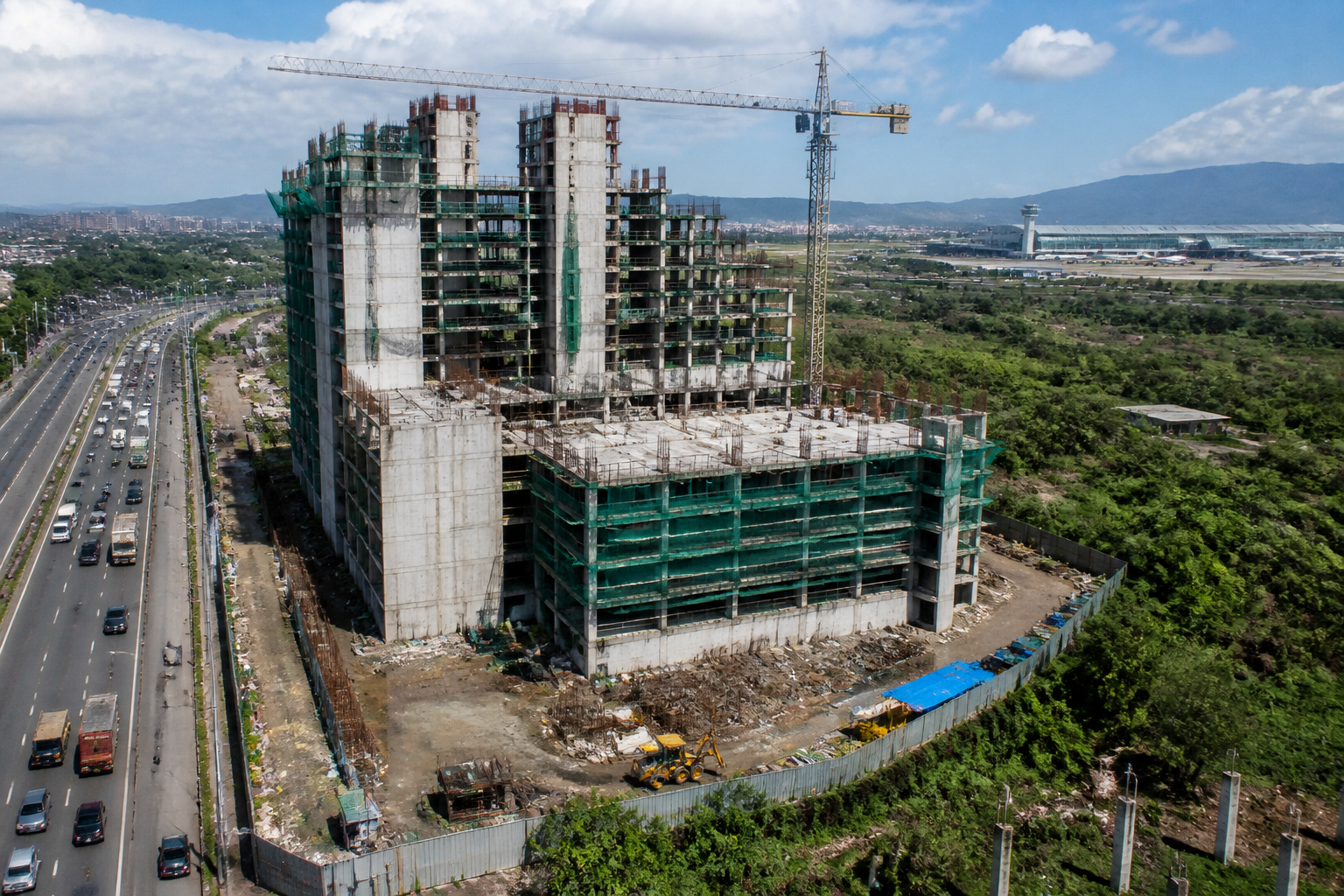
The construction of Panvel Municipal Corporation’s proposed Swarajya headquarters has moved well beyond its original schedule and budget, according to information obtained through the Right to Information Act and cited in a report by Loksatta. The project, planned near the Navi Mumbai International Airport and along the Panvel-Sion highway, was originally awarded for about Rs 112.93 crore excluding GST. Its revised value has risen to about Rs 161.49 crore excluding GST, representing an increase of Rs 48.57 crore, or 43.01 per cent, over the original work order.
The project’s delay is significant not only because it concerns a major public building, but also because the reported causes extend across design, contracting, financial planning, site conditions, compliance and supervision. A municipal headquarters is a core administrative asset: it houses public offices, supports service delivery and represents the institution’s long-term physical capacity. When such a project experiences repeated extensions and substantial cost revisions, the immediate question is not simply when the building will open. It is how the project was planned, monitored and altered after the contract was awarded.
The first phase of construction was tendered for a plot identified as Plot No. 4 in Sector 16, New Panvel. The original estimated cost, excluding GST, was Rs 110.78 crore. After negotiations, the work was awarded to Harsh Constructions Private Limited for approximately Rs 112.93 crore on April 29, 2022. The contract period was fixed at 30 months, placing the original completion date at November 1, 2024.
That deadline was not met. The project received an extension up to April 30, 2025, followed by another extension up to October 1, 2025. A further extension process was then undertaken up to October 31, 2026. Each extension has been associated with an increase in the project cost, according to the details cited in the report. The sequence makes the project an example of how a fixed-price public works contract can become financially open-ended when the design, quantities and site requirements continue to change after award.
The reported revised cost includes several components: additional work, increased quantities, changes to the design, alterations in foundation requirements, changes involving steel and iron, deductions for deleted work and GST. These categories do not automatically establish wrongdoing. Construction projects can require legitimate variations when site conditions differ from the tender assumptions or when an authority changes the scope. But each variation requires a clear technical justification, an approved rate, a documented chain of responsibility and evidence that the change was necessary and properly authorised.
This is the central accountability issue raised by the project. Information-rights activist Suhas Wankhede has questioned whether the reasons for each delay, the responsibility for the delay, the steps taken to prevent it and the eligibility of the associated rate increases have been clearly recorded. The public significance of that question lies in the difference between a genuine site-driven variation and a failure of pre-construction planning. Without the relevant technical and administrative records, the two cannot be distinguished.
The available account suggests that land availability and the initial development permission were not, at least on the facts cited, the primary causes of the delay. The municipal corporation reportedly entered into a lease agreement with the City and Industrial Development Corporation after paying compensation on April 19, 2021, and took possession of the plot. Development permission was obtained on September 7, 2021. Since the site and initial permission were available before the work order was issued, the explanation for the delay appears to lie elsewhere in the project cycle.
One disputed area concerns the soil and foundation conditions. Later extension records reportedly stated that the soil strata were found approximately 1.5 metres deeper than expected, requiring additional excavation, retaining walls, foundation work and changes to the design. Such a condition may have technical consequences, but its significance depends on what investigations were conducted before tendering. The tender documents reportedly required the successful contractor to undertake a fresh soil test before beginning work. That raises a practical planning question: whether the additional condition was genuinely unforeseeable or whether the pre-construction investigation was insufficient for a project of this scale.
This distinction matters because foundation changes are among the most expensive and disruptive variations in a building project. They affect structural design, quantities, sequencing, materials and time. If the ground condition could reasonably have been established before the tender, the resulting delay may point to an inadequacy in the authority’s investigation and tender preparation. If it could not have been established despite appropriate testing, the records should show why the variation was technically unavoidable and how the revised rates were assessed.
The contractor’s financial planning is another element in the reported explanation. Panvel Mayor Nitin Patil told Loksatta that changes in the original design increased the cost and that the contractor had quoted seven per cent below the original amount for the second phase after not studying the tender properly. According to the mayor, the contractor faced difficulties during execution and could not progress beyond five per cent of the work. These are serious claims about contract viability, but the report does not provide the complete tender documents, progress records or the corporation’s formal findings on the contractor’s performance.
That limitation is important. A low bid can reduce the initial cost of a public project, but it can also create execution pressure if the bidder has underestimated quantities, risks or financing needs. Conversely, a contractor’s difficulty in completing work does not by itself justify every subsequent variation. The municipal corporation must be able to demonstrate which changes arose from the authority’s revised requirements, which arose from site conditions, which arose from market or material factors and which were connected to the contractor’s own bid or performance.
The reported increase from Rs 112.93 crore to Rs 161.49 crore, excluding GST, therefore represents more than a simple price adjustment. It indicates that the project’s financial structure was substantially altered after award. The increase is especially material because it combines multiple categories of change rather than reflecting only a single, clearly defined factor. A proper public audit would need to examine the original bill of quantities, revised quantities, deleted items, additional items, approval dates, rate analysis and the authority competent to approve each change.
The project also raises questions beyond cost and scheduling. The report refers to the validity of bank guarantees, gaps in insurance protection, notices concerning worker safety and questions about compliance with environmental requirements. These safeguards are not administrative formalities. A bank guarantee protects the public authority against certain contractual failures. Insurance helps manage risks associated with construction activity. Worker-safety compliance addresses direct risks at the site, while environmental permissions and conditions govern how construction affects the surrounding area.
If these documents were not kept current during repeated extensions, the municipality could face exposure at precisely the point when a delayed project becomes more vulnerable to disputes and additional claims. The records should establish whether guarantees and insurance policies covered the entire extended construction period, whether safety notices were resolved and whether environmental conditions were complied with as work continued. The supplied report identifies these as areas requiring scrutiny, but does not establish the final status of each document.
The timing of the project adds another layer of relevance. The headquarters is being built near the Navi Mumbai International Airport, whose operations are expected to accelerate development activity in Panvel and the wider Raigad region. The airport-related growth context makes municipal administrative capacity more consequential, but it does not reduce the need for disciplined project management. In fact, increased development pressure makes reliable public institutions, predictable approvals and functioning civic infrastructure more important.
The case also illustrates the difference between announcing a public building and delivering it. The project was launched with an intended 30-month schedule, but repeated extensions have moved the expected completion into October 2026. During that period, the cost has risen by 43.01 per cent against the original work order. The physical condition of the building, the percentage completed and the remaining contract value are not fully established in the supplied material. The mayor’s statement, as reported, says that work on the second phase had not progressed beyond five per cent, but the report does not provide a consolidated progress certificate for the entire headquarters project.
For the municipality, the immediate administrative challenge is to separate work that is technically necessary from work that reflects earlier planning deficiencies. That requires a documented technical review, a financial reconciliation and a compliance audit. The demand for independent technical, financial and environmental supervision, cited in the report, follows directly from the number of unresolved elements: design changes, foundation revisions, cost variations, deadline extensions, contractor performance and statutory safeguards.
The evidence currently confirms three points: the original contract was awarded in April 2022 for approximately Rs 112.93 crore excluding GST; the original November 2024 completion date was not met and the project received successive extensions; and the revised value cited in the report is approximately Rs 161.49 crore excluding GST, 43.01 per cent above the original work order. It does not, on its own, establish whether the cost increase was lawful, whether any party is liable for the delay or whether the final building will be completed within the latest deadline.
Those questions depend on the underlying tender, variation approvals, soil reports, progress records, guarantee and insurance documents, safety notices and environmental compliance files. Until those records are examined, the Panvel headquarters project should be understood as a case of major schedule and cost slippage accompanied by unresolved questions about planning and oversight. The next decisive development will be the municipal corporation’s documented explanation of each variation and its plan to complete the remaining work by the extended October 31, 2026 deadline.
