


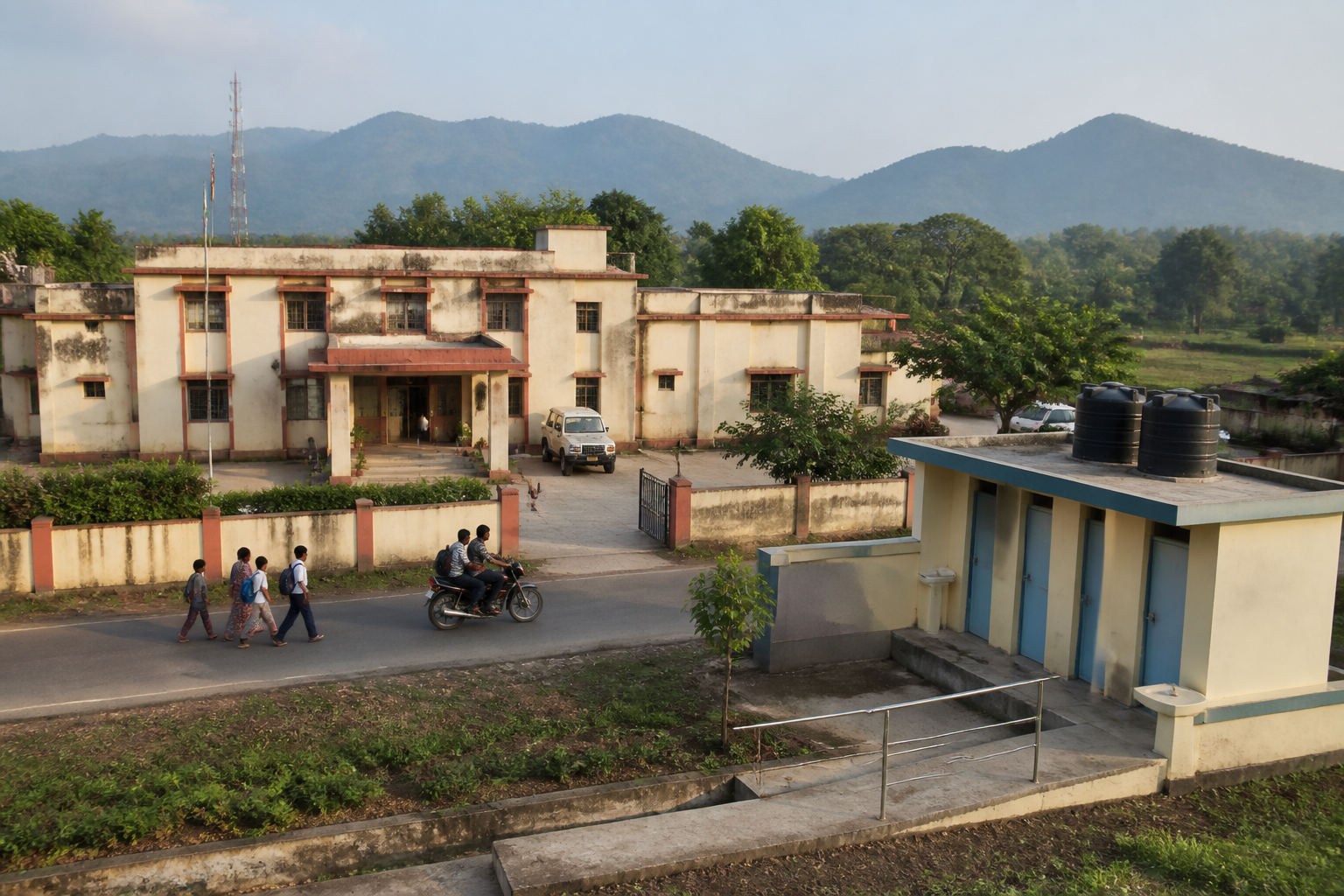
Palghar Zilla Parishad’s decision to reconsider the distribution of unspent funds under its 2025–26 supplementary plan brings a familiar local-government problem into focus: how development money is distributed across geographically unequal districts. The proposed Palghar Zilla Parishad fund reallocation follows complaints that the supplementary plan gave disproportionate weight to Jawhar and Vikramgad while leaving other talukas without comparable development allocations.
The issue is not only about which works receive money. It also concerns how a district administration defines need, records decisions, prepares project estimates and checks whether public funds are being distributed fairly across areas with different infrastructure gaps. According to a report by Loksatta – Palghar, the Zilla Parishad management has said that the remaining unspent funds will be reorganised to improve regional balance before the funding period ends.
The supplementary plan was prepared under the 15th Finance Commission for 2025–26. The Zilla Parishad had earlier approved an original plan worth ₹11.58 crore through resolution number 498 at its general body meeting on December 13, 2024. A further ₹4.53 crore was made available in connection with interest receipts, additional funds and funds released from cancelled works. The report says approval for this supplementary plan was recorded in the minutes of the general body meeting held on February 17, 2025, with the plan linked to funds that became available by December 31, 2024.
That sequence matters because supplementary plans are often shaped by funds that emerge after an original budget has been approved. Interest income, additional receipts and savings or cancellations can create a second allocation exercise. Such decisions may appear administrative, but they determine which villages receive repairs, sanitation facilities or other local works, and which areas must wait for a later funding cycle.
The distribution of the supplementary plan became contentious after 35 works were approved in Mokhada and 15 in Vikramgad, while the other talukas were reported to have received little or no comparable attention. Local-level office-bearers of the Shiv Sena (Uddhav Balasaheb Thackeray) raised objections, after which former Zilla Parishad members also questioned the balance of allocations. Some members met Zilla Parishad officials and sought changes to the plan.
The available report does not establish that the allocation breached a specific statutory rule. It does, however, record a political and administrative demand for a clearer explanation of how works were selected and how the available funds were matched to local needs. The Zilla Parishad’s stated response is to examine the remaining funds again and use them according to need and geographical balance.
The dispute also includes a specific concern about the preparation of cost estimates. In Mokhada, a proposal was reportedly made to spend approximately ₹8 lakh on a high-standard toilet facility. The report says the proposed work involved repair of a toilet and was assigned through the construction department, although school-related works are generally handled by the education department. Questions were also raised because the proposed repair cost was reportedly several times higher than the cost of constructing a new toilet.
These details are allegations and administrative concerns, not established findings of wrongdoing. The Zilla Parishad has begun an internal inquiry into the estimates, according to the report. The construction department has been asked to explain why the estimates were not prepared according to prevailing Schedule of Rates, commonly referred to as DSR. The inquiry therefore appears to be examining both the department responsible for preparing the estimates and the basis on which the proposed expenditure was calculated.
The Schedule of Rates is important because it provides an administrative reference for construction costs. When a proposed estimate departs from those rates, the departure may require a documented technical explanation. The report does not provide the detailed estimate, the relevant rate schedule or the department’s response. It is therefore not possible from the supplied material to determine whether the proposed ₹8 lakh expenditure was justified, excessive or technically necessary.
The case illustrates two connected layers of local infrastructure governance. The first is the allocation layer: deciding which talukas and works receive money. The second is the execution layer: preparing estimates, assigning departmental responsibility and verifying whether the proposed work represents reasonable value. A plan can appear regionally balanced but still face questions if individual works are poorly estimated. Conversely, technically sound works may generate public dissatisfaction if their distribution appears concentrated in a few areas.
The Zilla Parishad’s proposed response combines redistribution with inspection. Some works included in the supplementary plan have already been completed, while other works remain pending. The administration has said that the remaining money will be reallocated with an emphasis on fairness among all talukas. It has also said that completed works under the plan will be inspected.
The chief executive officer, Manoj Ranade, said that the remaining funds would be used to address pending requirements in all talukas while maintaining geographical balance. The report also says that the administration plans to use the available funds for pending toilet construction in 14 Zilla Parishad schools and for repairs to anganwadi buildings. These proposed works shift the discussion from an abstract allocation dispute to basic public facilities serving children and early-childhood services.
The report does not specify how much of the remaining money will go to each taluka, how many works have already been completed, or the implementation schedule for the 14 school toilets and anganwadi repairs. It also does not identify the full list of cancelled works or disclose the detailed criteria that will be used to decide which projects are retained, revised or removed. Those omissions are significant because regional balance cannot be assessed only by counting approved works. The value, location, urgency and public use of each work would also matter.
A further limitation is that the supplied material does not include the complete general body minutes, the original ₹11.58 crore plan, the supplementary plan document or the internal inquiry report. It also does not include a response from representatives of the talukas that were said to be overlooked, or the construction department’s explanation regarding the estimate. The available evidence supports reporting the administrative decision and the existence of the concerns, but not a final conclusion about whether the allocation was unjust or whether the toilet estimate involved financial misconduct.
The Palghar case nevertheless raises a broader question about supplementary public finance at the district level. When funds become available after the main plan has been approved, the administration must balance speed against scrutiny. Rapid approval can help prevent funds from remaining unused, particularly when the funding period is approaching its end. At the same time, compressed decision-making can make it harder for elected members and residents to understand why certain areas and works were prioritised.
Transparency in this context requires more than announcing that funds will be redistributed. A usable public record would show the amount available, the source of the funds, the works originally approved, their status, the estimated cost of each work and the proposed revised allocation by taluka. It would also distinguish between completed works, cancelled works, works under execution and works awaiting technical or administrative approval. None of those details is fully available in the supplied report.
The focus on toilets and anganwadi repairs also points to the importance of separating visible construction from essential service infrastructure. A large number of works does not necessarily indicate better outcomes if facilities are poorly located, inadequately maintained or not connected to the institutions that are expected to operate them. The report does not provide evidence on the condition or usage of the 14 schools and anganwadis, so the need for each proposed work remains to be documented by the administration.
What the available evidence confirms is narrower but consequential. Palghar Zilla Parishad approved an original 15th Finance Commission plan worth ₹11.58 crore, later considered a supplementary plan involving ₹4.53 crore, and faced objections over the concentration of works in Mokhada and Vikramgad. It has now stated that remaining funds will be reconsidered for regional balance, while an internal inquiry examines questions about construction estimates.
The next test will be whether the revised allocation is published with taluka-wise and work-wise details, whether the inspection of completed works identifies deficiencies, and whether the construction department provides a documented explanation for the disputed estimates. Until those records are available, the issue remains one of contested allocation and ongoing administrative review rather than a proven case of financial irregularity.
