


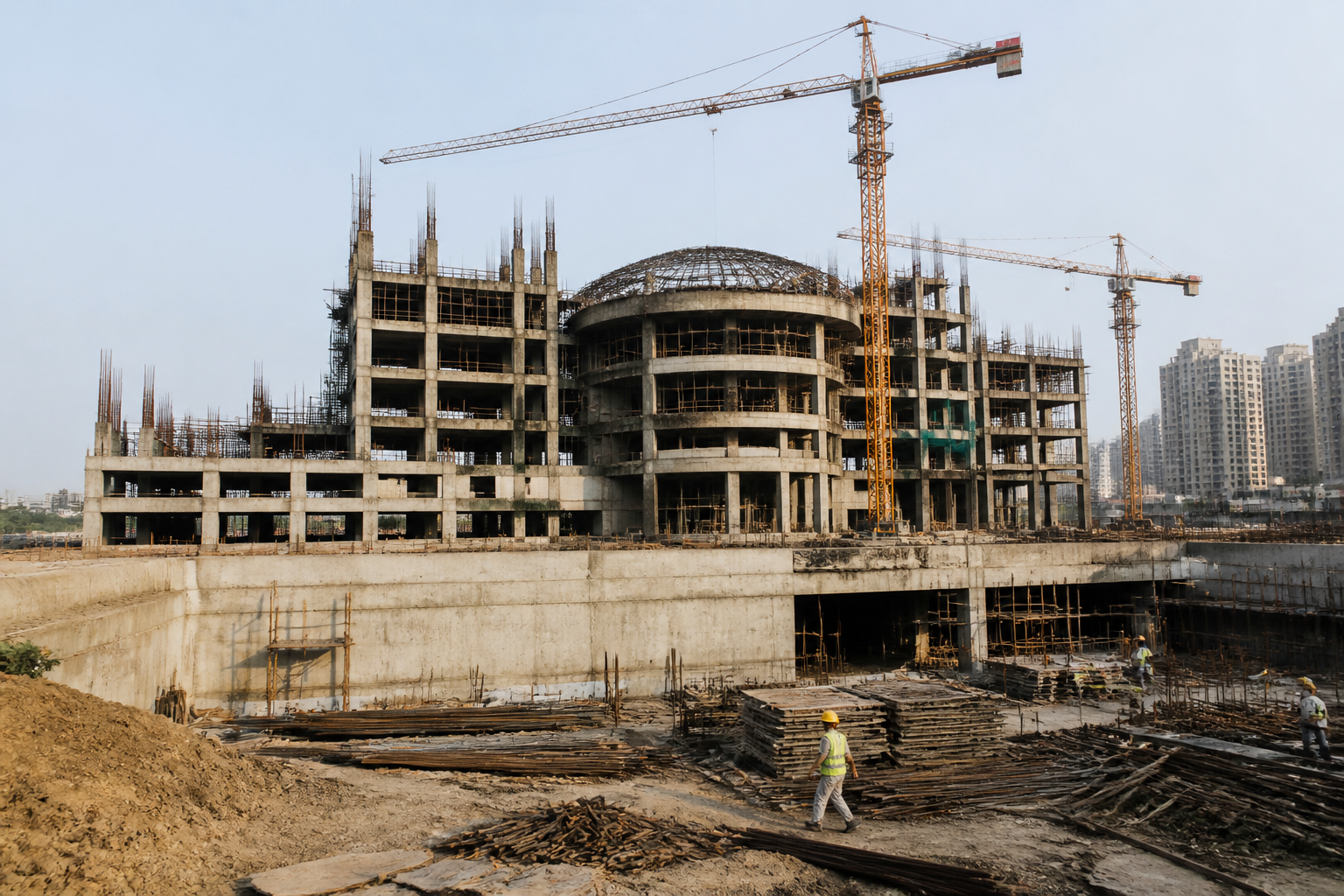
Subheadline: Repeated design changes, foundation-related revisions and contractor difficulties have pushed the reported cost of the Panvel civic headquarters up by 43.01 percent.
Standfirst: The delayed construction of Panvel Municipal Corporation’s ‘Swarajya’ headquarters is more than an unfinished public building. According to information obtained under the Right to Information Act and cited in a report by Loksatta, the project’s cost excluding GST has risen from about Rs 112.93 crore to Rs 161.49 crore, while its completion deadline has moved from November 2024 to October 2026. The municipality has attributed part of the increase to changes in the original design, while the mayor has also said the contractor submitted a bid at seven percent below the base amount and struggled to proceed beyond five percent of the work. The case raises a wider question for fast-growing municipalities: whether public construction projects are being designed, tendered and monitored with enough technical and financial discipline before work begins.
The Panvel municipal headquarters was conceived as a prominent civic project near the Navi Mumbai International Airport and along the Panvel-Sion highway. The first phase was planned for a plot in Sector 16, New Panvel. The project was presented as a major administrative building for a municipality operating in a region expected to experience accelerated construction and urban growth after the airport becomes operational. Yet the building’s own delivery has become a test of the corporation’s ability to manage a complex capital project.
The tender estimated the construction cost at Rs 110.78 crore excluding GST. After negotiations, the work was awarded to Harsh Constructions Private Limited for approximately Rs 112.93 crore on April 29, 2022. The contract period was set at 30 months, placing the original completion date at November 1, 2024. That deadline was not met. According to the report, extensions were subsequently processed up to April 30, 2025, then October 1, 2025, and finally October 31, 2026.
The chronology matters because the delay was not accompanied by a single clearly identified disruption such as unavailable land or an unissued initial development permission. The corporation had entered into a lease agreement with the City and Industrial Development Corporation on April 19, 2021, after paying the required consideration, and had obtained development permission on September 7, 2021. The report therefore questions whether the principal causes of delay emerged from project execution, design development, site conditions, contract management or a combination of these factors.
The financial change is substantial. The revised project amount excluding GST is reported at Rs 161.49 crore, compared with the original work-order value of Rs 112.93 crore. That represents an increase of Rs 48.57 crore, or 43.01 percent. Including GST, the revised amount is reported at approximately Rs 190.56 crore. The increase is attributed to several components: additional work, increased quantities, changes to the design, revisions to the foundation, changes involving steel and iron, deductions for deleted work and GST.
This breakdown is important because a large increase in a public works project cannot be assessed only as a consequence of inflation. Each component raises a different administrative question. Additional quantities may indicate that the original assessment was incomplete. Design changes may reflect evolving requirements or deficiencies in the initial drawings. Foundation revisions may result from genuine site conditions, but they also require evidence that the conditions were not reasonably identifiable before tendering. Deleted work, meanwhile, should be examined alongside added work to determine whether the project scope was properly controlled.
The report cites information obtained by RTI activist Suhas Wankhede, who has called for the reasons behind every extension, the responsibility for each delay, the steps taken to avoid it and the legality of granting rate increases during the extended periods to be recorded clearly. These questions go to the core of municipal procurement. A project can face legitimate technical complications, but a credible public record must distinguish between unforeseen conditions, changes requested by the client, contractor underperformance and weaknesses in the original tender documents.
The foundation issue illustrates that distinction. Extension records reportedly state that the soil strata were found approximately 1.5 metres deeper than expected, requiring additional excavation, retaining walls, foundation work and design changes. The tender documents, however, reportedly required the successful contractor to conduct a fresh soil investigation before beginning construction. That creates a need for a technical comparison between the pre-tender information, the contractor’s investigation and the subsequent site findings. The available report does not establish whether the deeper strata were genuinely unforeseeable. It does establish why an independent technical examination has been sought.
The mayor has offered a second explanation linked to the tender and the contractor’s financial position. Nitin Patil told Loksatta that changes were made to parts of the original design and that the contractor had bid seven percent below the original amount after not studying the tender properly. According to the mayor, the contractor encountered difficulties during execution and could not progress beyond five percent of the work. This statement places attention on the relationship between an abnormally low bid, the contractor’s ability to finance construction and the municipality’s process for assessing bid realism before awarding the work.
Low bids can reduce the initial cost of a public project, but the tender price is only the starting point if the contractor cannot sustain procurement, labour and site operations. The report does not provide the complete bid comparison, the contractor’s financial evaluation or the precise share of delay attributable to the contractor. Those records would be necessary to determine whether the low bid was a warning sign that should have been addressed during tender scrutiny, or whether subsequent design and site changes were the dominant cause of failure.
The project also raises questions beyond the headline cost. The report refers to concerns involving the validity of bank guarantees, gaps in insurance protection, notices related to worker safety, environmental compliance and the continued updating of independent quality-control records. These are not peripheral documents. A bank guarantee protects the public authority against specified contractual risks. Insurance safeguards workers, third parties and the project itself against defined liabilities. Safety notices indicate whether construction is being managed within statutory requirements, while environmental compliance determines whether work is proceeding under the conditions attached to the project.
Taken together, these issues suggest that project monitoring has to be understood as a continuous system rather than a final inspection. Municipal oversight begins with the quality of the feasibility study and soil investigation, continues through design approval and tender evaluation, and extends to measurement, payment, safety, insurance, environmental records and extension approvals. Weakness at any one stage can transfer risk to the next stage, where correcting it becomes more expensive.
The Panvel case also shows why municipal headquarters are not merely administrative real estate. A headquarters concentrates public services, officials, records and decision-making in one civic asset. Delays can postpone operational benefits, while cost increases consume funds that could otherwise support other municipal priorities. In a rapidly urbanising region, the credibility of such a building project also affects public confidence in the corporation’s capacity to deliver roads, drainage, waste systems and other infrastructure.
The institutional responsibility is correspondingly divided. The municipality is responsible for defining the requirement, securing the site, approving designs, managing the contract and documenting changes. The contractor is responsible for executing the work in accordance with the contract, maintaining required guarantees and insurance, and meeting safety obligations. Designers, consultants and quality agencies have distinct technical roles. A proper review must therefore assign responsibility by decision and stage rather than treating the delay as an undifferentiated project failure.
The reported cost figures provide a clear measure of the problem, but they do not by themselves explain whether every increase was avoidable. The original value, revised value, percentage increase, deadline extensions and foundation changes are established in the report. What remains unresolved is the evidentiary basis for each variation, the status of the work as of the latest extension, the amount already paid, the remaining physical work and the enforcement action, if any, available under the contract.
Those gaps are central to the next phase of scrutiny. A transparent project record would show the approved drawings at tender stage, each subsequent design revision, the technical justification for foundation changes, measurement books, variation statements, extension orders, guarantee and insurance renewals, safety compliance reports and independent quality assessments. It would also clarify whether the October 31, 2026 deadline is achievable under the current contract and what controls are in place to prevent another extension.
The broader lesson is not that every delayed municipal project reflects mismanagement. Construction projects can encounter genuine ground conditions, regulatory changes and scope revisions. The lesson is that public agencies must make those causes traceable. Without a clear chain linking the original estimate, the site evidence, the design decision, the contractor’s performance and the revised payment, cost escalation becomes a number without accountability.
For Panvel, the immediate task is to complete the remaining work within a defined and publicly monitored schedule while establishing how the 43.01 percent increase was assembled. The report’s evidence confirms a project that has moved well beyond its original cost and deadline. It does not, on its own, settle responsibility for every delay or variation. That determination will depend on the municipality’s technical, financial and contractual records, and on whether those records are made available for independent review.

