


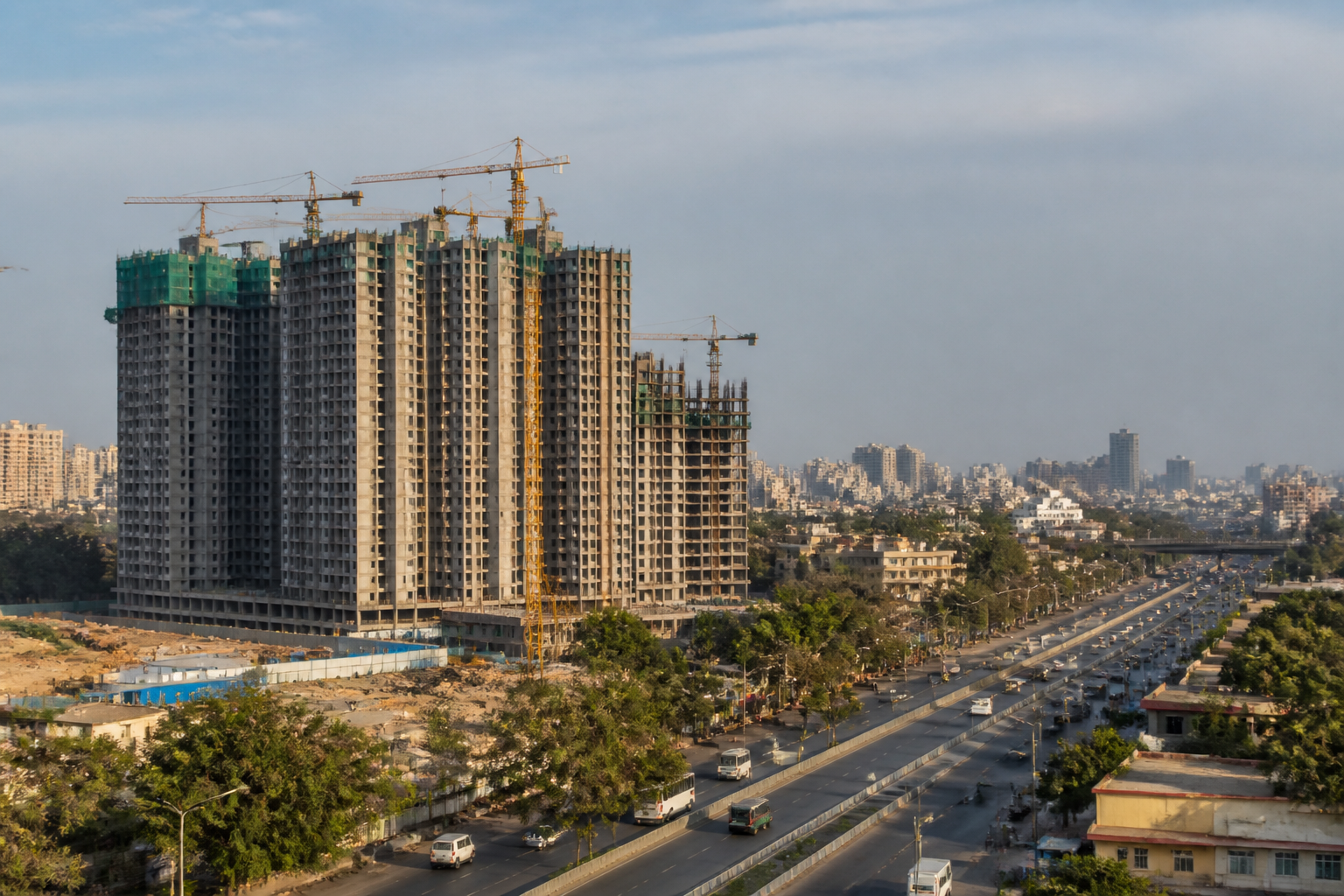
Pune’s next phase of construction is being framed not only as a real estate expansion but as a test of whether the city can build roads, water systems, drainage and other civic networks at the same speed. Pune Municipal Corporation Commissioner Naval Kishor Ram has estimated that around 6.5 crore square feet of construction could take place within the civic limits over the next four years.
The projection, reported by Loksatta, covers the city and its suburbs. Ram said the estimate emerged from a recent study presented at a high-level meeting on potential construction activity. He pointed to housing societies, information technology centres and data centres as the principal drivers of the expected increase.
The number is significant because it shifts the question from how much Pune may build to whether its supporting infrastructure will be ready when that construction is occupied and operational. The commissioner’s own description of the challenge links new buildings with the capacity of roads, water supply and other municipal services. In his assessment, infrastructure expansion must proceed at the same pace as construction.
That requirement is difficult because the city’s physical growth is taking place through several different processes at once. New housing is being built in areas that have recently entered the municipal boundary. Older structures in the peth areas are being replaced by new buildings. Information technology facilities and data centres are adding another category of demand. These forms of development do not place identical pressures on the city, but all depend on transport access, utility connections and the ability of municipal systems to handle greater use.
The commissioner attributed part of the increase in taller buildings to the Unified Development Control and Promotion Regulations, or UDCPR, which allow additional floor space index or the use of increased transferable development rights. As a result, high-rise construction is increasing, according to the report. The expansion of vertical development makes the capacity of surrounding infrastructure especially important: a larger building can add substantial demand within a comparatively small site, while the adjoining road, drainage and pedestrian network may remain largely unchanged.
The report also identifies a related pattern in the newly included villages. Open land in these areas is being used for high-rise construction. This creates a planning challenge because building permissions and construction activity can move more quickly than the extension or formalisation of public infrastructure. The issue is not simply whether land is available for development. It is whether the public network serving that land has been acquired, designed, funded and delivered.
Pune’s roads are the clearest example of this gap. Ram said that roads proposed in the development plan in suburban areas have not yet been fully acquired. According to the report, some private landowners insist on cash compensation during acquisition, slowing the process. The resulting road-width constraints contribute to congestion, particularly where planned roads and missing links have not been completed.
This places land acquisition at the centre of the city’s construction question. A development plan may identify a road, but the road does not become a functioning public connection until the land is secured and the project is executed. Until then, new buildings may be connected to an existing network that was not designed for the additional traffic. The commissioner’s remarks therefore connect construction growth with an administrative sequence involving planning, land procurement, road construction and coordination among departments.
The municipality has identified the High Capacity Mass Transit Route, or HCMTR, the ring road around the city and development-plan roads as priority projects. Ram said that completing these projects, along with missing links connecting major roads, would be necessary to support the city’s expansion. The report does not provide project-wise completion dates, costs, land-acquisition status or capacity assessments for these schemes. Those details will be important for assessing whether the proposed infrastructure response matches the scale of projected construction.
The same capacity question applies to water supply and underground drainage. Ram said that roads, water supply and other infrastructure would need to be created or expanded in parallel with new construction. The report states that systems are being upgraded in different areas, but that the pace of this work remains slow. It does not specify the current or planned additional water-treatment, distribution or sewage capacity, nor does it quantify the infrastructure deficit in the areas seeing the fastest development.
That absence of capacity data limits what can be concluded from the 6.5-crore-square-foot projection. The estimate establishes the potential scale of construction described by the municipal commissioner, but it does not by itself indicate how many residents, workers, vehicles or daily water users the new development would add. Nor does it establish whether every approved project will be completed within the four-year period. The figure should therefore be read as a planning signal rather than a confirmed measure of delivered floor space.
Even so, the projection exposes a recurring feature of urban growth: private construction can be measured in approvals and square feet, while public readiness depends on multiple agencies and longer implementation cycles. The municipal administration’s response, as described in the report, is to accelerate ongoing projects and coordinate the roads, construction and land-acquisition departments. That coordination is essential because delays in one department can prevent the benefits of work undertaken by another. A road cannot function as planned if the required land is unavailable, and a new development cannot be adequately served if connecting roads or utility networks are incomplete.
The policy framework adds another layer. UDCPR provisions can enable additional development intensity through higher FSI or increased TDR use. The municipal commissioner’s comments suggest that the resulting vertical growth must be considered alongside infrastructure planning. The supplied material does not establish whether infrastructure contributions, development charges or other funding mechanisms are sufficient to finance the required expansion. It also does not state how responsibilities are divided between the PMC and other agencies involved in the ring road, regional transport or utility systems.
That institutional question matters because Pune’s urban area extends beyond a single project or department. The report refers to the PMC’s boundaries, city suburbs and newly included villages, while also naming road and ring-road projects that may involve wider regional connections. A construction forecast within the municipal limits can therefore generate demands that are experienced across adjoining areas. Effective implementation will depend on whether the relevant agencies work from a common assessment of projected growth and infrastructure capacity. The article does not provide evidence that such a consolidated assessment has yet been published.
For residents, the immediate implications are practical. Where road widening and missing links are delayed, additional construction can increase pressure on already narrow routes. Where water and drainage upgrades lag behind building activity, the question is whether municipal systems can absorb new demand. In areas undergoing redevelopment, the replacement of older structures may change the intensity of land use without immediately changing the street pattern. In newly incorporated villages, high-rise development may arrive before the full urban network is in place.
The commissioner also warned that inadequate infrastructure could create traffic congestion and make it harder for industries to come to the city. That is an official assessment, not an independently quantified forecast in the supplied material. It nevertheless captures the larger planning issue: infrastructure is not a secondary service to be added after construction. It is part of the city’s economic and residential capacity.
Pune’s 6.5-crore-square-foot construction projection thus raises a question of sequencing. The city’s administration has identified major roads, ring-road connectivity, HCMTR, development-plan roads and missing links as necessary responses. It has also acknowledged that land acquisition and slow infrastructure execution remain obstacles. What is not yet established is whether these projects have secured land, funding, implementation schedules and measurable capacity targets that correspond to the projected building activity.
The next stage of scrutiny should focus on those details. The municipal administration’s high-level study, the status of land acquisition for development-plan roads, the timelines for HCMTR and ring-road work, and the planned expansion of water and drainage systems will determine whether the projection becomes a coordinated urban build-out or a widening gap between construction and civic capacity. The evidence currently confirms the scale of the challenge, while the adequacy and timing of the response remain to be demonstrated.
