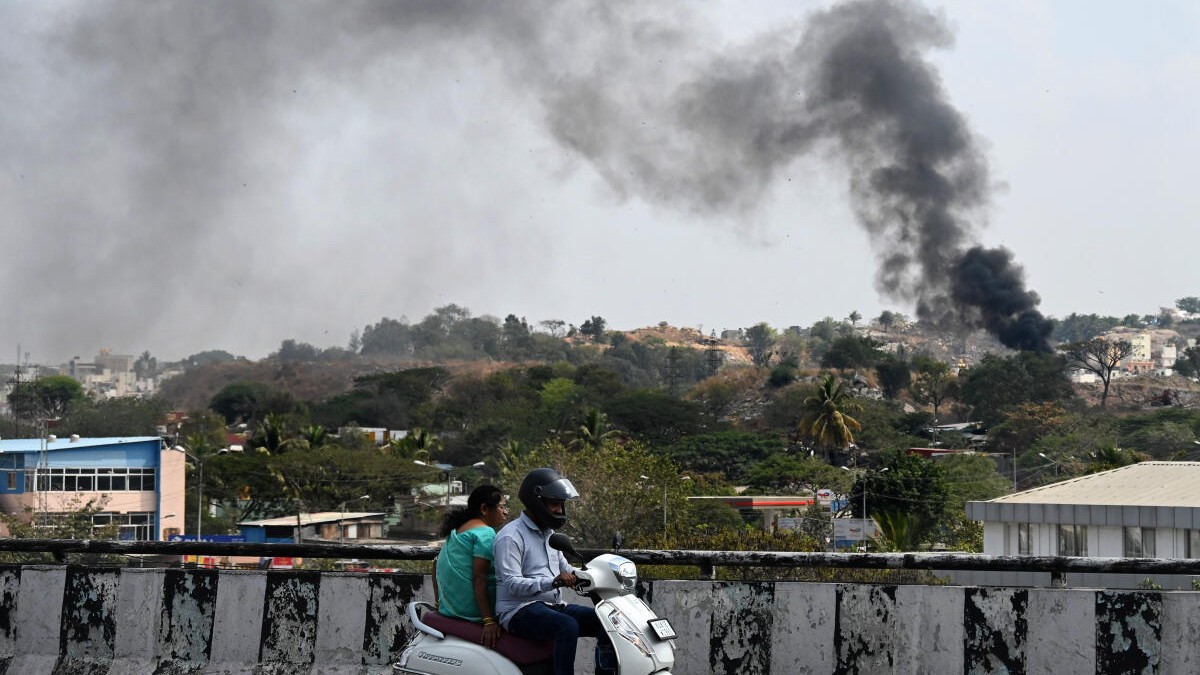
Bengaluru Air Pollution Shows Need For Regional Action
Bengaluru’s air pollution challenge cannot be viewed entirely within the city’s boundaries, according to a new regional study examining how pollution moves across South India. Karnataka both receives and exports a moderate share of pollution, placing Bengaluru within a wider atmospheric network where emissions from neighbouring states can influence local air quality.
The study by Bengaluru-based Centre for Study of Science, Technology and Policy used chemical transport modelling to examine the movement of pollutants, including particulate matter, between Karnataka, Tamil Nadu, Andhra Pradesh, Telangana and Kerala. It found that between 38% and 65% of annual average pollution in the five states originates within the respective state. Karnataka accounted for 47%, placing it between the other southern states. For Bengaluru air pollution, the finding adds an important dimension to the city’s efforts to reduce emissions. Local sources remain critical, but atmospheric conditions can transport pollutants across administrative boundaries. This means measures taken within Bengaluru may not fully determine the air experienced by residents. The study found that Tamil Nadu and Andhra Pradesh are net contributors, exporting more pollution to neighbouring states than they receive. Kerala and Telangana are net receivers, while Karnataka occupies an intermediate position, both receiving and exporting pollution. That regional connection matters for Bengaluru because its pollution sources are closely tied to mobility, construction, industrial activity, energy use and road dust.
Research on the city’s emissions has previously identified transport as a dominant source, while windblown road dust and waste burning also contribute to pollution hotspots. The latest findings also strengthen the case for looking beyond city-level air-quality targets. South India has 25 of India’s 131 non-attainment cities under the National Clean Air Programme, according to the study. For Bengaluru air pollution, regional coordination could therefore complement local action. The researchers have proposed a statutory body called Peninsular Air Quality Regional Coordination, or PARC, which could establish common regional emission targets while leaving implementation to individual states. Such coordination would be particularly useful for pollutants that travel over long distances. Shared monitoring networks, compatible emissions inventories and common reduction targets could help governments identify where pollution originates and where interventions are producing measurable results. At the city level, Bengaluru still has significant scope to reduce its own contribution. Better public transport, cleaner freight movement, dust control at construction sites, improved waste management and protection of green infrastructure can reduce local emissions while supporting healthier streets.
Recent government data also indicate that Bengaluru’s PM10 levels have declined compared with 2017-18, showing that targeted measures can produce improvements. The new research nevertheless points to a broader reality: cleaner air cannot be secured by one city acting alone. For Bengaluru, the next phase of air-quality planning may need to connect local emission control with a coordinated South Indian strategy, making regional cooperation as important as city-level enforcement.