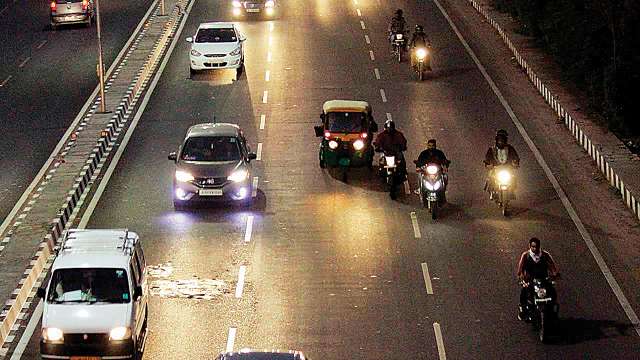
Ahmedabad’s SG Road corridor has emerged as one of the city’s most stressed urban highways, with traffic volumes more than tripling over the past eight years. The arterial stretch linking Sarkhej to Gandhinagar now handles over one lakh passenger car units daily, according to official data, intensifying congestion and raising fresh concerns around road safety, land use planning and long-term mobility resilience.
Between 2017 and 2025, daily vehicle movement on the NHAI-managed corridor increased from under 30,000 to over 100,000 a sharp escalation that has outpaced traffic growth on other major radial highways connected to Ahmedabad. Urban planners say the SG Road traffic surge reflects both rapid peri-urban real estate expansion and the clustering of commercial, retail and institutional developments along the corridor. Originally conceived as a growth spine connecting the city to emerging western suburbs and Gandhinagar, the stretch today functions as a mixed-use urban boulevard carrying intercity traffic, office commuters, freight vehicles and residential traffic simultaneously. This convergence has altered its risk profile. Emergency response data indicates that several of the city’s most incident-prone junctions now fall within the SG Road influence zone.
Officials associated with emergency medical services note that a significant share of road trauma cases originate along this corridor and its feeder roads. While response data typically reflects service coverage areas rather than precise crash coordinates, the density of distress calls highlights mounting safety challenges linked to complex junctions, high speeds and inconsistent pedestrian infrastructure. Transport analysts argue that the SG Road traffic surge is symptomatic of a broader mobility imbalance. Public transport penetration along the corridor remains limited relative to demand, pushing private vehicle dependence higher. The absence of continuous, protected cycling tracks and safe pedestrian crossings further narrows modal choices in a corridor that houses offices, housing clusters and educational campuses.
Senior officials in the state’s infrastructure departments acknowledge that traffic volumes have exceeded earlier projections. Multiple flyovers and underpasses have been added over the past decade, yet induced demand where added capacity attracts more vehicles appears to have offset gains. An elevated corridor and additional bridges linking Sarkhej to Chiloda are now under planning and execution to enable uninterrupted movement. Urban mobility experts caution that capacity expansion alone may not resolve the SG Road traffic surge. They recommend integrating bus priority systems, strengthening mass transit connectivity, and redesigning junctions with a people-first approach. Climate-sensitive planning also becomes critical as idling vehicles increase emissions in a city already grappling with rising temperatures. For Ahmedabad, the corridor’s future will test whether infrastructure can transition from reactive widening to sustainable mobility management. How authorities balance throughput with safety, air quality and inclusive access will shape not only traffic flows but also the liveability of one of the city’s fastest-growing urban districts.