


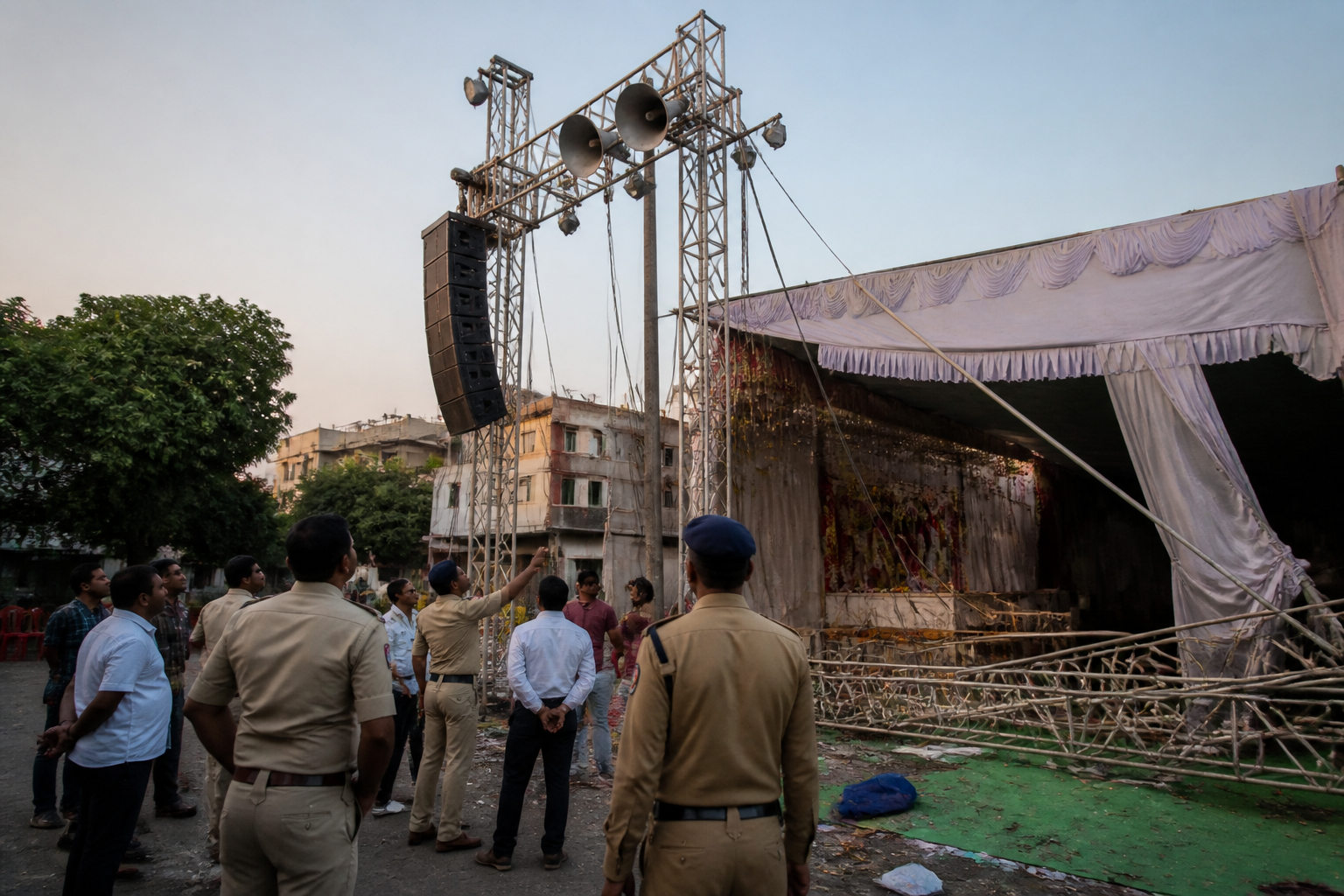
A woman’s death after a hanging sound system and its metal support structure collapsed at a Dahihandi event in Old Sangvi has led to arrests and a criminal case. The incident, reported by Loksatta, raises a wider urban question: how are temporary structures, sound installations and crowd-facing equipment made safe before public events take place?
The incident occurred at the Vighnaharta Dahihandi Mandal in Old Sangvi on Friday night, September 4, according to the report. Salma Salauddin Pathan, 46, and her husband had gone to watch the event. After the Dahihandi programme ended, as the couple were leaving, a hanging sound system and its iron stand suddenly fell. The structure struck Salma, who sustained serious injuries. She was taken to Aundh Hospital, where doctors declared her dead before treatment could begin.
Sangvi police later registered a criminal case against the mandal’s office-bearer, the mandap contractor and the sound-system provider, the report said. Mehboob alias Sam Ramzan Shaikh, 27, identified as the person who erected the mandap and iron structure, and Kunal Anil Bhogawade, 29, identified as the provider of the speaker sound system, were arrested. A case was also registered against the mandal’s president or office-bearer.
The immediate legal action is significant because the death did not occur in an enclosed private workplace or inside a formally permanent building. It occurred at a public religious-cultural event where temporary equipment had been installed for spectators and participants. The case therefore brings several layers of responsibility into view: the organisers who arranged the event, the contractor who erected the temporary structure, and the sound-system provider whose equipment and support frame were involved in the collapse.
The available report does not establish which specific failure caused the structure to fall. It does not say whether the stand was improperly anchored, whether the load exceeded the equipment’s capacity, whether the installation had been inspected, or whether the event had received all permissions required for the arrangement. Those questions are central to determining criminal responsibility, but they remain matters for the police investigation and any subsequent legal proceedings.
That distinction matters. A collapse at a public event can appear to be a single equipment failure, but responsibility may be distributed across a chain of decisions. A sound system may be supplied by one party, assembled by another, positioned by event organisers and used in a space where spectators are moving through designated or informal exits. If the arrangement is not checked as a complete installation, each individual component may be treated as separate even though the public experiences it as one risk.
In this case, the report identifies the mandap owner and sound-system owner as the two people arrested. It also identifies the mandal’s office-bearer as facing a case. That combination suggests that investigators are examining not only the physical structure but also the organisation of the event. However, the supplied material does not include the sections of law invoked, the contents of the first information report, police findings from the site, or details of any permissions and safety conditions attached to the programme.
The sequence of the police response is another important part of the story. The report says Salma’s son, Rahim Pathan, 24, was a worker associated with the Dahihandi mandal. It also says he told the police that he and his father had no complaint and requested that no independent action be taken against the mandal. Police initially recorded the matter as an accidental death. A criminal case was ultimately registered on Sunday night after the police complaint filed by Assistant Police Inspector Rajesh Malegave.
This sequence shows how the classification of a public-event death can change as the facts are examined. The first response recorded the death as accidental. The later case indicates that the police considered the circumstances serious enough to investigate possible negligence or responsibility. The report does not explain what new evidence prompted the change, whether the site was inspected, or whether statements from witnesses and technical personnel were recorded. Those details will be necessary to understand the basis of the charges.
The case also shows the difficulty of separating family consent from the state’s responsibility to investigate a death in a public setting. The family’s initial position, as reported, was that it did not want action against the mandal. But the safety of temporary public infrastructure is not only a private dispute between an organiser and a victim’s relatives. Equipment placed above or beside a crowd can affect anyone attending, passing through or leaving an event. The police decision to register a case places the incident within a public accountability framework rather than leaving it solely to an agreement between individuals.
For urban administrations, temporary event infrastructure presents a recurring governance challenge. Permanent buildings are generally subject to established approval, construction and inspection systems. Temporary mandaps, stages, lighting frames, speaker towers and hanging equipment are assembled for short periods, often in streets, neighbourhood grounds or other spaces with heavy pedestrian movement. Their temporary nature does not reduce the consequences of structural failure, but it can make responsibility and inspection less visible.
The Sangvi report does not provide evidence about the permission process for the event or the role of the local civic administration. It therefore cannot establish whether officials approved the installation, whether a safety inspection was required, or whether any condition was violated. Those facts should not be assumed. They are, however, among the questions that naturally follow from the case and that authorities would need to answer if the investigation is to establish how the collapse occurred.
The same caution applies to the broader safety record of religious and cultural events. The supplied material describes one fatal incident, not a dataset of failures or a citywide pattern. It would be inaccurate to conclude from this report alone that all temporary event structures in Pimpri-Chinchwad are unsafe or that organisers routinely bypass safety requirements. What the case does establish is that a temporary sound installation at one public event collapsed and caused a death, leading to arrests and a criminal case.
That limited but clear evidence is enough to identify the central governance question: whether safety checks are treated as a formal responsibility or as an informal arrangement between event organisers and vendors. A formal system would need to identify who is responsible for structural stability, who confirms that sound equipment is securely mounted, who checks the area below suspended or elevated installations, and who has authority to stop an event when those conditions are not met. The supplied report does not say whether such a system was in place at the Vighnaharta Dahihandi event.
It also leaves open the question of documentation. The investigation may need to examine contracts, equipment specifications, installation details, photographs, witness statements, permission records and post-incident site evidence. None of these materials is included in the report. Without them, the public can know the broad sequence of events but not yet the precise technical or administrative failure that led to the collapse.
The arrests should therefore be understood as part of an investigation, not as a final finding of guilt. The report attributes the arrests to Sangvi police and names the alleged roles of the two people detained. It does not report a court finding or a completed inquiry. The legal process will have to determine whether the accused persons were responsible for the installation, whether negligence is established, and whether other parties had a relevant duty of care.
The timing of the case is also relevant. The death occurred after the event had ended, while spectators were leaving. That places attention on the transition period after a programme, when equipment may still be energised or suspended even though crowd movement continues. The report does not say whether the sound system was being dismantled, whether people were passing directly beneath it, or whether the collapse occurred because of movement, impact, anchoring or another cause. These details remain unconfirmed.
For residents, the case underscores the fact that event safety extends beyond the main performance area. People attending a neighbourhood celebration may be exposed to temporary structures while entering, watching or leaving. The public generally cannot assess whether a metal frame or suspended speaker has been secured correctly. That makes the organiser, installer, contractor and relevant authorities important points of accountability in the safety chain.
The Sangvi Dahihandi accident therefore has two distinct dimensions. The first is the criminal investigation into the death of Salma Pathan and the conduct of the people named in the case. The second is the administrative question of how temporary installations at public events are approved, inspected and monitored. The first will be tested through police investigation and court proceedings. The second cannot be answered by the available report alone.
What is established is that a woman died after a hanging sound system and its iron stand fell on her, that she was taken to Aundh Hospital and declared dead, and that Sangvi police later arrested the mandap and sound-system providers while registering a case against a mandal office-bearer. What remains uncertain is the precise cause of the collapse, the permissions obtained for the installation, the existence of any inspection, and the evidence supporting the charges. Those are the next facts that will determine whether the incident is treated only as an individual failure or as evidence of a wider gap in the governance of temporary public-event infrastructure.
