


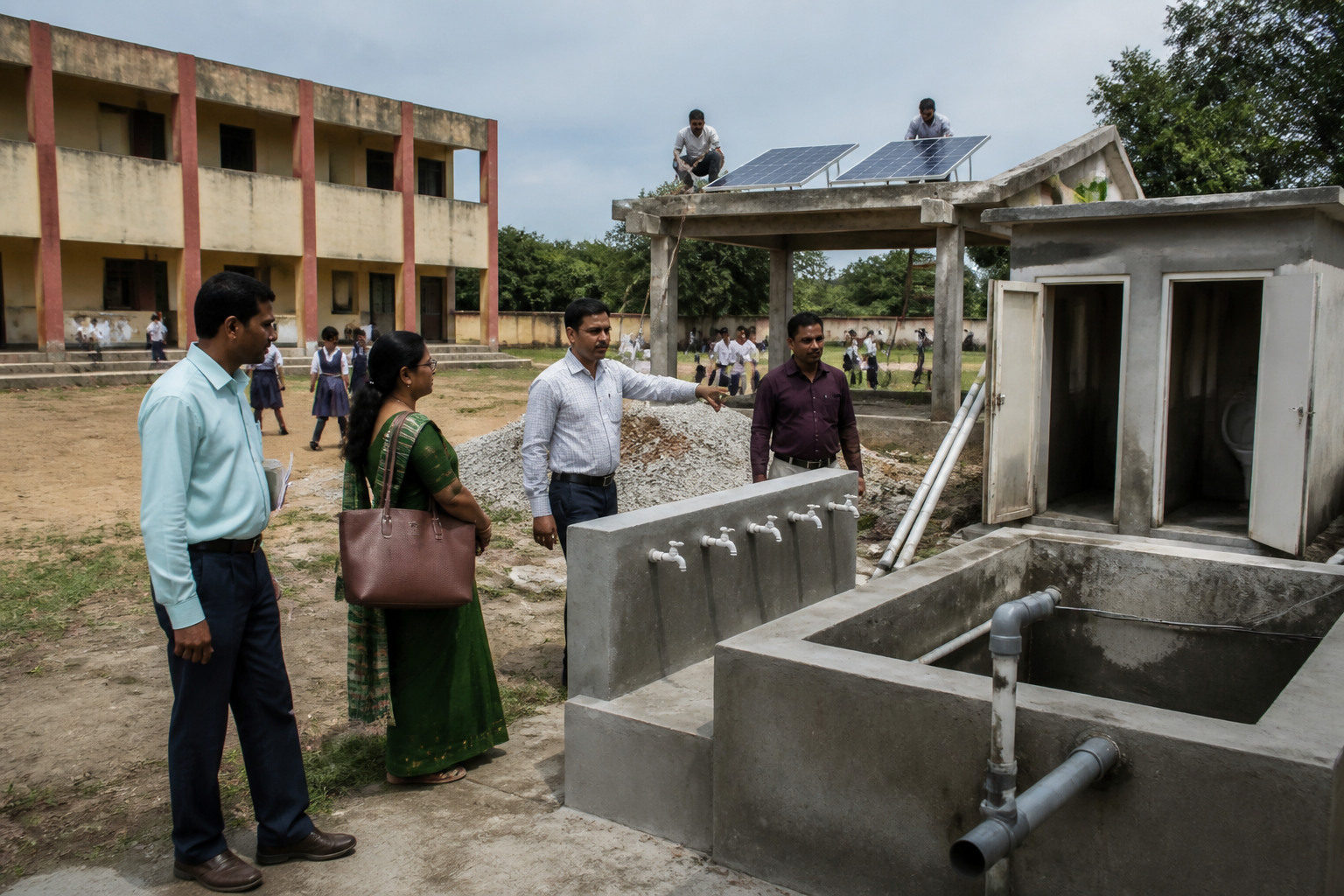
West Bengal schools are missing out on a central government recognition programme because many lack basic infrastructure such as rainwater harvesting systems, solar panels, accessible toilets and waste-management facilities, according to a report by Sangbad Pratidin. The deadline for schools to submit their names for participation in the Swachh and Harit Vidyalaya Recognition programme was September 30.
The report said no school from West Bengal participated in the 2025-26 edition of the programme, even though 10,47,859 schools from across India joined it. The state’s absence has prompted the School Education Department to begin preparations for the next cycle, with officials aiming for at least 80,000 of the state’s estimated 90,000-94,000 government-approved schools to participate.
The programme evaluates schools against national standards and awards ratings of up to five stars. The required infrastructure includes filtered drinking water, accessible toilets for persons with disabilities, handwashing facilities, rainwater harvesting, solar panels, waste-management systems, sanitary napkin facilities, eco-club and kitchen-garden certification, and documentation linked to the Mission LiFE programme.
The report said schools in urban areas commonly lack space for tree planting and water-conservation infrastructure, while schools in rural areas have struggled to install solar panels. These gaps have prevented several institutions from meeting the programme’s eligibility requirements and, consequently, from accessing the benefits associated with participation.
The department has begun a fresh assessment process. Six district inspectors of schools have reportedly been issued show-cause notices after schools failed to meet the required standards. The state’s communication to education officials said schools would be assessed on the basis of national criteria. District-level evaluations are expected to take place during October, followed by state-level nominations within the subsequent seven days.
The department has also asked schools to submit drinking-water quality reports by October 31. The immediate exercise is intended to establish the condition of basic services before schools are assessed for the next round of recognition.
The infrastructure requirements show that the programme is not limited to cleanliness campaigns. Participation depends on a combination of public-health facilities, accessibility, water security, renewable energy, waste management and environmental education. For schools, the absence of these systems is therefore both an operational constraint and a barrier to recognition under a national framework.
According to the report, state officials acknowledged that the new administration had been in office for only four months, leaving limited time to create the required infrastructure for the current cycle. The state government now plans to begin preparations earlier so that schools can improve their eligibility before the next submission window.
The report also noted that 8.23 lakh schools across the country had participated in the programme in 2021-22, while schools from West Bengal had not taken part in earlier editions. The state government’s stated objective is for schools across Bengal to participate in central programmes and secure higher national visibility. The next milestones are the October water-quality reporting, district-level evaluations and the subsequent state-level nomination process.
