


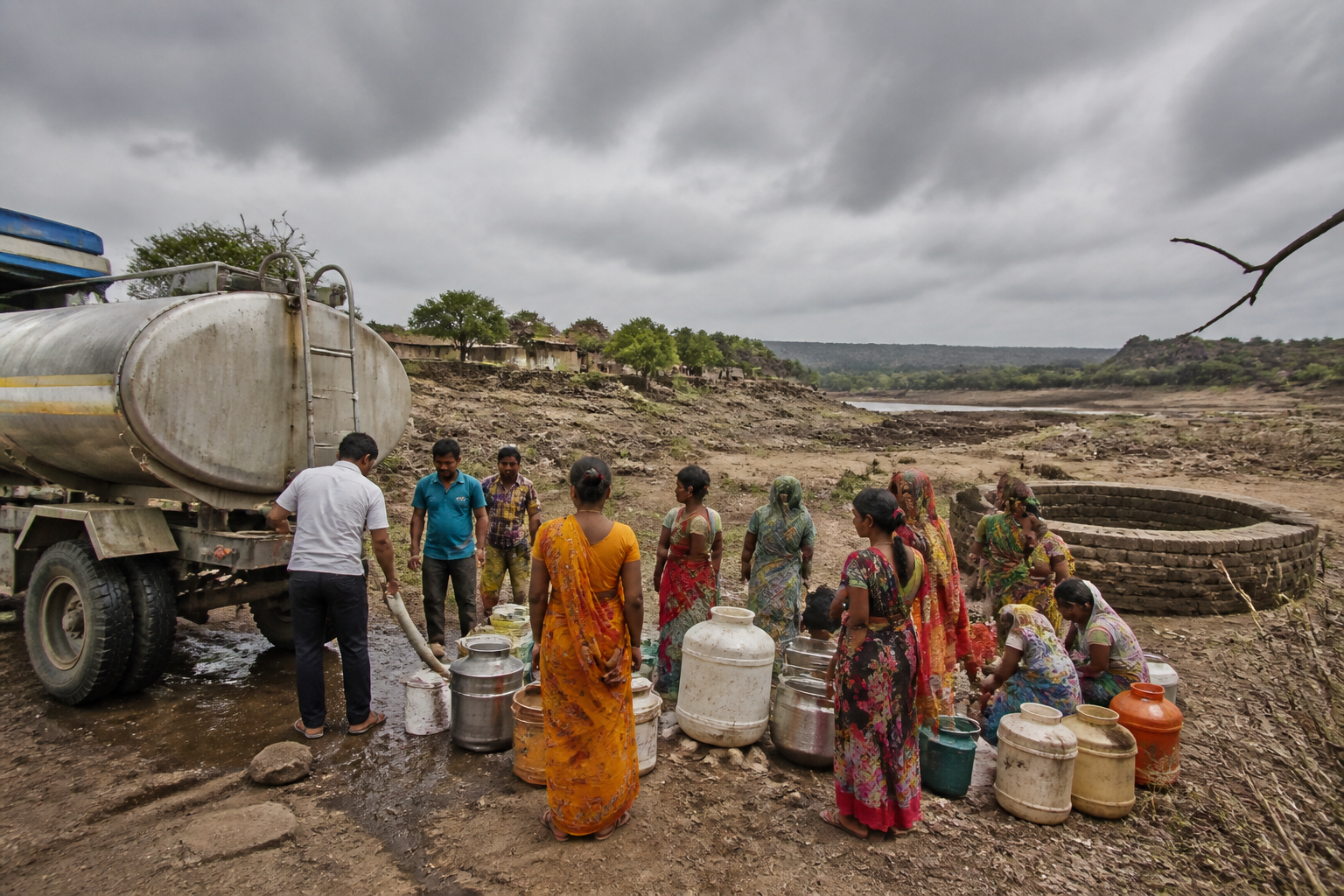
The Marathwada drought did not begin when Maharashtra formally declared it. In villages across Beed, Chhatrapati Sambhajinagar, Jalna and Dharashiv, the crisis had already become a daily administrative exercise: tankers were carrying drinking water, wells had been taken over and residents were waiting with cans and utensils during the monsoon itself.
That timing is the central fact in the report. Water tankers are commonly associated with the summer scarcity period, but villagers in the affected districts began seeking them as early as June and July. By September 29, district authorities had deployed 277 tankers and taken over 548 wells. The tankers were supplying 160 villages and 93 hamlets, indicating that the emergency was not confined to a single settlement or isolated source of water.
The geography of the response shows how uneven the crisis is. Beed accounted for 127 tankers, the highest number among the four districts listed in the report. Chhatrapati Sambhajinagar had 120, followed by Jalna with 22 and Dharashiv with eight. Within Beed, Ashti taluka was among the worst affected and received 42 tankers. In Georai, tankers made 76 trips a day, while in Ashti they made 84 trips in one week.
These figures are more than a record of emergency logistics. They show how the administration is compensating for the failure of local water sources. A tanker trip becomes necessary when the water system serving a village cannot meet basic drinking-water demand. Repeated trips also indicate that the intervention is not a one-time supply operation but a continuing dependence on a mobile source.
The affected villages described in the report make the institutional gap visible. In Beedsangavi village in Ashti taluka, resident Popat Berad said he had never seen the need for a tanker during a monsoon month. The 61-year-old compared the current conditions with the 1972 drought, which he remembers from childhood, and said the river was now completely dry. His account places the present crisis in a longer memory of water scarcity while also stressing that the seasonal pattern feels different.
In Kinhi, about 75 kilometres deeper into the dry landscape from Beed, residents had depended on tankers since July. Santosh Kakade described waiting every day with cans and utensils while reports of flooding in some cities circulated online. The contrast is not simply between rural drought and urban flooding. It demonstrates how the same monsoon period can produce sharply different water realities within the state, depending on where rain falls and whether local sources retain water.
The official accounts reinforce the residents’ descriptions. A district administration official said it was rare for people to struggle for drinking water in July. Ashti tehsildar Vaishali Patil said there had been no rain in the taluka during the season and that not even a stream formed in the rivers. She said tanker service to many villages began in April, briefly stopped in June and resumed in July. According to her account, the administration had no choice because the usual seasonal water pattern had not materialised.
The sequence matters. If tanker service began in April, the initial response followed a familiar summer-scarcity cycle. The brief halt in June suggests that the administration may have expected the monsoon to restore local sources. When that did not happen, tanker operations resumed in July. The result was an emergency system operating during the season when villages would ordinarily expect rainfall, stream flow and replenished wells.
The report also shows why a formal drought declaration does not fully describe the beginning of a water crisis. The declaration provides an official administrative marker, but residents experience scarcity through the condition of a well, the arrival of a tanker or the flow of a river. In Kinhi, Beedsangavi and other villages described in the report, those indicators had already turned negative before the declaration was made.
This distinction has consequences for how drought governance is understood. A declaration can activate or formalise relief measures, but it does not create the underlying crisis. By the time the declaration is issued, communities may already have changed their daily routines, demanded tanker supply and exhausted nearby sources. The difference between the administrative date and the lived date of drought is therefore a measure of how quickly local conditions are recognised and acted upon.
The numbers also reveal the scale of the state’s dependence on emergency distribution. Two hundred and seventy-seven tankers and 548 taken-over wells represent a substantial mobilisation of administrative capacity. Yet these measures remain temporary by design. A tanker moves water to a settlement; it does not restore the river, refill the well or establish a reliable local source for the next season. The report does not establish what long-term measures are planned, but it does show that the immediate response is centred on transporting water and controlling access to existing wells.
That response has a clear public-service function. Drinking water must reach villages when local sources fail, and tanker trips provide a visible way for authorities to meet that immediate obligation. At the same time, the repeated trips in Georai and Ashti indicate the operational burden of maintaining supply across scattered settlements. Each village or hamlet requires scheduling, transport and monitoring. The greater the distance between a source and a settlement, the more vulnerable the arrangement becomes to interruption, although the supplied report does not quantify those distances or interruptions.
Taking over wells is another important part of the administrative picture. The action allows authorities to bring existing sources into a managed supply system, but the report records that many wells were already dry. In Beedsangavi, both wells in the village were described as completely dry. This suggests that the existence of a water structure does not necessarily mean usable water is available. The condition of the source remains more important than the number of wells recorded in an official response.
The story therefore raises a broader planning question: how should water systems respond when seasonal assumptions fail? The villages in the report were not merely facing a shortage at the end of summer. They were facing a monsoon that, according to local residents and the tehsildar, did not produce the expected flows. Planning based on the arrival of seasonal rain becomes fragile when rainfall does not translate into functioning rivers, streams or wells.
The evidence supplied here does not establish the causes of the failed monsoon, nor does it provide rainfall totals, groundwater measurements or a comparison with previous years. It also does not assess whether the tanker deployment is sufficient, how much water each village receives or how long the emergency will continue. Those limits are important because the available evidence strongly establishes the extent and timing of the drinking-water crisis, but not every reason behind it or the effectiveness of every response.
What it does confirm is a serious mismatch between the calendar of official drought recognition and the calendar of village-level scarcity. By September 29, authorities were serving hundreds of settlements through tankers and had taken over hundreds of wells. Residents, meanwhile, said the crisis had begun during the monsoon, when they expected water sources to recover.
For Marathwada, the immediate administrative task is to keep drinking water moving to affected villages. The larger institutional issue is whether drought monitoring and response can recognise a failed monsoon early enough to prevent local scarcity from becoming a region-wide tanker dependency. The next developments to watch are the continuation of tanker services, the condition of wells and rivers, and the measures authorities announce for communities that remain without dependable local water sources.
