


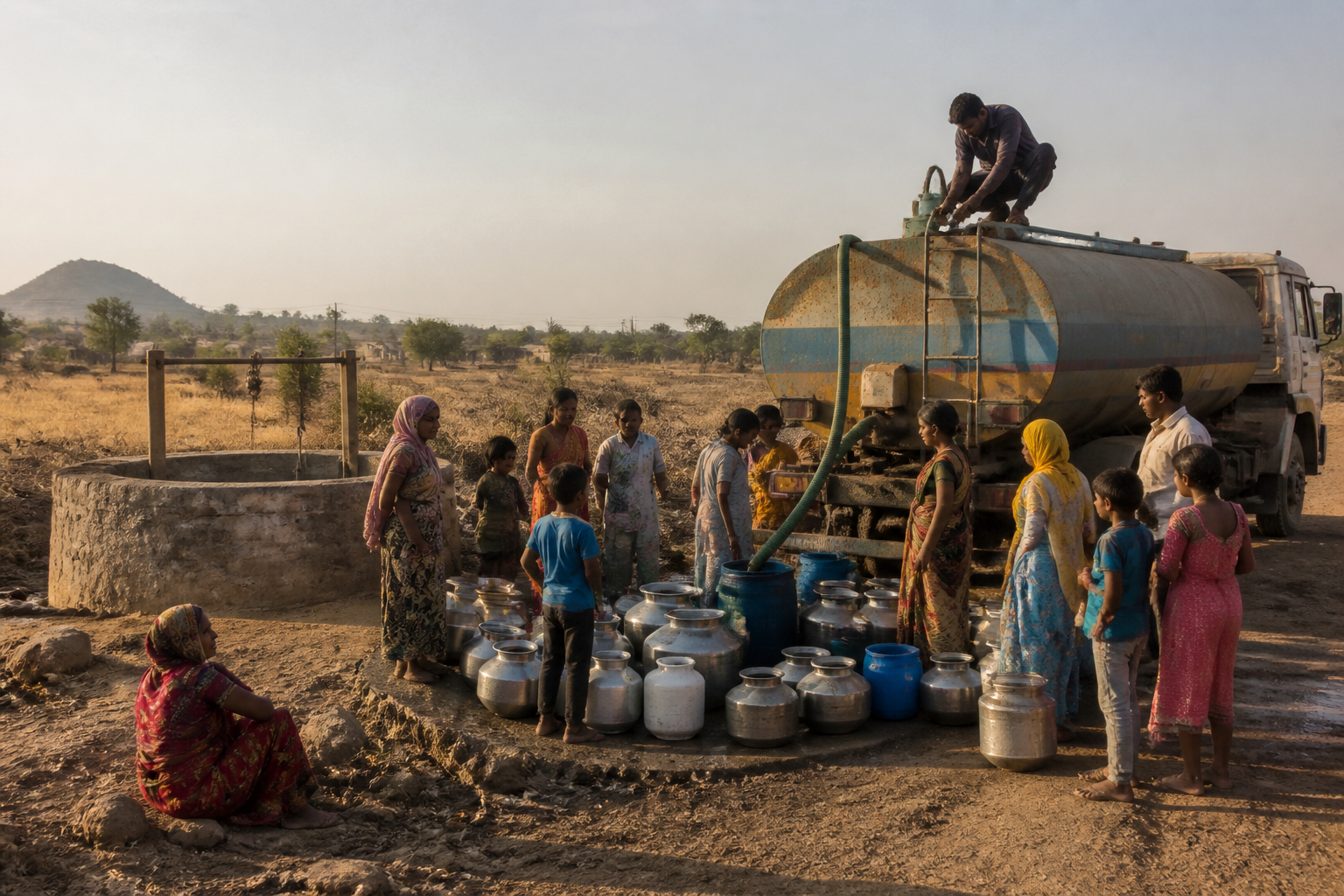
Marathwada’s water crisis is becoming visible before the monsoon has ended, with villages turning to tankers as wells and local water sources run dry. The immediate numbers are stark: 74 of the region’s 76 talukas have been declared drought-affected, 277 tankers are supplying 160 villages, and farmers are paying thousands of rupees to protect crops, livestock and household water supplies. But the deeper issue is not simply a failed monsoon. It is the gap between emergency water delivery and the slower infrastructure needed to make rural settlements less dependent on rainfall and private tankers.
The crisis is unfolding across a region where the distinction between drinking water and livelihood water is difficult to maintain. In Shahapur in Chhatrapati Sambhajinagar, farmer Badrinath Bharat is spending Rs 3,000 a day on two tankers to keep his ginger crop alive. The same water is being used by his family and 10 cattle. He told The Indian Express that his well had dried up and that he had already lost cotton and maize, along with other crops including tomato. His current spending is a short-term gamble: he can continue for about a month in the hope of obtaining some yield, after which he expects to stop.
In Siddhanath Vadgaon, farmer Sachin Bilwal has been buying tanker water for more than a month for his family and three cattle. A tanker costs him Rs 1,000 and lasts about a week. His cotton, maize and tur produced no output because of inadequate rainfall, and the well on his land has also dried up. His village has asked the gram sabha to seek government tanker supplies, but he said many villages were facing a similar situation even before the monsoon had ended.
These accounts show why a tanker count alone does not capture the scale of the problem. Tankers indicate that the administration has created a mechanism for responding to immediate drinking-water shortages. They do not show how much water households are buying privately, how much farmers are spending to keep animals alive, or how many cultivation decisions have already become financially unviable. Nor do they measure the opportunity cost of travelling to distant water sources when local wells fail.
The rainfall figures provide the immediate explanation. Maharashtra received 18 per cent less rainfall than normal, while Marathwada recorded a deficit of 38 per cent. The shortfall was higher in some districts: Latur recorded 48 per cent less rainfall than normal and Parbhani 43 per cent. In a region where agriculture continues to depend heavily on rainfall, these deficits reach beyond crop production. They affect the recharge of wells, the availability of water for livestock and the ability of families to maintain both domestic consumption and farm activity.
The experience of Abasaheb Dinkar Rathod in Govindpur, Jalna, illustrates the limits of farm-level adaptation when the underlying water source fails. Rathod invested in drip lines, mulching and protective covers for a tomato crop spread across an acre, with coriander and ladyfinger on another plot. Yet insufficient rain left him with little more than a few stunted coriander plants and one cart of tomatoes that he expected would fetch less than Rs 100. The technology reduced water use, but it could not compensate for the absence of water.
Rathod’s next decision is constrained by the same problem. He plans to remove the tomato plants and consider another crop during the rabi season, but that choice depends on whether he can find water. He said his area relies mainly on rainfall, there is no irrigation option for farms, and even household use depends on water from a local well two kilometres from his home. The account underlines a crucial distinction in drought response: efficient irrigation equipment can improve the use of available water, but it cannot substitute for reliable water availability.
The state’s emergency response is built around the declaration of drought in 265 of Maharashtra’s 358 talukas. Among the relief measures announced is the deployment of tankers for drinking water wherever required. In the current deployment, Chhatrapati Sambhajinagar has 120 tankers supplying 77 villages, Beed has 127 tankers supplying 65 villages, and Jalna has 22 tankers supplying villages. These figures reveal both the geographical concentration of the emergency and the administrative burden of keeping water moving across dispersed settlements.
They also expose the limits of the current delivery model. Of the 277 tankers deployed in the region, only three are owned by the government. The remaining tankers are operated by private owners and paid for by the state government. This arrangement can provide flexibility during a shortage, but it leaves a basic public service dependent on privately owned vehicles and ongoing administrative payments. The report does not establish whether this model is cheaper or more effective than other options. It does establish that emergency supply is being delivered through a largely outsourced system at a time when demand is expanding.
Officials in Chhatrapati Sambhajinagar said there was no water shortage or water cut in the district at present and that additional tankers would be deployed if required. That statement reflects a difference between district-level assessment and village-level experience. From the administration’s perspective, major reservoirs, including Jayakwadi dam near Paithan, are expected to contain sufficient water for drinking and other domestic requirements. At the settlement level, however, local wells and sources can be dry even when water exists in a large reservoir elsewhere in the system.
This is the central infrastructure problem revealed by the crisis: storage at the regional level does not automatically translate into dependable last-mile access. A reservoir may secure a district’s broad water position, while villages without functioning local sources, completed distribution networks or reliable connections remain dependent on tankers. The two conditions can exist at the same time. The official assurance about reservoir storage therefore does not negate the reported shortage in individual villages; it points to a distribution and access gap between bulk availability and household supply.
The incomplete progress under the Jal Jeevan Mission adds an important institutional dimension. Data from the Marathwada divisional administration indicate that only about half of the work under the scheme has been completed, with lack of funds and other reasons cited for delays. The source does not provide a village-wise breakdown or specify which components remain unfinished. It does, however, place the current tanker dependence alongside a longer-term drinking-water programme that is still incomplete.
That overlap matters because tankers are a response to scarcity, while a functioning water-supply network is intended to reduce the frequency and severity of such emergencies. If scheme works remain incomplete, drought relief must continue to carry a burden that should gradually shift to permanent infrastructure. At the same time, the present evidence does not establish that the Jal Jeevan Mission alone would have prevented the current shortage. The crisis involves rainfall deficits, depleted wells, agricultural water demand, livestock needs and the availability of distribution infrastructure. The incomplete scheme is therefore a significant part of the picture, not a complete explanation.
Marathwada’s current situation also demonstrates how rural water policy is pulled between competing priorities. The administration is focused on drinking water, while farmers are trying to protect crops and livestock. For households such as Bharat’s, these needs are not separate: the same tanker water supports domestic use, animals and cultivation. When a family pays Rs 3,000 a day, it is not merely purchasing irrigation. It is purchasing continuity for an entire household economy whose income, food security and livestock depend on access to water.
The crop losses reported from cotton, maize, tur, tomato and other cultivation show that the crisis has already moved beyond the question of whether a particular village will receive a tanker. It is affecting the viability of the agricultural season. Rathod’s damaged tomato crop and Bharat’s lost cotton and maize also show that investment in inputs does not guarantee resilience when rainfall and local water sources fail. In both cases, farmers made decisions based on the expectation that available water would be sufficient, but the physical water system did not support those plans.
The evidence confirms three layers of the emergency. First, rainfall deficits have reduced the water available to farms and local sources. Second, households and farmers are bridging the gap through tankers, often at substantial personal cost. Third, the permanent systems intended to improve household water access remain incomplete in much of the region. The immediate response is therefore functioning, but it is operating in a landscape where the underlying sources and infrastructure are under stress.
What remains uncertain is the duration of the tanker requirement, the condition of the major reservoirs as the season progresses, the number of additional villages seeking supplies and the pace at which pending Jal Jeevan Mission works will be completed. Those are the next indicators to watch. For now, Marathwada’s water crisis shows that declaring drought and deploying tankers can address an emergency, but neither measure resolves the structural distance between water stored in the system and water that reaches a village, a farm or a household when local sources run dry.
