


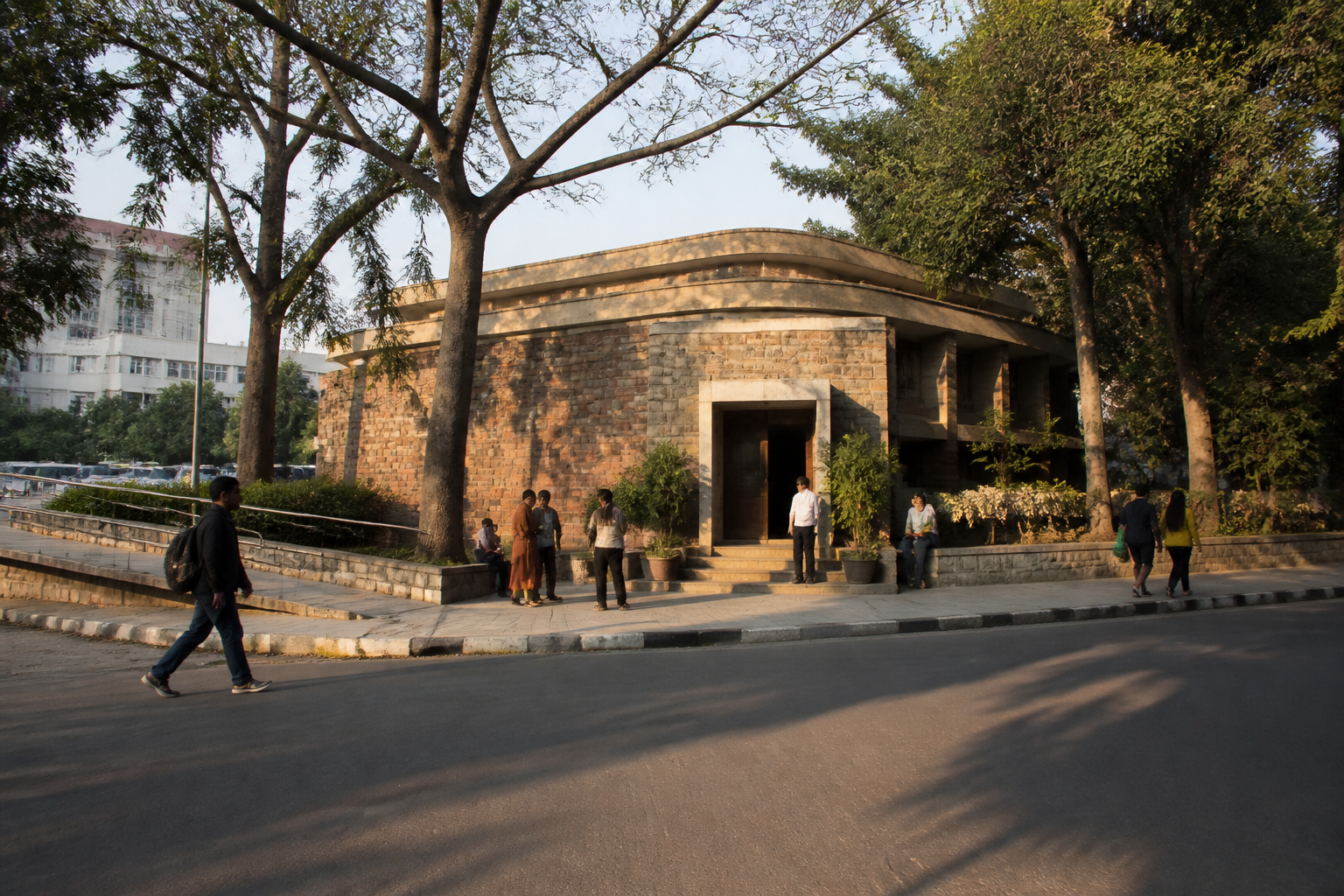
The Delhi High Court’s stay on eviction proceedings against Akshara Theatre has temporarily protected one of the capital’s most distinctive cultural spaces, but the dispute exposes a larger problem: Delhi has never developed a durable framework for protecting institutions whose public value extends beyond the land they occupy. Akshara is not only a 54-year-old theatre on Baba Kharak Singh Marg. It is an example of how a small, affordable and artist-led venue can become part of a city’s social infrastructure.
The proceedings were initiated by the Land and Development Office of the Union Ministry of Housing and Urban Affairs against the theatre, which stands on a 0.72-acre plot adjacent to Ram Manohar Lohia Hospital. The court’s intervention followed a long history of uncertainty over the site. According to the account of Anasuya Vaidya, daughter of founders Gopal Sharman and Jalabala Vaidya, the theatre has faced eviction threats since the Emergency in 1975-76. Notices were issued under successive governments, and on earlier occasions the proposed action was deferred or set aside.
That history matters because it shows that Akshara’s current predicament is not an isolated administrative action. The theatre has survived repeated changes in political leadership, but its continued existence has depended on interventions rather than a settled institutional arrangement. The result is a cultural landmark that has operated for more than five decades while remaining vulnerable to the changing interpretation of land use, occupation and public purpose.
Akshara opened on March 11, 1972, as a 50-seat theatre. Its origins lay in the work of Sharman and Vaidya, who had toured Europe and the United Kingdom with their production Full Circle in 1969-70. The Indian government subsequently agreed to provide the couple with accommodation in Delhi and offered them several sites. They chose the location where Akshara now stands.
The theatre was expanded in 1994 after the government provided additional space. Its physical design reflects the founders’ attempt to build a venue suited to intimate performance rather than large-scale commercial entertainment. Sharman used carved Dholpur stone and designed the structure like a musical instrument. A family of masons and carpenters worked under his supervision on a teak and rosewood stage, while pine, cedar and deodar were used in the seating area to shape the acoustics. Even the amphitheatre’s chairs were designed by Sharman with metal workers.
This architectural history is important to the land dispute because Akshara’s value cannot be measured only by its plot size or seating capacity. The theatre’s design, acoustics and scale are inseparable from its role. A 50-seat venue offers a different kind of urban cultural experience from a large auditorium: performers and audiences share a closer physical relationship, productions can be staged with fewer resources, and emerging artists can access a platform that would otherwise be difficult to afford.
The theatre’s institutional role developed alongside its physical form. Its first production was the Ramayana, and Akshara later took performances to Hyderabad, Visakhapatnam, Chandigarh and Jammu. It became a venue for independent theatre, college festivals, children’s programmes and emerging performers. The account supplied by the Indian Express also notes that stand-up comedy in Delhi took some of its first steps there, while young artists received access to props and costumes.
In 2013, when the National School of Drama cancelled two Pakistani plays, Akshara hosted one of them, Ajoka Theatre group’s Kaun Hai Yeh Gustakh, based on the life and legacy of Saadat Hasan Manto. The venue also hosted a theatrical reading and performance linked to Fifty Shades of Grey. These examples show the theatre functioning as a space for work that did not always fit established institutional or commercial circuits.
Sunit Tandon, a theatre personality quoted in the report, described Akshara as one of Delhi’s few intimate and affordable theatre spaces, particularly for young performers and stand-up comedians. He also said it may be the only brick-and-mortar theatre in India to have staged the Ramayana on Dussehra and Ram Navami continuously for more than 50 years. His account places Akshara within a cultural network that includes not only professional theatre but also religious performance, education, comedy, children’s work and experimental programming.
That combination gives the site a form of public value that conventional land administration may struggle to recognise. Government land systems generally need clear categories: residential, institutional, commercial, public or government use. Cultural spaces, however, often occupy a more complex position. They may be privately managed but publicly accessible; historically significant but financially modest; and dependent on low rents or concessional arrangements while producing benefits that are distributed across a city.
Akshara’s story illustrates this ambiguity. It was founded by a theatre couple, but its reported beneficiaries have included artists, students, children, audiences and cultural groups. Its patrons have included several former prime ministers and members of the Nehru-Gandhi family. Yet the presence of prominent visitors has not converted the theatre into a secure national cultural institution. Its survival has instead remained tied to the decisions of the land-owning authority and the ability of its managers to contest eviction.
The dispute therefore raises a question about the relationship between land ownership and cultural stewardship. If a public authority provides land or accommodation for a cultural purpose, what obligations continue after the founding generation changes? Sharman died in 2016 and Jalabala in 2023. Their daughter, filmmaker and theatreperson Anasuya Vaidya, is now leading the effort to protect the theatre. The transition exposes a recurring weakness in cultural governance: institutions often depend on individual founders, while legal and administrative systems do not always provide a clear mechanism for succession.
The report does not establish the legal basis of the eviction proceedings or the precise claims made by the Land and Development Office. It does establish that the proceedings were stayed by the Delhi High Court and that the theatre’s current management is contesting the threat. That distinction is important. The cultural case for preservation may be compelling, but the eventual outcome will also depend on the documents governing the site, the terms under which the land was allotted or occupied, and the court’s assessment of the eviction process.
This is where Delhi’s broader planning challenge becomes visible. The city has major cultural institutions, but many smaller venues operate in adapted, leased or institutionally uncertain spaces. Their contribution is often recognised only when closure becomes imminent. By then, the venue’s networks, audiences and accumulated memory may already be difficult to recreate elsewhere. A replacement auditorium, even if larger or newer, would not automatically reproduce Akshara’s scale, affordability, acoustics or history.
The location adds another layer. Akshara stands in a central Delhi setting next to Ram Manohar Lohia Hospital, where land is likely to face competing institutional demands. The report does not say that the theatre’s land is required for a specific expansion or public project. That absence is itself significant: the available material records the eviction proceedings but does not establish the development rationale behind them. Any decision affecting the site will therefore need to clarify not only the legal status of the occupation but also the stated public purpose of removing the theatre.
The institutional question is equally important. The land is under the administrative ambit of the Union housing and urban affairs ministry through the Land and Development Office, while cultural activity at the site has been developed by a theatre organisation and its founders. This division means that the agency controlling land may not be the agency best placed to assess cultural value. Without coordination between land administration and cultural authorities, a long-running public institution can be treated primarily as a property case.
Akshara’s five-decade record provides evidence of continuity. It opened in 1972, expanded in 1994, and has hosted performances, festivals and programmes across generations. The theatre also survived earlier eviction notices during the Emergency, the Janata government and the period after Indira Gandhi returned to power. These episodes do not settle the present legal dispute, but they demonstrate that the question of the site has repeatedly outlasted individual administrations.
The central urban lesson is that cultural infrastructure is not limited to museums, national academies or large performance complexes. Small venues can perform essential functions that formal cultural policy may overlook. They provide entry points for new artists, allow audiences to gather at modest cost and support forms of experimentation that require less capital but depend heavily on continuity. Their contribution is measured not only in ticket sales or built-up area but also in the communities and careers they help sustain.
For now, the Delhi High Court’s stay has kept Akshara open while the dispute proceeds. What remains uncertain is whether the court proceedings will produce a long-term resolution or another temporary reprieve. The next significant developments will be the legal arguments over the eviction action, the land documents governing the theatre and any response from the Union housing and urban affairs authorities. Until those questions are answered, Akshara remains both a functioning theatre and a test of whether Delhi’s land administration can account for cultural institutions whose public value has accumulated over decades.
