


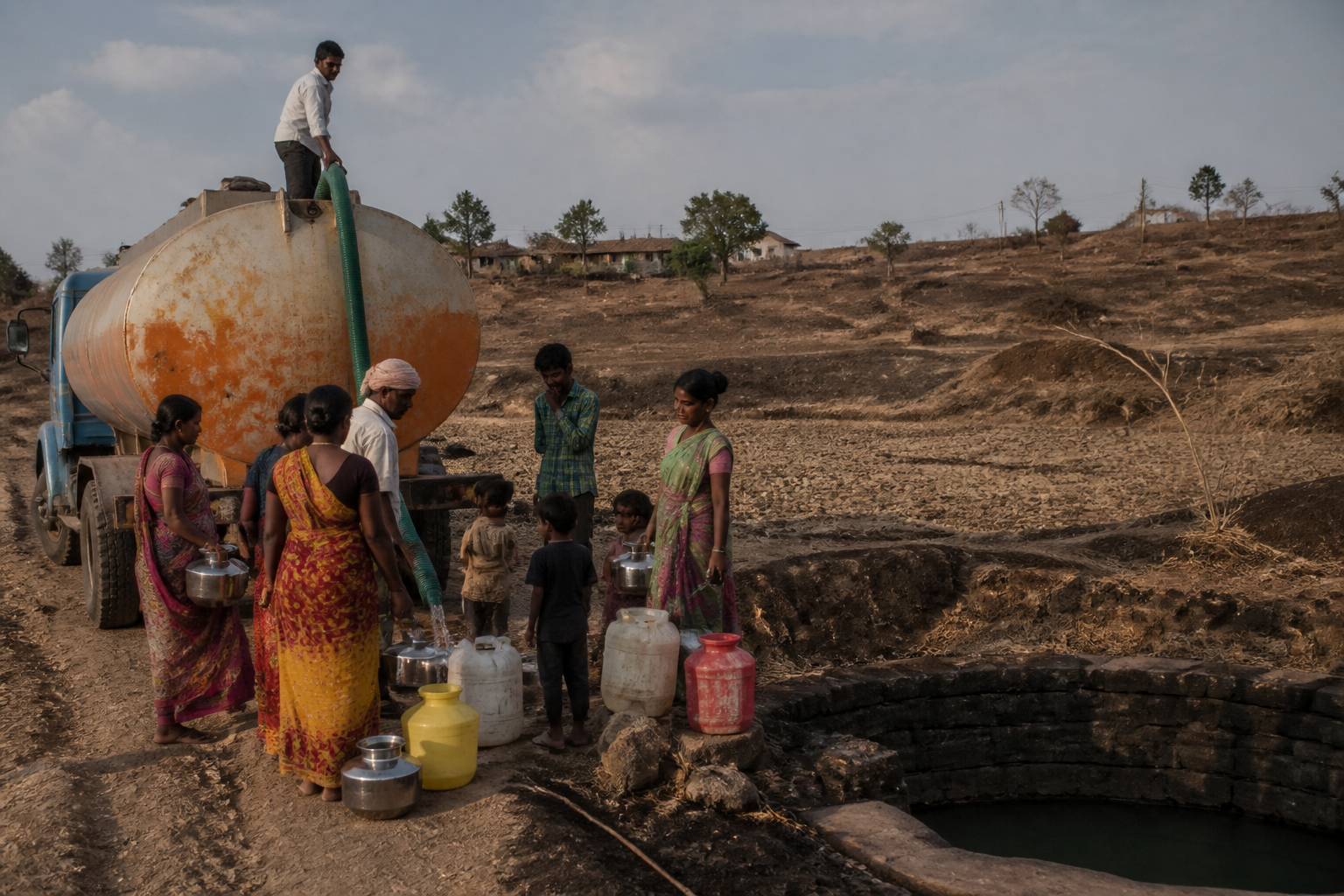
The Marathwada water crisis is arriving before the monsoon has ended. Across drought-affected villages, wells and local sources are running dry, farmers are paying privately for tanker water, and the state’s formal response is expanding even as the infrastructure meant to provide regular household supply remains incomplete.
The immediate figures show the scale of the problem. Seventy-four of Marathwada’s 76 talukas have been declared drought-affected. As reported by The Indian Express, 277 tankers are supplying water to 160 villages, with more villages seeking tanker support. The deployment is concentrated in the districts facing the sharpest visible stress: 120 tankers are supplying 77 villages in Chhatrapati Sambhajinagar, while 127 tankers are serving 65 villages in Beed. Jalna has 22 tankers operating in villages.
These numbers are not simply a measure of emergency logistics. They show how rural water security is being managed when local sources fail: through a temporary, vehicle-dependent system that has to reach scattered settlements, respond to applications and continue for as long as the shortage lasts. Of the 277 tankers deployed in the region, only three are government-owned. The remaining vehicles are operated by private owners and paid for by the state government.
That arrangement allows the administration to move water quickly, but it also reveals a structural dependence. The state can procure transport when a village is declared in need, yet that is different from having a reliable local distribution network, functioning sources and household connections. Tankers address the immediate availability of water; they do not restore a dry well, replenish a failed source or complete a delayed piped-water scheme.
The rainfall deficit explains the pressure on those sources. Maharashtra received 18 per cent less rainfall than normal this year, while Marathwada recorded a deficit of 38 per cent. The shortfall was higher in some districts: Latur recorded 48 per cent less rainfall than normal and Parbhani 43 per cent less. The regional averages conceal the way water stress is experienced locally, particularly in villages that depend heavily on rainfall and have limited irrigation alternatives.
The accounts of farmers quoted in the report illustrate that difference between regional water availability and village-level access. In Shahapur in Chhatrapati Sambhajinagar, farmer Badrinath Bharat is spending Rs 3,000 a day on two tankers to keep his ginger crop alive. The same water is used by his family and 10 cattle. He said he had already lost cotton and maize crops, as well as tomato, and that his well had dried up. He has been paying for tankers for 15 days and expects to stop if the crop does not justify the expense.
In Siddhanath Vadgaon, farmer Sachin Bilwal has been buying tanker water for more than a month for his family and three cattle. He pays Rs 1,000 for a tanker that lasts about a week. Bilwal cultivated cotton, maize and tur but said the crops produced no output because of inadequate rain. His request for government tanker supply had been made through the gram sabha, with the expectation that assistance would be arranged.
These cases place the water crisis at the intersection of domestic supply, livestock care and agricultural survival. A tanker brought for household use may also be needed for cattle. Water purchased to protect a crop competes with the family’s daily needs. The financial cost is therefore not limited to the price of transport. It includes lost crops, sunk investment in cultivation and the decision about which use can be sustained for another week or month.
The experience of Jalna’s farmers further shows why rainfall-dependent agriculture remains vulnerable even when farmers invest in water-saving methods. Abasaheb Dinkar Rathod of Govindpur had installed drip lines, used mulching and placed protective covers over a tomato crop. He also cultivated coriander and ladyfinger. But the rain did not arrive, leaving little more than stunted coriander plants and a single cart of tomatoes that he expected would fetch less than Rs 100.
The investment in drip irrigation could reduce water use where water is available. It cannot substitute for the water source itself. Rathod told The Indian Express that there was no irrigation option for his farms and that even personal use depended on water from a local well two kilometres from his home. His decision about a rabi crop is consequently tied to whether he can find water, not only to the price of seed, labour or market conditions.
This is the central institutional gap exposed by the current emergency. The administration in Chhatrapati Sambhajinagar says there is no water shortage or water cut in the district at present and that additional tankers will be deployed if required. At the same time, villages within the district are reporting dry wells and relying on 120 tankers. Both statements can coexist because they refer to different levels of the system: district-level reservoir and administrative assessments on one side, and the condition of individual village sources on the other.
The administration has also said that water stored in major reservoirs, including the Jayakwadi dam near Paithan, will be sufficient for drinking and other domestic requirements. Reservoir storage, however, is only one part of the supply chain. Water must still be accessed, treated where required, transported or piped, distributed and delivered to households. A reservoir-level assurance does not automatically mean that every village well, local source or incomplete connection is functioning.
The delayed implementation of the Jal Jeevan Mission makes that distinction particularly important. Data from the Marathwada divisional administration cited in the report shows that only about half of the work under the scheme has been completed in the region. Lack of funds and other reasons have been cited for the delay. The mission’s unfinished works therefore sit alongside a drought-relief system that is already being activated at scale.
This does not mean that a completed piped-water scheme would eliminate drought risk. A distribution network also depends on a sustainable source, and a rainfall deficit can affect source availability. But incomplete works leave villages more dependent on wells, local sources and emergency tankers precisely when those sources are under stress. The result is a layered vulnerability: weak rainfall reduces availability, inadequate local infrastructure limits alternatives, and private tanker procurement transfers part of the burden to the state and, in some cases, directly to farmers.
The state’s drought response was formally framed around relief measures after Maharashtra declared drought in 265 of its 358 talukas. Among those measures is the deployment of drinking-water tankers wherever required. The scale of present deployment suggests that the declaration has moved from administrative classification to an operational challenge involving route planning, private contractors, payments, monitoring and repeated requests from villages.
The fact that only three of the 277 tankers are government-owned also raises an administrative question about how emergency water delivery is organised, although the supplied report does not provide details on contracts, payment rates, monitoring or delivery frequency. What is established is that the system depends overwhelmingly on private vehicles while the government bears the cost. That makes tanker deployment a crucial relief instrument, but not a substitute for durable public water infrastructure.
The evidence also shows why counting tankers alone is an incomplete way to measure the crisis. A tanker’s presence indicates that water is reaching a village, but not whether the quantity is sufficient, whether every household can access it, how far residents must travel, or how much water is available for livestock and crops. Bilwal’s Rs 1,000 tanker lasts about a week; Bharat’s two tankers cost Rs 3,000 a day because they are also being used to protect a crop. The same intervention therefore has sharply different meanings depending on the household’s livelihood and water demand.
Marathwada’s current emergency is consequently a test of the distinction between drought relief and water security. Relief can be activated through tankers, while water security requires functioning sources, completed networks and enough institutional capacity to maintain supply beyond the immediate shortage. The report confirms that the state has reservoir reserves and a mechanism for deploying tankers, but it also documents dry wells, crop losses, household expenditure and incomplete piped-water works.
The developments to monitor are therefore concrete: whether tanker coverage expands to the additional villages seeking assistance; whether the administration’s assessment of reservoir sufficiency translates into dependable village-level supply; how long private tanker operations continue; and whether the incomplete Jal Jeevan Mission works receive the funds and administrative attention needed for completion. Until those questions are answered, Marathwada’s water crisis will remain visible not only in official drought figures, but in the daily cost of keeping families, livestock and crops alive.
