


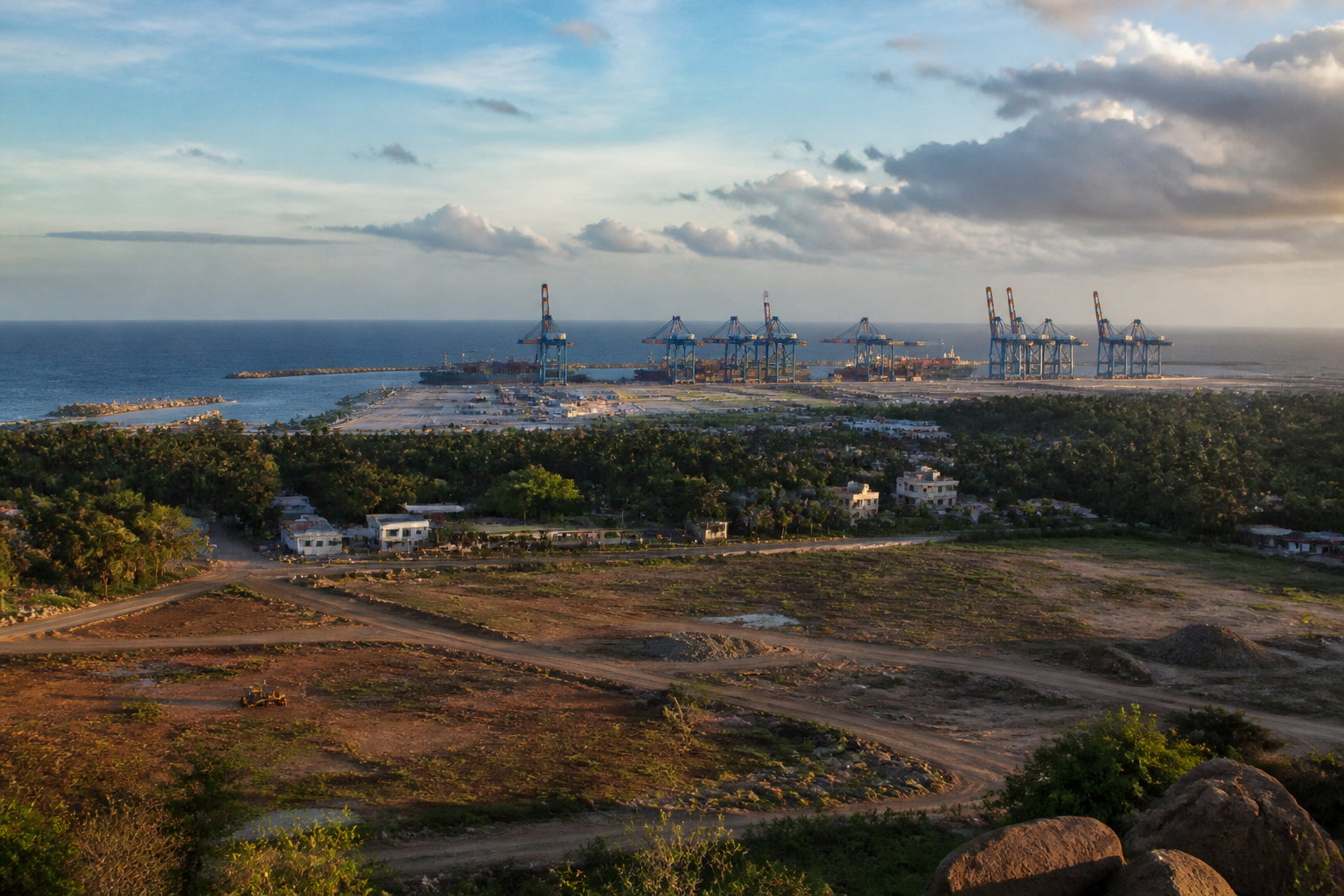
Kerala’s plan to revise negotiated land purchase norms for the Vizhinjam port region is more than an administrative adjustment. It is an attempt to solve one of the most difficult parts of port-led development: assembling sufficiently large, connected parcels of land in a densely settled state where ownership is fragmented and voluntary negotiations can take time.
The state government is preparing a new framework intended to make compensation more attractive to landowners and reduce delays in acquiring about 500 acres identified in Thiruvananthapuram district. The land is expected to support industrial parks, logistics facilities and other infrastructure linked to Vizhinjam International Seaport. The industries and revenue departments are working on the changes, with a government order expected to enable acquisitions under the revised norms.
The proposal places land assembly at the centre of Vizhinjam’s next phase. A port can increase maritime trade capacity, but the wider economic benefits depend on what happens around it: whether cargo can be stored, processed and moved efficiently; whether logistics facilities are available near the port; and whether industrial uses can be organised on land with adequate transport connections. The government’s stated objective is to create an industrial ecosystem that can use the port’s growing maritime activity.
The immediate question is not whether Vizhinjam has strategic potential. It is whether the state can acquire and prepare land at the scale and speed required to convert that potential into functioning logistics and industrial infrastructure.
The land-acquisition problem
According to the report, around 500 acres have been identified in the Neyyattinkara and Kattakada taluks. Kinfra is overseeing the identification of suitable parcels, which are being assessed for industrial parks and logistics-related facilities. The assessment includes road and rail connectivity, proximity to the port and the requirements of prospective industries.
This approach suggests that the land is not being treated as a single uniform development site. Different parcels may serve different purposes depending on their location and access. Sites with suitable railway connectivity could support freight-oriented facilities, while other areas could accommodate warehouses, logistics parks and industrial units.
That distinction matters because port-led development is not created simply by acquiring acreage. The usefulness of each parcel depends on its relationship with the port and with the transport network beyond it. A warehouse without reliable road access, or an industrial site without an efficient freight connection, may add land to the project without adding equivalent logistical capacity.
The government had earlier explored land pooling as a mechanism for planned development along the proposed outer area growth corridor. The report identifies several obstacles to that model in Kerala, including high population density, fragmented landholdings and the need to coordinate with numerous individual landowners. The shift towards negotiated purchase is therefore an administrative response to a specific land-market condition: the difficulty of assembling large, contiguous areas through a model that requires broad coordination among owners.
Negotiated purchase changes the state’s role from relying on a wider pooling arrangement to reaching individual agreements with willing sellers. The proposed revision is intended to make those agreements more attractive by improving the terms available to landowners. The state’s expectation is that better compensation and a simpler process will encourage voluntary sales and reduce the time spent in negotiations.
The compensation question
The credibility of the revised framework will depend on how it addresses valuation and compensation. The supplied report does not specify the proposed rates, valuation formula or procedural safeguards. It does establish, however, that valuation-related work and discussions with landowners are already part of the preparatory process.
That makes compensation the central operational link between the government’s industrial ambition and the landowner’s decision to sell. If the terms are not considered sufficiently attractive, the state may continue to face delays even after identifying the land. If the terms are accepted widely, negotiated purchase could allow Kinfra to assemble land without relying on a more complex land-pooling arrangement.
The state is also attempting to reduce uncertainty over timing. Additional chief secretary of the industries department A P M Mohammed Hanish told The Times of India that the government was moving forward with the proposal and would begin acquiring land already identified once the government order was issued. He said the proceedings were planned for completion as soon as possible.
That statement points to a sequence of administrative milestones: finalising the revised provisions, issuing the government order, completing negotiations and valuation, acquiring the identified parcels, and then developing the land into industrial infrastructure. The report does not provide a completion date for the acquisitions or identify the number of landowners involved.
From port to production network
The proposed uses show how the state is defining port-led industrialisation. The plan includes container freight stations, warehouses, logistics parks, processing units and manufacturing facilities. These are not interchangeable assets. Container freight stations support cargo handling and consolidation; warehouses provide storage; processing and manufacturing units create additional activity around goods moving through the port.
Together, these facilities could form a network around Vizhinjam rather than a single port-side project. The report describes the objective as establishing industries and logistics facilities that can capitalise on the port’s growing maritime trade. It also indicates that the locations will be assigned different roles according to their physical characteristics and connectivity.
However, the current information confirms planning and land identification, not completed industrial capacity. The 500 acres remain a target for acquisition, while Kinfra is expected to develop the land after it is acquired. The distinction is important: a budget allocation and a land strategy are enabling steps, but they do not by themselves establish operating logistics parks or manufacturing units.
The financial commitment
The 2026-27 state budget allocated Rs 1,000 crore to Kinfra for land acquisition linked to port-led industrial development. This allocation gives the programme a defined financial base for the acquisition stage. It also indicates that the state views land assembly as a major public investment requirement rather than a secondary task after port construction.
The relationship between the allocation and the 500-acre target is not detailed in the report. No parcel-wise acquisition cost, land valuation or expenditure schedule is provided. It is therefore not possible from the available information to determine how much of the allocation would be spent on purchase, how much would remain for site preparation, or whether additional funding would be required for industrial infrastructure.
Those details will become important as the programme moves from identification to execution. The cost of land, the number of separate transactions, the availability of road and rail connections and the infrastructure needed to prepare each site will shape how far the allocation can take the project.
Kinfra’s institutional role
Kinfra is positioned as the key implementing corporation in the land programme. It is identifying suitable parcels and is expected to develop acquired land into industrial infrastructure. This gives the corporation responsibility across two linked stages: finding land that meets the project’s requirements and converting that land into usable industrial sites.
The arrangement also places coordination between departments at the heart of the programme. The industries department is working with the revenue department on the revised purchase provisions, while Kinfra is handling site identification and preparing for discussions with landowners. The eventual outcome will depend on whether these functions move in sequence without creating fresh administrative delays.
The proposed framework may therefore be read as a governance reform as much as a land-acquisition measure. It seeks to align compensation rules, departmental responsibilities and the development role of Kinfra around a single port-linked objective. The available material does not establish whether a separate authority will coordinate the wider industrial ecosystem or how future operators will be selected.
The larger urban question
Vizhinjam’s industrial expansion raises a wider question for Kerala’s urban and regional planning: how can major transport infrastructure generate economic activity without treating land as an unlimited or easily assembled resource?
The state’s dense settlement pattern and fragmented ownership make that question particularly visible. The proposed reliance on negotiated purchase acknowledges that local land conditions cannot simply be overridden by the scale of a national or international port project. Instead, the industrial strategy is being adapted to the realities of individual ownership and voluntary participation.
At the same time, the plan’s success will be measured not only by the number of acres acquired but by whether the resulting sites are connected, serviced and occupied by the facilities they are intended to support. The report confirms the government’s plan, the identified land, the budget allocation and the proposed policy change. It does not yet establish the final compensation terms, the acquisition timetable, the number of completed agreements or the schedule for operationalising the planned facilities.
The next decisive step is the government order revising the negotiated purchase norms. After that, the progress of landowner negotiations, valuation, parcel acquisition and Kinfra’s site-development work will show whether Vizhinjam’s port-led industrialisation strategy can move from a land plan to a functioning logistics and manufacturing network.

