


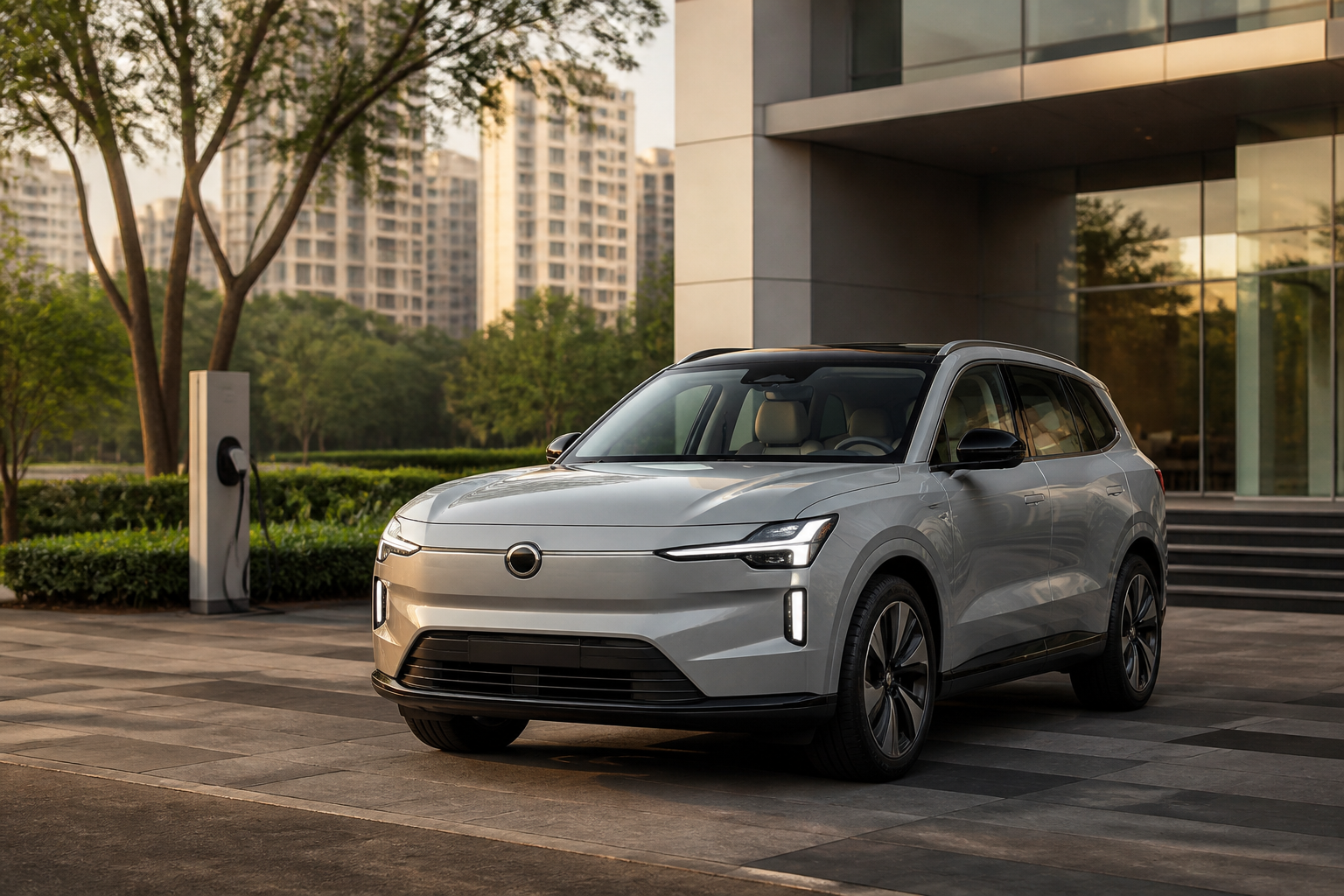
Volvo’s EX90 launch in India is not merely a new luxury electric SUV entering a crowded market. It is a test of whether aggressive pricing, advanced vehicle technology and a future delivery schedule can help a smaller premium automaker regain ground in a segment increasingly dominated by BMW, Tesla and Mercedes-Benz.
Volvo Cars India launched the six-seat EX90 at ₹1.26 crore, positioning it below the Kia EV9 GT-Line at ₹1.30 crore and the Mercedes-Benz EQS SUV 580 at ₹1.49 crore. The pricing gives Volvo a clear entry point in the premium electric-SUV market, but the company will have to wait until January 2027 to begin deliveries. Customer drives are scheduled to start in November, creating an opportunity to build bookings during the festive season before the vehicle reaches buyers.
That gap between launch and delivery is central to the EX90’s commercial prospects. In a fast-changing electric-vehicle market, a product can attract attention at launch but still struggle to convert that interest into registrations if customers must wait several months. The delay also means the EX90 will make no immediate contribution to Volvo’s sales performance, even as competitors continue to add vehicles to the market.
The numbers show why Volvo is seeking a stronger position. According to Vahan data cited in the report, India’s luxury EV segment expanded 61 per cent to 5,404 vehicles in FY26. Volvo’s share, however, declined to 7 per cent from 12 per cent a year earlier. The fall came even as the overall market grew, indicating that the company’s challenge is not a lack of demand for luxury electric vehicles but its ability to capture that demand.
BMW has emerged as the segment’s strongest player. It registered 3,537 electric vehicles in FY26, accounting for nearly two-thirds of the luxury EV market. The concentration was also visible in September 2026, when BMW, Tesla and Mercedes-Benz together accounted for approximately 94 per cent of luxury EV registrations. Volvo registered 45 electric vehicles during the month, giving it a 4.6 per cent share.
The broader luxury-car figures underline the scale of the gap. Seven luxury carmakers—BMW, Mercedes-Benz, JLR, Tesla, Volvo, Porsche and Lamborghini—registered a combined 4,534 vehicles in September. BMW led with 1,955 units, followed by Mercedes-Benz with 1,527 and JLR with 573. Volvo recorded 126 registrations across its overall portfolio, placing it well behind the leading brands.
The EX90 therefore enters a market where the problem is not simply product availability. It is visibility, distribution, customer confidence and the ability to maintain a reliable ownership experience. Volvo Managing Director Jyoti Malhotra has identified brand positioning, customer experience, dealership expansion and charging infrastructure as priorities for rebuilding sustainable sales growth. Those priorities point to the wider urban system surrounding a premium EV: the vehicle is only one part of the purchase decision.
On specifications, the EX90 is designed to compete directly with the Kia EV9 and Mercedes-Benz EQS SUV 580. It has a 106 kWh battery and produces 456 PS. Volvo claims a 10–80 per cent DC charging time of 22 minutes, compared with 24 minutes for the Kia. Both vehicles use 800-volt electrical architectures. The Kia is marginally quicker from 0–100 km/h, at 5.3 seconds against 5.5 seconds for the Volvo.
The Mercedes-Benz model offers a larger 122 kWh battery, 544 PS, seven seats and a 4.7-second acceleration time. Its claimed 10–80 per cent charging time is 31 minutes. It also has an ARAI-certified range of 809 km, while Volvo claims 625 km under the WLTP cycle. Because the two figures use different testing cycles, they cannot be directly compared, but the comparison demonstrates the complexity of luxury EV purchasing, where battery capacity, seating, charging speed, range claims and price compete simultaneously.
Volvo is also using ownership incentives to support the EX90’s launch. Bookings made by December 31 include an 11 kW home charger and three years of servicing. Dealers are offering a 65 per cent buyback value after three years. These measures address two practical concerns for premium EV buyers: the cost of setting up home charging and uncertainty about resale value.
The home charger offer is particularly relevant to how electric vehicles are used in Indian cities. For many private buyers, reliable overnight charging at home can reduce dependence on public charging networks. But that model is less straightforward for residents in apartment buildings, mixed-use developments and older housing societies, where parking ownership, electrical capacity and installation permissions can complicate charger deployment. The source material does not establish how Volvo will address those differences, but the company’s emphasis on charging infrastructure indicates that the issue has become part of its market strategy.
The EX90’s price advantage may also be vulnerable to cost pressures outside the showroom. Rising shipping and transportation costs have increased logistics expenses, according to industry sources cited in the report. Volvo had already raised prices by up to ₹1 lakh in May, and further revisions remain a possibility if those costs persist. For an imported luxury EV, maintaining a headline price is therefore partly a logistics and supply-chain challenge rather than only a marketing decision.
This is where Volvo’s launch intersects with the broader economics of India’s premium EV market. A lower price can narrow the gap with rivals, but it cannot by itself overcome delayed deliveries, limited registrations, uneven dealership reach or questions about service access. Nor can advanced specifications guarantee market share when buyers are also assessing charging convenience, resale value and confidence in the brand’s long-term presence.
Volvo’s wider India business reflects these pressures. Overall registrations declined 2 per cent to 1,647 in FY26. They recovered 4 per cent to 874 during January–June 2026, while the nine-month tally reached 1,262. The company also teased the ES90 electric sedan, signalling a return to the luxury-sedan segment after discontinuing the S90 in June 2025. The move suggests an effort to rebuild a broader electric portfolio rather than rely on one SUV.
Yet portfolio expansion can create its own operational demands. More models require product support, trained dealerships, parts availability and charging guidance across a market where volumes remain relatively small. The source material identifies dealership expansion and customer experience as priorities, but does not provide a rollout target or details of planned investments. That leaves implementation, rather than product ambition, as the key unresolved part of Volvo’s strategy.
The September data also show that luxury EV demand is expanding but not evenly distributed. Of 4,534 luxury-car registrations by the seven manufacturers, 975 were electric vehicles. BMW registered 502 electric vehicles, Tesla 291 and Mercedes-Benz 125. Volvo’s 45 registrations were a small fraction of the total. The evidence suggests that the market is rewarding brands that have already built recognition and sales momentum in electric vehicles, making it harder for a smaller player to convert a new launch into rapid share gains.
For cities, this competition matters even though the vehicles occupy the premium end of the market. Luxury EVs are early indicators of how charging expectations, home-energy systems, dealership networks and resale markets are developing. They also reveal that the transition to electric mobility is not defined only by vehicle sales. It depends on the coordination of manufacturers, building managers, electricity systems, service networks and public and private charging providers.
The EX90 gives Volvo a technically competitive flagship and a price position below two major rivals. But the available evidence shows that its challenge is structural: the company must translate a launch announcement into deliveries, registrations and repeatable customer confidence while managing logistics costs and strengthening the support system around the vehicle.
The next measurable milestones will be customer drives from November, deliveries beginning in January 2027, the response to the introductory package and Volvo’s progress on dealerships and charging infrastructure. Until those steps produce higher registration volumes, the EX90 will remain a strong product intervention in a market where BMW, Tesla and Mercedes-Benz continue to set the pace.

