


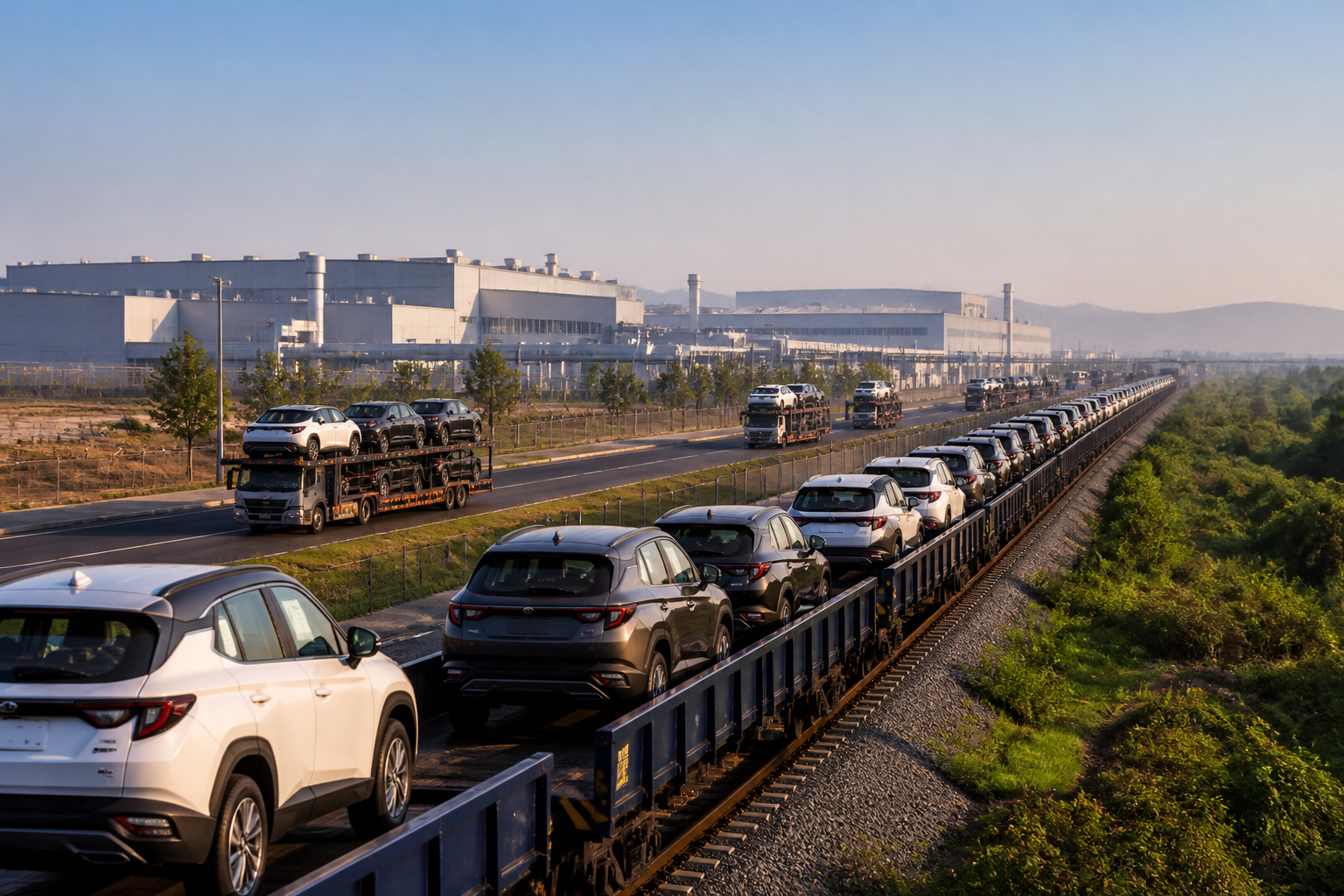
Hyundai Motor India’s expansion of its Talegaon plant is more than a capacity addition by a carmaker. It is a test of whether an industrial location in Maharashtra can combine factory scale, rail connectivity and port access to support India’s transition from a domestic automobile market into a larger export platform.
The company is accelerating production at Talegaon, which began passenger vehicle manufacturing in October 2025. Its installed annual capacity is 170,000 vehicles, while Hyundai’s Chennai facilities can produce 824,000 units. Together, the two locations give the company an Indian manufacturing footprint of 994,000 vehicles, close to the one-million-unit threshold. Hyundai plans to increase total annual capacity to 1.14 million units by 2030.
The investment sits within the company’s ₹45,000 crore India roadmap, which includes 26 product launches by FY2030. Hyundai is also targeting exports of approximately 30 per cent of vehicles produced in India. Those figures place Talegaon within a wider industrial strategy: the plant is not being developed only to serve domestic demand, but to become a production base for vehicles sold across multiple international markets.
That shift matters because manufacturing capacity does not automatically become export capacity. It must be supported by product allocation, utilisation, freight movement and access to ports. Talegaon’s role is emerging through that combination. The facility has dispatched more than 62,000 Venue SUVs in its first six months of operations, supported by rail connectivity and export logistics through Mumbai Port.
## Capacity is being reorganised, not simply added
The most important operational change is the relocation of Venue production to Talegaon. By moving the model, Hyundai has freed capacity at Chennai for two upcoming products: the Bayon petrol-powered midsize SUV and a compact electric SUV expected in FY2026-27. Both are planned for production at Chennai, according to Hyundai Motor India Managing Director and Chief Executive Officer Tarun Garg’s comments to investors.
This allocation shows how a two-plant system can be used to manage different stages of growth. Talegaon is being positioned around a high-volume model with export potential, while Chennai receives new products that can increase utilisation of existing assets. The strategy avoids treating each plant as an isolated unit. Instead, production is being distributed across the network according to vehicle type, market opportunity and available capacity.
The company is advancing third-shift operations at Talegaon to October 1, nearly two years earlier than initially planned. At Chennai Plant 1, utilisation is estimated at about 72 per cent in 2026 and is expected to rise to 90-92 per cent in 2027 as production of new models increases. These figures reveal the immediate challenge behind the expansion: the value of a new plant depends on how quickly it reaches efficient utilisation.
Talegaon’s planned capacity is expected to rise to 250,000 units by 2028 and 320,000 units by 2030. The step-up is substantial compared with its current installed capacity of 170,000 vehicles. It also means that the plant’s long-term importance will depend on whether Hyundai can build a sufficiently broad and stable order book rather than rely on one model or one market.
## The export opportunity is concentrated in SUVs
Hyundai’s product mix explains why the Venue is central to the Talegaon strategy. The new-generation Venue will be produced exclusively at Talegaon and exported to around 35 markets, compared with 28 markets for the outgoing generation. By July, the company had received orders from more than 30 international markets.
Hyundai aims to raise annual Venue exports from approximately 6,500 units to between 15,000 and 20,000 units. The target is significant because SUVs represent only 13-14 per cent of Hyundai’s exports, while they account for roughly 70 per cent of its domestic sales. The gap suggests that Hyundai’s Indian export mix has not yet matched the preferences driving its home-market business.
The Talegaon plan is therefore partly an attempt to align India’s export portfolio with the company’s domestic product strengths. If the Venue and other SUVs gain wider acceptance overseas, India could contribute more than volume to Hyundai’s global network. It could also supply products with stronger commercial relevance in markets where SUVs are expanding.
However, the source material also records a constraint identified by ICICI Securities: Hyundai’s global manufacturing footprint may limit export opportunities over the longer term. India’s opportunity is not unlimited simply because capacity is increasing. Export destinations may also be served by plants in other countries, and production decisions will depend on cost, demand, logistics and the distribution of Hyundai’s wider manufacturing network.
This makes the role of infrastructure especially important. When a vehicle is produced for multiple international markets, the factory’s competitiveness is connected to the reliability and cost of moving components and finished vehicles. Talegaon’s rail connectivity and access to Mumbai Port are therefore not incidental features. They are part of the plant’s export proposition.
## The industrial corridor question
Talegaon’s expansion also raises a broader question about how manufacturing growth changes the urban and regional systems around a factory. A plant with a planned capacity of 320,000 vehicles by 2030 requires more than production lines. It depends on freight links, worker mobility, supplier networks, storage, utilities and connections to ports and markets.
The supplied evidence does not establish the scale of new road, housing, utility or labour-market requirements around Talegaon. It does, however, show that rail access and Mumbai Port logistics are already supporting vehicle dispatches. As output rises, these connections will become more important to the plant’s operating model and to the wider industrial geography of the region.
The location also demonstrates why industrial capacity should be assessed as a network rather than as a single site. Chennai remains Hyundai’s larger production base, with 824,000 units of annual capacity, while Talegaon is being used to create additional room for exports and new products. The company’s Indian manufacturing footprint is consequently being reorganised across two locations with different operational roles.
That arrangement can improve resilience by reducing pressure on one facility, but the source does not provide enough information to determine how risks are distributed between the two plants. Nor does it establish the precise effects on suppliers, employment, freight traffic or surrounding settlements. Those are important areas for future reporting as Talegaon moves from initial production to higher utilisation.
## Growth depends on utilisation and market recovery
Hyundai’s expansion is taking place after a period in which the company faced rising competition and production constraints. The company reported a recovery in September, with domestic sales increasing 10.9 per cent year on year to 57,166 units and exports rising 10.4 per cent to 20,750 units. Combined sales reached a monthly record of 77,916 vehicles.
Between April and September, domestic sales grew 12.3 per cent to 305,146 units. These numbers provide the immediate demand context for the capacity programme. The company is not expanding into a completely stagnant market; it is responding to signs of recovery while preparing for new product launches and higher Venue volumes.
Hyundai’s long-term target is to regain a 15 per cent market share by 2030. It is relying on new launches, increased Venue volumes and growing fleet sales to reach that goal. The connection between market share and factory investment is direct: new capacity creates room to produce more vehicles, but the capacity only supports growth if products find buyers in domestic and international markets.
Brokerage assessments point to both sides of that equation. Motilal Oswal expects Hyundai’s volumes to grow by about 9 per cent annually between FY2026 and FY2028, supported by new launches and a strong export order book, while exports could grow by around 12 per cent annually. Nomura expects exports to contribute more meaningfully to profitability. Nirmal Bang, however, sees near-term margin pressure from Talegaon until utilisation levels improve.
The distinction between capacity and profitability is crucial. A plant can increase a company’s theoretical output while initially raising costs if fixed investments are spread across insufficient volumes. Hyundai’s decision to bring forward third-shift operations indicates an effort to improve utilisation sooner. The financial outcome will depend on how quickly production, exports and new-model demand scale together.
## India’s manufacturing role is being tested at plant level
Hyundai’s Talegaon strategy reflects a larger industrial ambition for India, but its success will be determined through specific operational milestones. The first is the speed at which the facility moves from 170,000 units of installed annual capacity towards 250,000 units by 2028 and 320,000 units by 2030. The second is whether the new-generation Venue can sustain exports to approximately 35 markets. The third is whether Chennai can use the capacity released by the Venue’s relocation to raise utilisation and launch the Bayon and compact electric SUV.
These milestones connect industrial policy with everyday infrastructure. Export-led manufacturing requires factories, but it also requires dependable movement between plant, rail network and port. It requires product planning that matches market demand and an institutional system capable of supporting expansion across multiple sites.
The evidence currently confirms a clear direction: Hyundai is making Talegaon a central part of its India growth plan, using it for Venue production and exports while creating room at Chennai for new models. It also confirms that the company is increasing planned capacity at a time of improving sales. What remains uncertain is how quickly the additional capacity will translate into sustained profitability, higher market share and a larger export contribution. The next indicators will be the ramp-up of the third shift, the launch of the new products and the pace at which Talegaon’s export volumes grow.

