


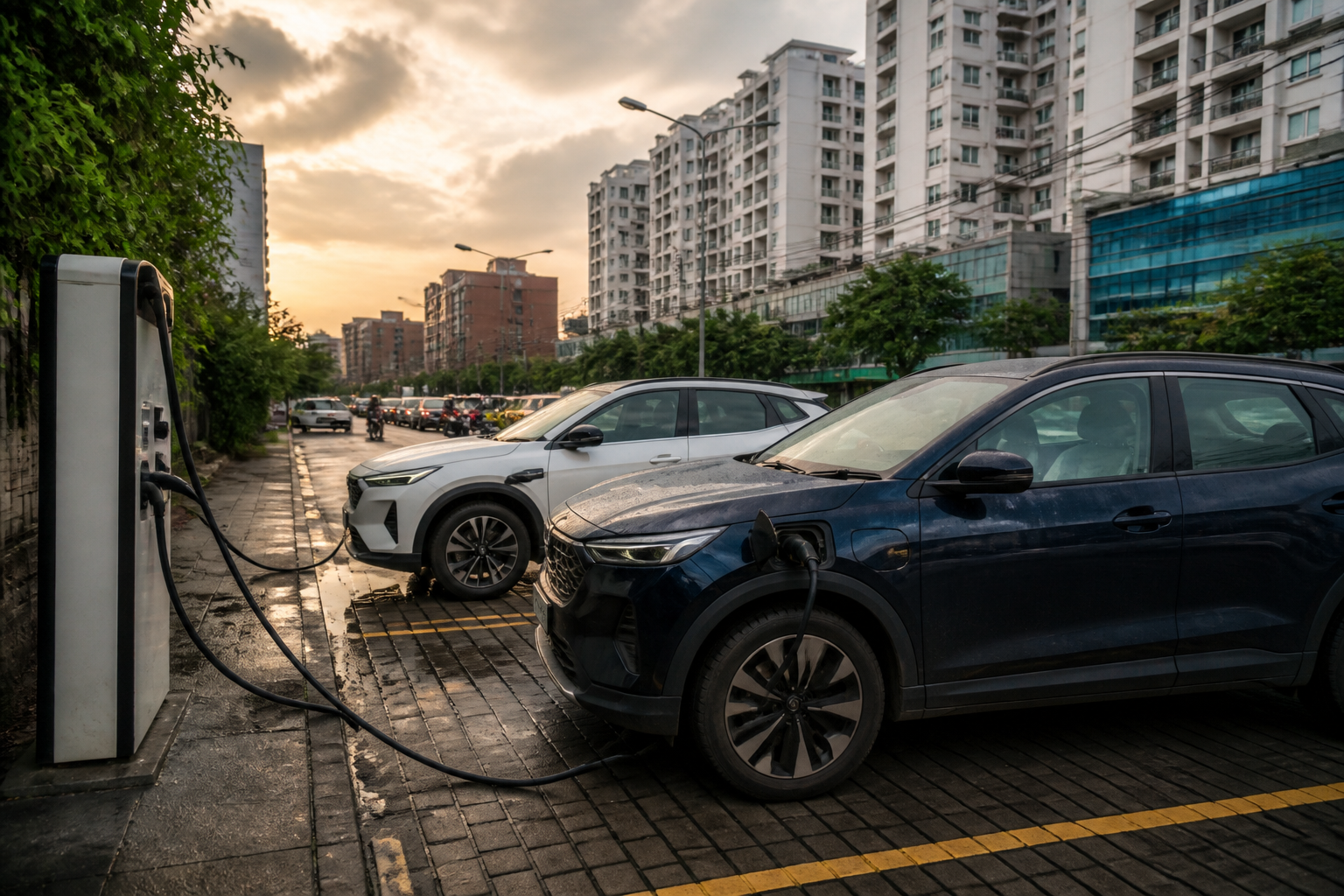
Telangana has improved its position in India’s electric mobility rankings, but the state’s progress is being held back by a basic urban constraint: the charging network has not expanded at the same pace as its policy ambition. The state moved up two places to rank 10th in the India Electric Mobility Index 2025, yet stood 12th among states for public charging points relative to registered vehicles.
The contrast is important because electric mobility is not measured only by how many vehicles are sold or how supportive a government’s policies appear. It also depends on whether residents can charge vehicles reliably at home, at workplaces, in public areas and along longer travel routes. Telangana’s latest index performance shows that progress in electrification and innovation can coexist with a network that remains too thin for mass adoption.
According to the report cited by Deccan Chronicle, Telangana’s score rose from 46 in 2024 to 51 in 2025. That placed it in the ‘Frontrunner’ category among large states and lifted it to 10th place across the index. Among 17 large states, it was placed seventh, alongside Tamil Nadu, Madhya Pradesh, Odisha, Andhra Pradesh, Haryana, Rajasthan and Uttar Pradesh, whose scores ranged between 50 and 64.
The overall ranking, however, conceals a sharper weakness. Telangana had 12.6 public electric vehicle charging points for every one lakh registered vehicles, placing it 12th among states on that measure. Karnataka, by contrast, topped charging readiness with a score of 97. Delhi led the overall index with a score of 84, followed by Maharashtra at 78 and Karnataka at 73.
The index assesses 36 states and Union Territories across three broad dimensions. Transport electrification progress carries the largest weight at 50 per cent, charging infrastructure readiness accounts for 30 per cent, and electric vehicle research and innovation contributes the remaining 20 per cent. Telangana’s improvement therefore indicates that its performance in electrification and innovation was sufficient to lift its overall score despite its weaker charging network.
That weighting also explains why a state can rise in the rankings without having solved the practical problems that determine whether a resident can use an electric vehicle every day. A stronger policy framework, higher adoption and innovation activity can improve a state’s position, but the user experience remains dependent on the physical availability of chargers. If charging points are difficult to find, concentrated in a few urban locations or absent along highways, adoption can remain cautious even when purchase incentives are available.
Telangana has already used policy tools to encourage the transition. The report cited tax exemptions and a ₹200-crore auto conversion scheme as measures supporting electric mobility in the state. These interventions address the cost and adoption side of the transition, but they do not automatically create the network needed to keep vehicles operating. The charging gap therefore points to an implementation problem rather than a complete absence of policy intent.
The distinction matters particularly in Hyderabad, where vehicle ownership, apartment living, workplace travel and commuting patterns make charging access an urban planning issue as much as an energy issue. The supplied report does not provide a city-level breakdown of Telangana’s charging points, but the state-level figure raises questions about how infrastructure is distributed between major urban centres, tier-2 towns and intercity corridors. A statewide average can improve while important parts of the network remain difficult for residents to use.
The same issue applies to housing and commercial development. The report cites the need to mandate charging facilities in new apartments and offices. This recommendation reflects a practical constraint in cities where many residents do not have exclusive parking or the ability to install private chargers. Without provisions in building design and parking management, electric vehicle ownership may be easier for households with dedicated parking than for apartment residents who depend on shared spaces.
Public charging is equally significant for users who cannot charge at home, commercial fleet operators and people travelling between towns. The report identifies tier-2 towns and highways as priority areas for expansion. This broadens the infrastructure question beyond Hyderabad: a credible electric mobility system requires both dense urban access and dependable connections between settlements.
The state’s institutional challenge is consequently to align several forms of action that are often handled separately. Vehicle conversion schemes and tax exemptions can stimulate demand. Apartment and office requirements can build charging capacity into new development. Highway and town-level stations can support longer trips. Support for electric buses and local manufacturing can influence public transport and the wider supply chain. The report does not establish how these measures are currently coordinated, funded or implemented, but its findings show why coordination will matter.
Dr Anil Reddy, an energy policy analyst working with the Centre for Sustainable Energy Futures, told Deccan Chronicle that Telangana would need to expand public charging stations, particularly in tier-2 towns and on highways. He also pointed to charging requirements in new apartments and offices, the conversion of more diesel buses to electric, support for local EV manufacturing and low-interest loans. Awareness campaigns and direct subsidies for electric two-wheelers were identified as additional measures that could encourage buyers.
These proposals cover the main points at which the transition can stall: infrastructure, public transport, manufacturing, finance and consumer awareness. They also indicate that charging infrastructure cannot be treated as a standalone technology project. It is connected to land use, building approvals, parking, public transport operations, lending and household purchasing decisions. The index result makes this interdependence visible without establishing whether each proposed intervention has been adopted or funded.
Telangana’s position also shows the limits of reading rankings as a single measure of readiness. The state improved its overall score by five points and entered the Frontrunner category, which signals meaningful progress. But its charging-point ratio remained a clear weakness, while Karnataka’s leadership in charging readiness demonstrates that performance varies sharply across the components of electric mobility. A higher overall rank does not necessarily mean that the network is equally prepared in every location or for every type of user.
The report describes India’s electric vehicle growth as slow but steady. For Telangana, the immediate evidence points to a state moving forward while carrying a specific infrastructure deficit. Its policy base and innovation performance have helped it rise, but the low relative availability of public charging points could limit how far that progress translates into routine, convenient electric mobility.
The larger urban question is whether charging infrastructure will be planned as essential city infrastructure or added gradually after vehicles arrive on the roads. Telangana’s 2025 index result confirms progress, but it also identifies the next test: converting policy support and innovation strength into a charging network that reaches apartments, offices, public spaces, tier-2 towns and highways. The supplied findings do not establish the pace at which that expansion will occur. They make clear, however, that the state’s continued rise will be judged not only by its ranking, but by whether residents can charge where they live, work and travel.
