


Uttar Pradesh’s draft microbiome plan places hospitals, wastewater treatment plants, river basins and farms within one policy framework, signalling a shift from treating microorganisms only as a health concern to using them as indicators and tools across the urban system. The proposal is still awaiting approval from Chief Minister Yogi Adityanath, but its design raises a larger question: can a state coordinate public health, sanitation, water management and agriculture through a shared biological and data-led approach?
The plan, titled the Uttar Pradesh State Specific Note on Microbiome Technologies, has been drafted to apply microbiome technology across healthcare, environmental protection, sanitation, food safety and sustainable agriculture, according to a report by The Times of India. Kritika Sharma, CEO of the Uttar Pradesh Promote Pharma Council, said the document would be submitted to the chief minister for approval. The proposed rollout is phased over 24 months, with pilot projects planned at selected institutions.
That combination of a draft policy, a defined implementation period and multiple departmental responsibilities makes the proposal more significant than a standalone research initiative. It is framed as a state-level programme, but many of its proposed applications sit inside everyday urban services: infection monitoring in hospitals, biological treatment at wastewater plants, pollution control in river catchments and the management of organic waste. Its success would therefore depend not only on scientific capability, but also on how departments share information, operate facilities and act on the results.
Microbiomes are communities of microorganisms living in a particular environment. Some are associated with disease, while others support digestion, soil fertility and the breakdown of organic waste. The draft’s central idea is to use this diversity in practical ways. In hospitals, microbial evidence could help track infections and antimicrobial resistance. In wastewater treatment, understanding microbial communities could help assess and improve biological treatment. In agriculture, the proposed applications are linked to crop quality.
The plan’s institutional structure reflects the breadth of that ambition. The science and technology department is expected to coordinate with the departments of health, agriculture, horticulture, urban development, water and sanitation, and pollution control. Biotechnology Park in Lucknow and the Uttar Pradesh Promote Pharma Council are also identified as key participants. This places the programme at the intersection of research institutions, service-delivery departments, regulators and local urban systems.
That intersection is where the practical challenge lies. A hospital may generate information about infection patterns, a wastewater treatment plant may reveal changes in microbial communities, and a pollution-control agency may hold environmental data. But these datasets do not automatically become a common monitoring system. The supplied report does not specify the proposed data architecture, reporting standards, laboratory accreditation requirements or funding arrangements. Those details will determine whether the plan becomes a coordinated public programme or a collection of disconnected pilots.
The healthcare component is focused on hospital-acquired infections and antimicrobial resistance. Subject expert Dr GN Singh has recommended using a network of government and selected private hospitals to strengthen surveillance. The draft considers conventional laboratory tests, targeted genetic testing and DNA sequencing as possible tools for identifying infection sources and understanding the mechanisms through which microorganisms develop resistance to medicines.
This proposed combination matters because it links routine diagnosis with deeper investigation. Conventional tests may support immediate clinical decisions, while genetic testing and sequencing can provide more detailed information about infection sources and resistance mechanisms. The report does not establish how many hospitals would participate, which institutions would be selected or what testing frequency is proposed. It also does not state whether the network would initially cover a particular city, district or hospital category.
Those unanswered questions are important for urban governance. Hospitals are not isolated facilities; they are connected to dense populations, wastewater networks, pharmaceutical use and surrounding communities. A stronger infection-surveillance system could produce valuable evidence, but only if hospitals have the laboratory capacity, trained personnel and administrative protocols to record and share it consistently. The plan’s proposed network model suggests an attempt to build that coordination across public and selected private institutions, although the final design remains subject to approval.
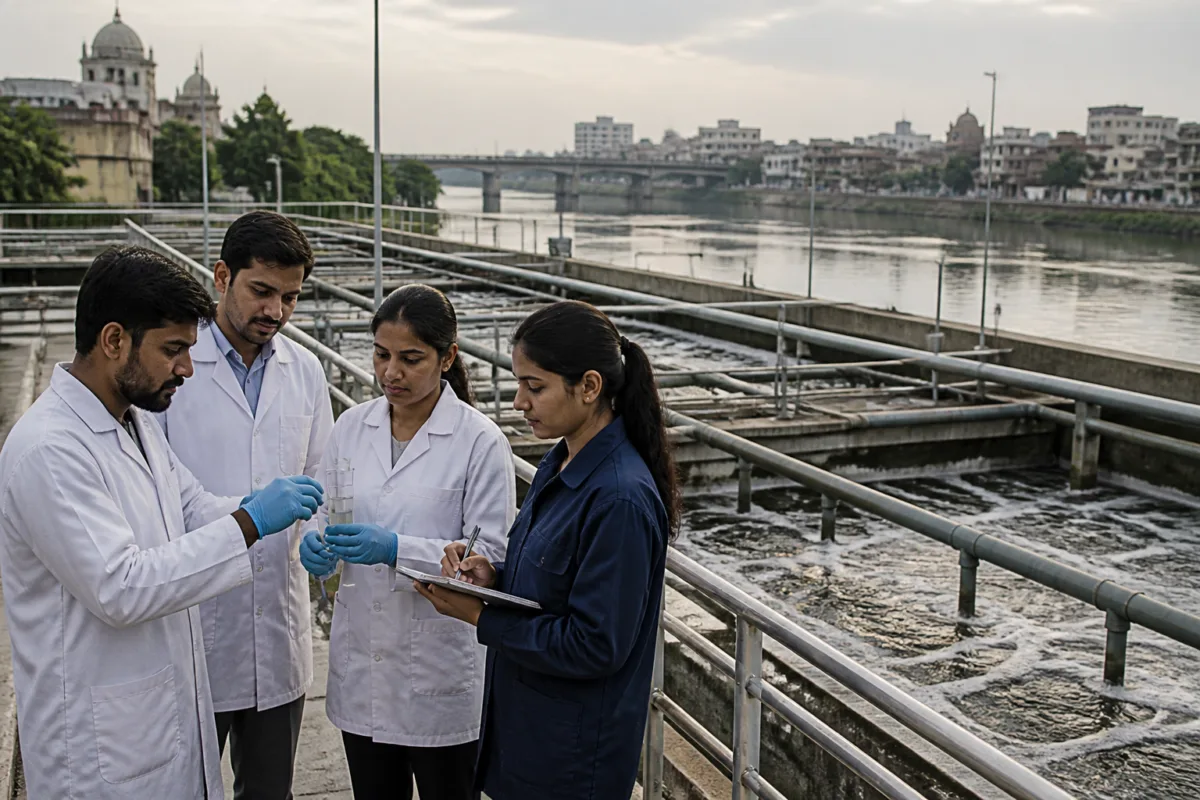
The environmental component extends the proposal from hospital interiors to river catchments. Treatment-based pilot projects are proposed in the catchment areas of the Ganga, Yamuna and Gomti. These pilots would assess microbial communities in existing wastewater treatment plants and explore improvements in biological treatment. The draft identifies aeration, nutrient balance and the entry of toxic substances as factors that can influence treatment performance.
This is a notable framing of wastewater infrastructure. Treatment plants are often discussed through their capacity, physical assets and compliance requirements. The draft adds the condition of microbial communities as another way to understand how biological treatment is functioning. That approach does not replace conventional monitoring; rather, the proposal, as described, is to examine the biological processes that support treatment and identify ways to improve them.
The river-basin focus also matters because wastewater systems operate across administrative boundaries. Ganga, Yamuna and Gomti catchments include urban settlements, treatment facilities and receiving water bodies that may fall under different agencies. The supplied material does not identify the cities or plants selected for the pilots, nor does it provide current treatment-performance figures. It therefore cannot establish whether the plan targets specific failures, capacity gaps or pollution hotspots. What it does establish is that the proposed pilots are intended to test biological treatment within existing wastewater infrastructure.
The reference to aeration, nutrient balance and toxic substances points to the operational nature of the proposal. Wastewater treatment is not only a construction problem. It also involves plant operation, inflow quality, process control and the ability of operators to respond when biological conditions change. By focusing on microbial communities, the draft appears to treat plant performance as a living process that requires monitoring and adjustment. Whether operators receive the equipment, training and technical support required for that work is not detailed in the report.
Agriculture and horticulture form the third major component. The plan proposes using microbiome technology to improve crop quality, while also including agriculture and horticulture departments in the coordinating structure. The supplied information does not specify crops, districts, soil types, agricultural inputs or expected quality indicators. It therefore does not support conclusions about likely farm-level outcomes. The policy significance lies instead in the attempt to connect soil and crop applications with the same wider microbiome framework being proposed for hospitals and wastewater systems.
This cross-sector design is the plan’s defining feature. It treats microorganisms as part of several linked systems rather than as a narrowly biomedical subject. In hospitals, they are connected to infection and resistance. In wastewater plants, they are part of biological treatment. In agriculture, they are associated with soil fertility and crop quality. The state’s proposed role is to create a common programme around these applications, supported by science and technology institutions and implemented through sectoral departments.
The 24-month phased rollout provides a timetable, but not yet a complete implementation framework. The report does not state how the phases will be sequenced, what approval milestones will apply, how pilots will be evaluated or what criteria will determine expansion. It also does not identify a budget, procurement model or responsibility for maintaining the required laboratory and treatment-monitoring systems. These are not minor administrative details. They will determine whether evidence from the pilots can be translated into routine public services.
For urban development, the most important implication is that public infrastructure may increasingly be managed through information about invisible biological processes. Hospitals, sewers and treatment plants are usually experienced by citizens through visible outcomes: infection control, sanitation, odour, water quality and the condition of rivers. The proposed plan operates behind those outcomes, through testing, sequencing and process monitoring. Its public value will depend on whether that technical layer produces measurable improvements in service delivery.
The available numbers are limited but significant. The draft proposes a 24-month rollout, covers three named river basins—the Ganga, Yamuna and Gomti—and envisages a network involving government and selected private hospitals. It also brings together at least seven state departments or functional areas: science and technology, health, agriculture, horticulture, urban development, water and sanitation, and pollution control. The report does not provide baseline infection rates, antimicrobial-resistance figures, wastewater-treatment performance data or crop-quality measurements. Without those baselines, future progress will be difficult to assess.
That absence of baseline information is one of the central issues for the next stage. A plan focused on microbiome technology will need clear definitions of what is being measured, where samples are collected, how results are compared and which authority is responsible for action. It will also need to distinguish between research findings and operational decisions. The report confirms that these questions are being addressed through a draft policy process, but it does not provide the final protocols.
The larger urban question is whether institutions can coordinate around systems that cross conventional departmental boundaries. Wastewater is connected to public health and rivers. Hospitals are connected to sanitation and antimicrobial use. Agricultural quality is connected to soil biology and environmental conditions. The proposed plan recognises those connections, but recognition alone does not resolve the administrative fragmentation involved.
At this stage, the evidence confirms that Uttar Pradesh has drafted a state-specific, 24-month microbiome programme with proposed applications in hospitals, wastewater treatment and agriculture. It also confirms that the plan is awaiting approval and that pilots are proposed rather than operational. The developments that require monitoring are the approval decision, the selection of pilot institutions and wastewater plants, the funding and laboratory arrangements, and the metrics used to judge whether the programme improves infection surveillance, treatment performance and crop quality.

