


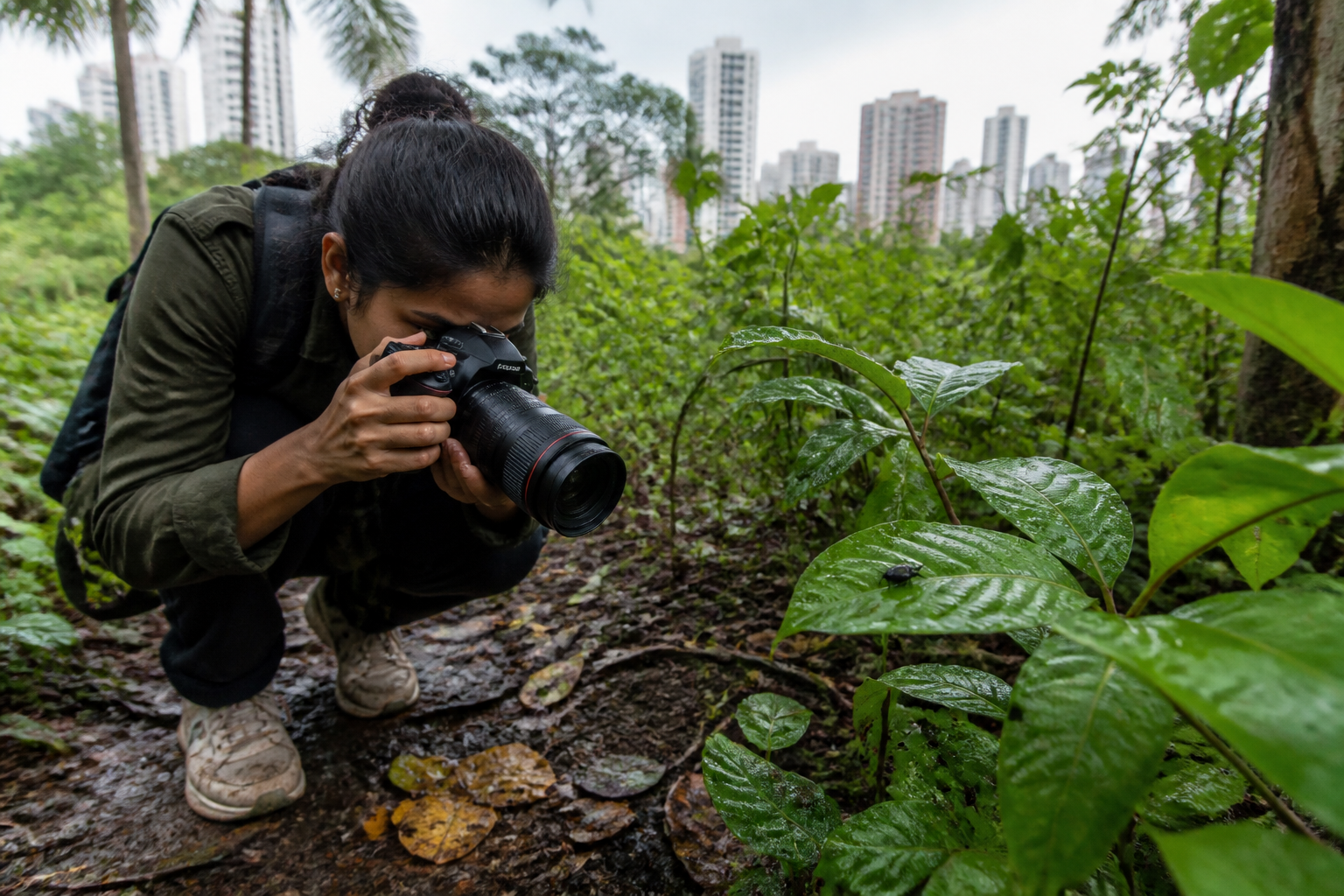
Mumbai’s nature calendar is expanding beyond birds and trees as residents, educators and researchers turn their cameras towards beetles, moths, dragonflies, ants and other insects. The rise of “bugging”—observing and documenting insects in parks, compounds and forests—offers more than a new recreational activity: it is opening a citizen-led window into how urban ecosystems are changing.
The movement remains relatively small, but its significance lies in what it makes visible. Insects are among the most numerous and diverse organisms in the natural world, yet they are rarely central to public conversations about urban biodiversity. Entomologists and nature educators quoted in a Times of India report say that organised walks, workshops, camps and online courses are helping correct that imbalance.
For a city such as Mumbai, where large populations live alongside fragmented forests, gardens, wetlands, private compounds and roadside vegetation, insect observation can make nature more accessible. People do not need to travel to a distant sanctuary to encounter a beetle, ant colony or dragonfly. The activity can begin in a neighbourhood park or building compound, often with nothing more than a smartphone.
## Why urban insect biodiversity matters
V. Shubhalaxmi, an entomologist who has conducted workshops and walks for two decades, told the Times of India that insects attract people because they are accessible and offer extraordinary variety. A major study published in June estimated that there could be between 14 million and 20 million insect species worldwide, more than twice earlier estimates. Only about 1.2 million species have been formally described, according to the report.
The comparison with birds illustrates the scale of the knowledge gap. The world has 11,131 recorded bird species, while the estimated number of insect species runs into the millions. Yet birding has a much stronger public identity, supported by field guides, specialist groups, binoculars, organised walks and extensive documentation. “Bugging” is still building those cultural and institutional supports.
Smartphone technology is helping. Meehir Pawar, a young naturalist known for work on dragonflies and damselflies, said budget phones with macro lenses allow users to examine insects as small as weevils. Details such as the triangular head of an Indian Grass Mantis or the translucent edges of an Indian Green Tortoise Beetle become visible through a device that many urban residents already carry.
This shift in scale is important. Urban nature is often represented through large or attractive subjects—trees, birds, lakes and mammals. Macro photography changes the point of attention. A patch of soil, a wall, a flowering plant or a drain-side shrub becomes an ecological site. The city is no longer just a backdrop for nature; it becomes the place where ecological relationships can be observed at close range.
## From fear to observation
The public image of insects remains shaped by fear, discomfort and associations with disease, crop damage or property damage. Pawar said that learning about insects can change reactions from repulsion to appreciation by showing their roles as decomposers, pollinators and pest controllers. It can also correct common misconceptions, including the belief that dragonflies sting with their tails.
That change in perception has practical value for urban ecology. Residents who recognise insects as part of an ecosystem may be more attentive to the plants, soil, water and habitat conditions that support them. The source report does not establish that insect walks directly change urban management decisions, but it shows how education can create a wider constituency for observing and discussing less visible forms of biodiversity.
Children appear to be particularly receptive. Shubhalaxmi said younger people may have had fewer opportunities to develop “insectophobia”, while online information and direct encounters with nature have made learning more accessible. The report profiles Viyaan Bhatia, an 11-year-old from Chembur who has raised ant colonies at home after watching a YouTube video.
His experience also demonstrates that interest in insects is not limited to formal institutions. A colony can become a long-term observation project, with children learning to identify queens, distinguish species and understand social behaviour. Bhatia is now raising six colonies, and his friends reportedly stop playing when he spots a queen ant. Such encounters connect urban childhood with biological processes that are usually hidden from view.
## Building an insect knowledge network
The emerging insect community is developing its own forums, courses and campaigns. Eshaan Pahade established the Entomon Institute of Invertebrate Zoology in 2023 to focus on research and communication. In January, he launched online courses covering subjects ranging from insect behaviour to forensic entomology, the study of arthropods as evidence in death investigations. Participants have reportedly ranged in age from seven to 82.
The breadth of participation matters because urban biodiversity knowledge is not produced only by professional scientists. Enthusiasts can contribute observations, photographs and local knowledge, while educators can help identify species and explain ecological roles. Online groups provide a way to connect these scattered observations, even when the contributors are not part of a formal research institution.
The Facebook group Insect India, to which Pahade belongs, has 46,000 members, although he estimates that around 2,000 are active. The difference between total membership and active participation is significant. It suggests both the reach of public interest and the challenge of converting passive curiosity into consistent documentation.
Specialisation is also emerging within the community, with groups focused on ants, butterflies, moths and beetles. This mirrors the structure of more established nature movements, where broad interest gradually develops into detailed expertise. Over time, such specialisation can produce better species records, stronger local networks and more informed public discussion, although the report does not quantify how much of this material is currently used in official urban planning or conservation.
## The beetle documentation gap
The scale of the gap is particularly visible in beetle research and citizen science. India’s Nature runs an annual Beetle Mania campaign to document and celebrate Coleoptera, the largest animal order, with nearly 400,000 described species. India is estimated to have 22,299 beetle species, according to the Zoological Survey of India.
Yet Ramnarayan Kalyanaraman, co-founder of India’s Nature, said there is a “real, measurable gap” in citizen-science coverage of beetles in India. Butterflies average 461 research-grade observations per species on iNaturalist, while beetles average about 24, according to the figures cited in the report.
These numbers do not indicate that beetles are less important. They show that public attention, identification resources and documentation systems are unevenly distributed across species groups. Butterflies benefit from a strong visual appeal, a larger body of popular literature and established field-guide traditions. Beetles, by contrast, are often associated with pests, including the cotton boll weevil, which can make them harder to present as subjects of curiosity.
India’s Nature says the gap is also linked to a shortage of popular literature, field guides and outreach groups, particularly in vernacular languages. That limitation affects who can participate. A city’s biodiversity cannot be fully documented if identification material is available only to people with specialist knowledge, high-quality equipment or access to English-language resources.
The fifth edition of Beetle Mania, held from August 22 to September 13 this year, used webinars and public documentation to expand participation. The campaign is also inviting nominations for a “Beetles of India” pamphlet that will include regional names and local folklore. This approach treats biodiversity as both scientific and cultural knowledge.
## Local stories and urban ecology
Jennifer Divyadarshi, co-founder of India’s Nature, said folklore helps connect people to nature and oral storytelling. Her observation points to an important feature of urban biodiversity work: identification is not only about assigning a Latin name to an organism. Regional names, local memories and community explanations can reveal how people have historically encountered a species or landscape.
For cities, this can help bridge the distance between formal conservation language and everyday experience. Residents may not describe a habitat using ecological terminology, but they may know when a particular insect appears, which plant it is associated with or how its presence has changed. Such knowledge does not replace scientific documentation, but it can add context to observations.
The report does not claim that all local accounts are scientifically verified. It does show that natural-history communication works more effectively when it gives people stories and reference points that relate to their own landscapes. In a dense city, that may mean connecting insects to a housing society garden, a school campus, a roadside tree or a seasonal wet patch.
## Insects as early environmental signals
The strongest urban implication of the insect movement is its potential connection to environmental monitoring. Shubhalaxmi described insects as early indicators of threatened ecosystems and climate change, comparing them to occupants on the first floor of a three-storey building developing cracks from the ground upwards. The analogy is that ecological damage may become visible in insect populations before it reaches systems that directly affect people.
The supplied report does not provide a long-term Mumbai dataset showing how insect populations have changed, nor does it establish a direct link between individual observations and climate policy. That limitation is important. Public enthusiasm for bugging should not be confused with a completed monitoring system.
What it does establish is the need for more research and better observation. If insects are to serve as indicators, cities need consistent records, reliable identification, repeated observations and institutions capable of interpreting the data. The growth of citizen-science groups can help expand the amount of information available, but documentation quality and continuity remain central challenges.
This is where urban governance enters the picture. Municipal parks, school grounds, housing developments, roadside landscapes and protected areas are not separate from biodiversity policy. They are the places where most residents encounter nature. Whether these spaces support insects depends on conditions that are rarely discussed in public—the range of plants, the availability of soil and leaf litter, the presence of water, the use of chemicals and the continuity of habitat.
The report does not attribute specific management practices to Mumbai’s municipal authorities, so no conclusion can be drawn about the city’s current insect policy. But the emergence of organised observation raises a broader institutional question: whether urban biodiversity programmes are designed to record only charismatic species or to understand the full ecological systems in which residents live.
Mumbai’s new interest in “bugging” is therefore not merely a lifestyle trend. It is an early-stage knowledge movement built around accessible technology, public education and curiosity about overlooked organisms. Its long-term value will depend on whether observations remain isolated hobby projects or become part of credible, inclusive and sustained ecological documentation.
The evidence currently confirms three developments: insect observation is attracting people across age groups, digital tools are making close study easier, and citizen-science coverage remains highly uneven. What remains uncertain is how much this growing interest will contribute to formal research, urban habitat management and climate monitoring. The next test will be whether Mumbai’s insect enthusiasts can turn scattered encounters into a durable public record of the city’s smallest inhabitants.
