


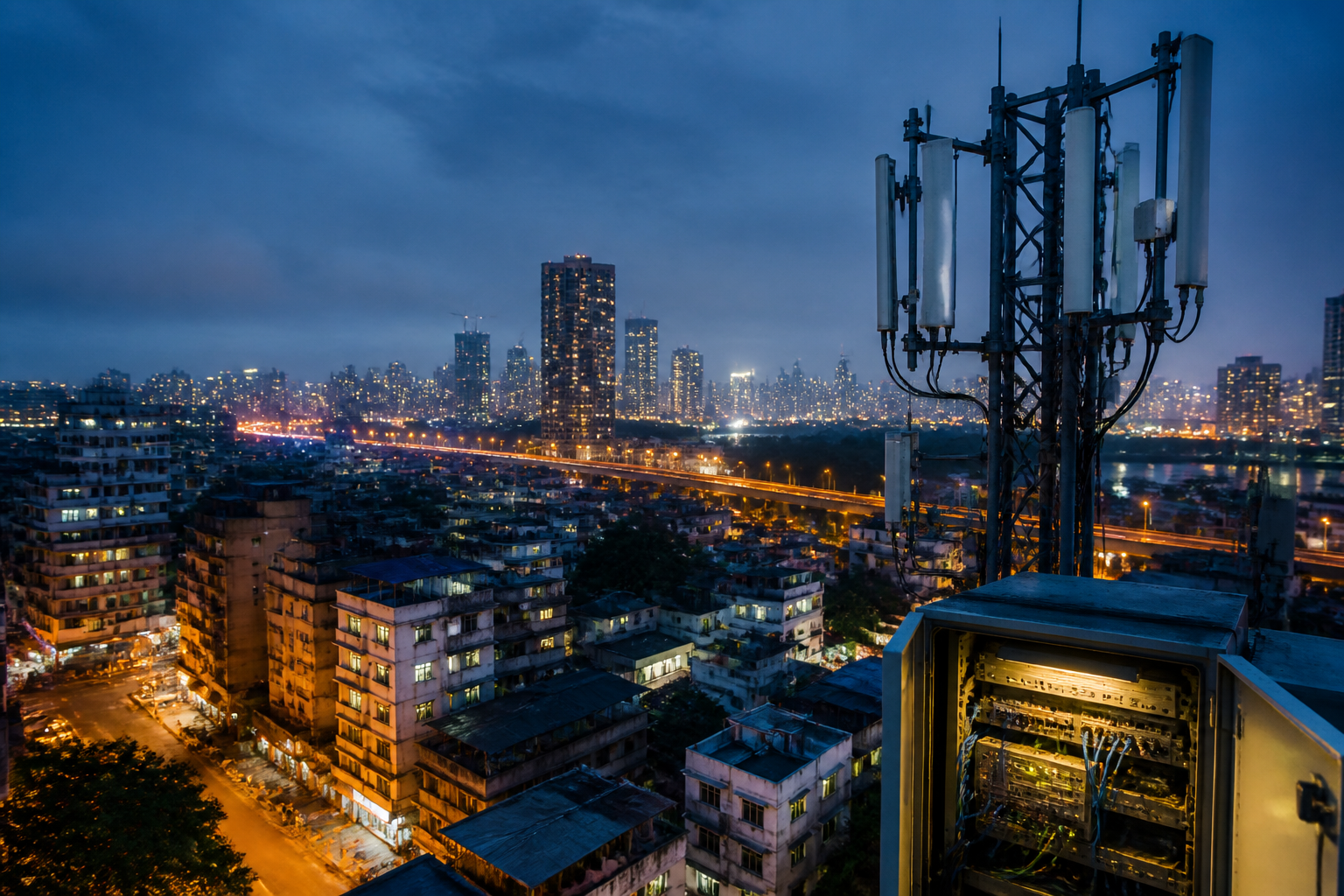
Jio Platforms’ proposed initial public offering is being presented as a landmark capital-markets event, but the draft red herring prospectus also reveals something more consequential for India’s urban economy: the scale of infrastructure, technology and regulatory exposure behind the country’s fast-expanding digital connectivity system. The company is reportedly seeking around Rs 37,700 crore, with subscriptions expected to begin on October 21, at a proposed valuation of about Rs 11 trillion.
The proposed Jio IPO comes as the company claims a leading position in wireless connectivity, home broadband, digital services and enterprise technology. Its DRHP says Jio had 524.4 million customers as of March 31, 2026, and carried around 60% of India’s wireless data traffic in Fiscal 2026. Its 4G and 5G subscriber base was approximately 1.4 times that of the second-largest player.
Those figures matter beyond the investment case. Connectivity is now a basic layer of urban life, supporting payments, work, education, entertainment, public services and commercial activity. A company that carries such a large share of national data traffic is not simply selling mobile plans. It is operating infrastructure on which households, firms and increasingly digitised public systems depend.
The DRHP portrays Jio as a platform built around the convergence of telecom networks and digital services. Its operations span connectivity, content, financial services, cloud and artificial intelligence. The company says its digital gateway allows consumers and businesses to access several categories of products through a single platform, while its existing customer base gives it an opportunity to distribute additional services at relatively low incremental acquisition costs.
That model reflects a broader change in the economics of connectivity. The network remains the essential physical layer, but value is increasingly sought from services delivered over it. During IPL 2026, more than 198.7 million viewers accessed IPL content through an integrated Jio Hotstar package with Jio connectivity services, according to the company. Jio also provides Jio Unlimited 5G users access to the Google AI Pro plan at no additional cost for 18 months and plans to distribute Reliance Enterprise Intelligence’s enterprise AI products to Indian businesses.
The company’s financial figures suggest that scale has so far been accompanied by strong operating performance. Jio reported revenue from operations of Rs 1,46,885.3 crore and EBITDA of Rs 76,255.4 crore in Fiscal 2026, producing an EBITDA margin of 51.91%. Revenue grew at a 15.79% compound annual growth rate between Fiscal 2024 and Fiscal 2026, while EBITDA grew at a 17.79% CAGR. Net leverage declined from 0.88 times in Fiscal 2024 to 0.36 times over the same period.
However, the same scale creates infrastructure obligations that cannot be treated as a one-time investment. The DRHP says digital connectivity companies must continually upgrade their networks and sometimes rebuild parts of their infrastructure. This includes integrating new technologies with existing systems and phasing out legacy platforms. For users, such changes are often invisible until they appear as better speeds, wider coverage, fewer disruptions or the need to replace devices and connections.
Jio’s technology workforce and patent portfolio indicate the company’s attempt to control more of this infrastructure stack. It had 11,303 full-time employees in its digital products and technology development team as of March 31, 2026, representing about 40% of its overall workforce. Jio and its subsidiaries had applied for 6,817 patents covering 4G, 5G, 6G, cloud-native core network architectures and AI-driven network automation.
The urban significance of this investment lies in the shift from connectivity as a standalone service to connectivity as an operating system for homes, enterprises and public-facing digital activity. Jio’s Jio Brain platform is described as supporting capacity allocation, fault prediction and resolution, and real-time network optimisation. Its Jio Things platform provides a unified interface for connected appliances, cameras, sensors and other automation devices.
The largest immediate opportunity identified in the DRHP is the movement of users from older networks. More than 263.5 million Indians remained on 2G networks as of March 31, 2026, according to the Analysys Mason Report cited by Jio. The company’s Rs 799 Jio Bharat phone is aimed at entry-level users and offers access to services including UPI payments, video streaming and music.
This transition is not only about faster internet. It determines who can participate in a digital economy and at what cost. Moving a user from 2G to 4G or 5G requires an affordable device, a suitable tariff, network availability and enough digital confidence to use services beyond voice calls. The DRHP identifies the opportunity, but the material supplied does not establish how many 2G users can be converted, the pace of that conversion or the cost of serving them profitably.
Home broadband presents another major expansion area. Fixed broadband penetration in India was around 20% in Fiscal 2026 and is projected to reach about 46% by Fiscal 2031, with 150.4 million fixed broadband customers, according to the report cited in the DRHP. Jio had 27.1 million home broadband customers as of March 31, 2026, through Jio Fiber and Jio AirFiber.
The figures point to a large gap between current access and projected demand. They also show why the distinction between fibre, fixed wireless access and mobile connectivity is becoming important. Jio identifies fixed wireless access as a way to offer fibre-like performance with relatively low installation and usage costs. At the same time, it says satellite connectivity could serve specialised use cases in remote or hard-to-reach locations, while remaining unlikely to scale significantly in India’s current connectivity landscape.
Enterprise connectivity is another underdeveloped segment. The DRHP estimates that adoption of enterprise digital services among small and medium enterprises is below 3%. India has 79 million micro, small and medium enterprises, according to the Analysys Mason Report cited by Jio. The company is targeting this market with connectivity, cloud and communications-platform-as-a-service offerings.
This is where the IPO story intersects with the built environment and urban economy. Small businesses increasingly require reliable connectivity for payments, logistics, customer management, cloud applications and digital marketing. Yet the DRHP’s figures also suggest that the enterprise opportunity remains largely unrealised. Converting it into revenue will depend not only on network reach but also on affordability, product simplicity, technical support and the ability of smaller firms to adopt digital tools.
Jio’s opportunity set is supported by the projected expansion of India’s digital economy. The DRHP estimates its size at approximately Rs 49.6 trillion, or around 14% of gross value added, and projects it to reach Rs 125.8 trillion by Fiscal 2031, contributing around 22% of GVA. The company links this growth to rising disposable income, a young population, higher data consumption and increasing business digitisation.
But the prospectus also makes clear that growth is exposed to structural risks. Jio’s telecom operations depend on licences and spectrum across multiple bands. Changes to licensing and spectrum-provisioning frameworks, including spectrum pricing, could affect the business. The company also identifies privacy and data-security regulation as areas of risk as more services move onto its platforms.
Network disruption is another risk with direct citizen consequences. The DRHP says failures affecting Jio’s network, passive infrastructure or technology could interrupt customer experience and increase churn. Cyberattacks and data-privacy failures could impose additional operational and reputational costs. For users and businesses, connectivity interruptions can affect payments, communication, entertainment and day-to-day work, making resilience a central infrastructure concern.
Competition could put pressure on the model. The DRHP says rivals may adopt aggressive pricing, including free or heavily discounted offerings, while global technology companies compete with Jio in digital services. Customer churn may also result from tariff increases, SIM consolidation, the deactivation of inactive SIMs and mobile number portability.
The proposed Jio IPO therefore represents more than a valuation event. It will expose to public-market scrutiny a company whose performance depends on simultaneously expanding access, upgrading networks, building digital products and managing regulation. The DRHP establishes Jio’s current scale, its financial performance and the markets it wants to enter. It does not, by itself, settle whether the company can convert every projected opportunity into sustainable growth.
The next important milestones are the proposed subscription opening on October 21, the final issue terms and the disclosures that accompany the public offering. Those details will determine how investors assess the balance between Jio’s infrastructure-led strengths and the capital, regulatory, pricing and security risks identified in its own prospectus.
