


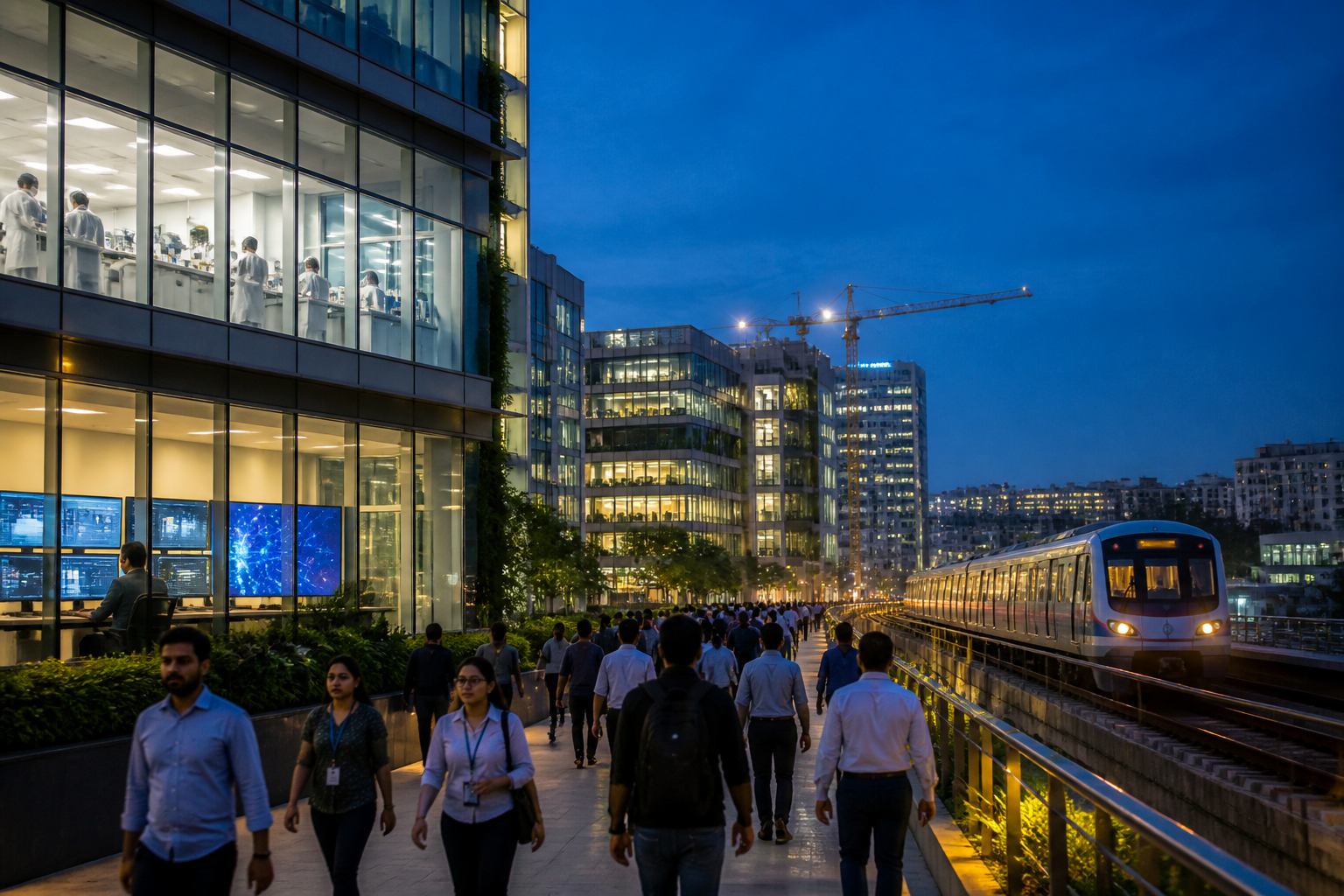
Telangana is preparing a new global capability centre (GCC) policy that would move the state away from broad incentives and towards targeted support for frontier-technology companies. The proposed approach places Hyderabad’s next phase of growth at the intersection of artificial intelligence, semiconductors, spacetech, aerospace, defence, quantum technology and advanced life sciences, while also seeking to extend GCC activity into Tier-2 cities.
The shift matters because Hyderabad’s GCC economy is no longer being presented simply as an expansion of the city’s information-technology services base. According to the report, the state has crossed 500 GCCs and added 75 centres in FY26, the highest number added by any state during the year. Telangana is now targeting 100 more GCCs in FY27, with about 55 of those centres already having opened in Hyderabad.
Those numbers establish the scale of the opportunity the government is trying to manage. They do not, by themselves, establish whether the new centres are creating high-value research, product development and technology ownership or mainly extending existing delivery operations. That distinction is central to the policy being drafted. Telangana officials have indicated that the quality and complexity of work will be tracked alongside the number of centres.
The state’s proposed strategy is therefore a response to a structural question: how can Hyderabad convert the arrival of more multinational capability centres into deeper local capabilities rather than simply a larger office footprint? The answer being considered is selective support for investments that can create new ecosystems around specialised technologies.
A senior official in the Telangana IT and industries department told the Times of India that incentives, if offered, would be reserved for investments capable of generating entirely new ecosystems. The areas identified include frontier space technology, next-generation semiconductor design, artificial-intelligence model development, quantum technology, aerospace and defence, and advanced life sciences.
The official cited the possibility of companies such as SpaceX or Nvidia establishing GCCs in Hyderabad as an example of the kind of investment that could attract support. The stated rationale is that a major technology centre can have a cascading effect on the city’s brand and its wider ecosystem. The policy, as described, would therefore attempt to use public incentives not merely to increase the number of companies but to influence the composition of the city’s economic base.
That is a significant change from a conventional investment-attraction model. Broad-based subsidies can help reduce the cost of setting up, but they do not necessarily determine what kind of work takes place after a centre opens. Telangana’s proposed framework appears to focus instead on whether an investment adds a new technological capability, creates specialised employment and draws related firms, suppliers and institutions into the same urban ecosystem.
The policy is being drafted while Telangana studies the approaches of Karnataka and Maharashtra, whose major hubs Bengaluru and Pune compete with Hyderabad for global technology operations. The report places these cities in distinct competitive categories: Bengaluru is associated with enterprise research and development, Chennai with automotive and engineering strengths, and Pune with automotive, engineering and banking, financial services and insurance activity.
Telangana’s pitch is that Hyderabad can operate as a cross-domain hub. Officials point to a talent base spread across life sciences, aerospace, defence, space technology, banking and financial services, retail, hospitality, fast-moving consumer goods, utilities and advanced digital engineering. The breadth of these sectors is being treated as an advantage because GCCs increasingly build products and platforms instead of functioning only as traditional software-delivery units.
This cross-domain ambition also changes the infrastructure and planning requirements associated with GCC growth. A city that hosts product engineering, advanced research and specialised life-sciences work needs more than office space. It must support concentrated pools of technical talent, reliable utilities, institutional research links and urban mobility that can connect companies to workers and related services. The supplied report does not provide a detailed infrastructure plan, but its emphasis on high-value capabilities makes the quality of the urban ecosystem an implicit part of the policy challenge.
The employment figures show why the policy has a wider urban-economic dimension. Telangana estimates that the 75 GCCs added in FY26 brought in Rs 1.43 lakh crore in new investments, created 75,000 direct jobs and generated 2.25 lakh indirect jobs. The state estimates that the GCC sector produced Rs 3.9 lakh crore in economic output. Hyderabad currently accounts for about 4 lakh GCC employees, according to the report.
Minister for IT and industries D Sridhar Babu has set a further target of 100 GCCs, 1 lakh direct jobs and 3 lakh indirect jobs. He attributed Hyderabad’s growth to infrastructure, talent, ecosystem and innovation, and said companies were choosing the city not only for scale but also to build high-value global capabilities.
These estimates describe an economic multiplier, but they should be read as government estimates rather than independently assessed outcomes within the supplied material. The numbers also combine different measures: new investment, direct employment, indirect employment and total economic output. They indicate the scale of the state’s claim, while leaving open questions about how jobs are distributed across skill levels, where indirect employment is located and how much of the value remains within Telangana.
The policy’s proposed geographic spread adds another layer. Officials want GCCs to establish operations in Tier-2 centres including Warangal, Adilabad, Karimnagar and Nizamabad. This would be an attempt to move beyond Hyderabad’s concentration and distribute some of the employment and investment associated with the sector across the state.
However, the report does not specify which functions would be suitable for these cities, what incentives would apply outside Hyderabad, or what infrastructure and talent investments would support the move. Those details matter because decentralising a knowledge-intensive economy is not the same as decentralising office space. The viability of Tier-2 locations would depend on the availability of specialised workers, connectivity, reliable services and institutions capable of supporting the relevant sectors.
For Hyderabad, the immediate policy question is not whether the city can attract more GCCs. The figures supplied by the state suggest that it already can. The harder question is whether the city can keep moving up the value chain as automation disrupts traditional IT services. Officials have explicitly linked GCC growth to this disruption, making product development and frontier technology a way to preserve the city’s relevance as routine technology work changes.
Sai Krishna, an IT adviser to the Telangana government, said the state was tracking the quality and complexity of work as closely as the number of centres. He described the depth of innovation brought to the city as the real measure of success and referred to strengthening Telangana’s “Innovation complexity index”. The report does not provide the methodology or current value of that index, so its practical use in evaluating the policy remains unclear.
That measurement issue is important. A count of GCCs is easy to communicate, but it can conceal differences between a small delivery unit, a large engineering centre and a research operation that creates intellectual property or new technology platforms. A policy built around frontier sectors will need a way to distinguish these models. The supplied material shows that the state recognises this distinction, but does not yet explain how it will be applied.
The proposed incentives also raise questions about public value. The official position is that support would be considered for investments capable of creating new ecosystems rather than offered as routine assistance. That could make incentives more selective and align them with long-term capability building. At the same time, the policy’s effectiveness would depend on the criteria used to decide which investments qualify and how outcomes are monitored after support is granted.
The institutional competition is equally clear. Telangana is studying policies in Karnataka and Maharashtra while trying to define a distinct proposition for Hyderabad. This is not only a contest for corporate offices. It is a contest over the types of knowledge, talent and technology that cities can retain and develop. Hyderabad’s proposed cross-domain identity is meant to differentiate it from more specialised rival hubs, but the report does not establish whether that positioning has already translated into a measurable advantage.
What the evidence does establish is that Telangana is trying to shift the GCC conversation from quantity to complexity. The state has reported rapid additions, high investment and large employment effects, but its officials are now emphasising the character of the work performed in the city. The proposed policy connects that ambition to selective incentives, frontier sectors and a possible expansion into Tier-2 centres.
The next stage will be the policy’s formal release and the definition of its implementation framework. Until then, the central claims about investment, jobs and output remain government estimates, while the proposed focus on innovation-led GCCs remains a policy direction rather than an established outcome. The eventual test will be whether the framework can turn Hyderabad’s existing scale into durable technological capabilities and distribute some of the resulting growth beyond the state capital.
