


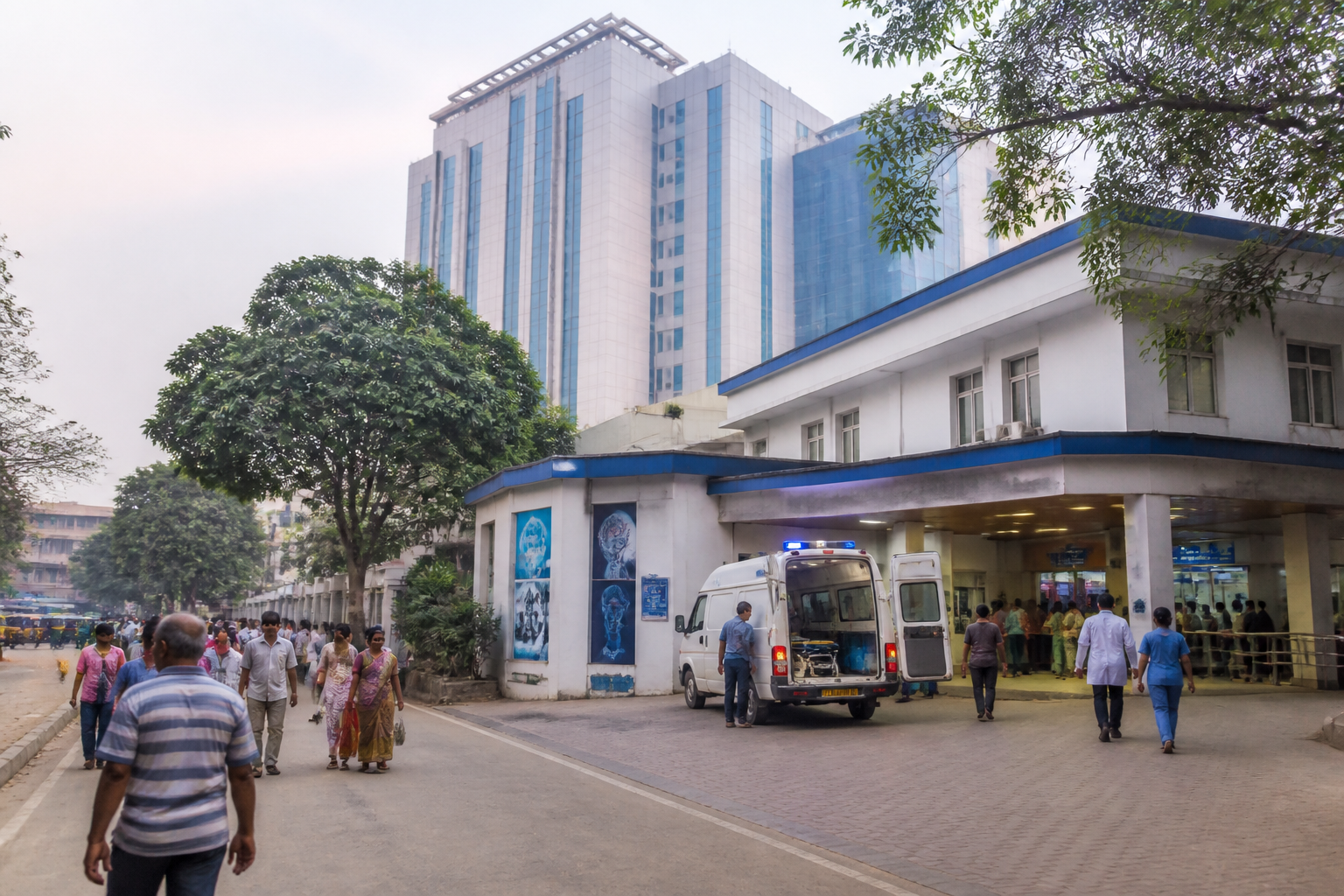
The central message from the 20th CII Healthcare East 2026 conference in Kolkata was not that India needs fewer hospitals. It was that hospital construction alone cannot solve the country’s access problem. Healthcare leaders argued that the next phase of healthcare infrastructure must place more services closer to patients while reserving hospitals for care that genuinely requires centralised clinical capacity.
R. Venkatesh, group chief operating officer of Narayana Health, said healthcare systems needed to move beyond hospital premises and reach patients at their doorsteps. He said infrastructure capacity remained inadequate across the country and in eastern India, but added that the question was not simply how many hospitals or beds should be built. It was also what needed to be housed inside hospitals and what could be delivered around them.
That distinction is important because healthcare is often measured through visible physical assets: beds, buildings, equipment and large tertiary-care campuses. The discussion at the conference pointed towards a wider definition of capacity, one that includes community hospitals, day-care facilities, outpatient departments, diagnostic centres, home-linked services and systems that allow patients to receive continuing care without repeatedly entering a major hospital.
The proposed shift is from episodic treatment to continuity of care. Venkatesh said around 65 per cent of patient care was delivered outside hospitals and 35 per cent within them. The figure, as presented at the conference, suggests that the formal hospital campus is only one part of the care system, even though it remains the most prominent part in public and private investment decisions.
## The hospital is not the whole healthcare network
The distinction between hospital-based and distributed care is also a distinction between different kinds of urban infrastructure. Oncology, transplants and critical care require highly specialised teams, equipment and clinical coordination. Venkatesh said these forms of complex care should remain within hospitals. Outpatient consultations, diagnostics and chronic disease management, by contrast, could be provided closer to patients.
This model changes the role of the hospital. Instead of functioning as the default destination for every stage of treatment, it becomes the centre of a broader network. Smaller facilities and community-level services would handle care that does not require a tertiary hospital, while larger institutions would focus on procedures and conditions that need centralised resources.
The conference discussion also connected the location of services to the speed of treatment. Venkatesh said improving critical care was not only about adding better machines, but also about reaching critical-care services 60 minutes earlier. That observation places geography, travel time and referral systems alongside equipment quality in the definition of healthcare access.
For cities, the implication is direct. A hospital may be well equipped, but its usefulness is reduced if patients must travel long distances through congested roads before reaching it. The location and distribution of first-contact care, diagnostics and emergency response become part of the infrastructure question. Healthcare planning therefore intersects with transport, land use and neighbourhood-level service provision.
## Eastern India’s capacity question
The need for greater capacity in eastern India was a recurring theme at the conference. Prashant Sharma, chairman of the CII Eastern Region Healthcare Sub-committee and managing director of Charnock Hospital, said the region needed more healthcare capacity but that building more large hospitals might not always be the answer.
That argument challenges a straightforward supply model in which unmet demand is addressed primarily through larger campuses. A hospital can add beds and services, but it may not resolve the everyday problems faced by patients who need consultations, diagnostics, chronic disease support or follow-up care. If those services remain concentrated in major institutions, patients may continue to use tertiary hospitals for needs that could be met closer to home.
Richa Singh Debgupta, group chief strategy officer and COO for East and Rajasthan at Fortis Healthcare, described India as hospital-centric, with attention often focused on filling beds. She argued for a care-centric model in which patients who can be treated at a community hospital or day-care facility are not required to use a large hospital.
She cited Singapore’s expansion of ambulatory care, high-end diagnostic centres and standalone genomics centres as an example of bringing services closer to patients. The conference report does not establish that the same model can be transferred directly to Indian cities. It does, however, show the direction of the discussion: capacity is being considered as a network of differentiated facilities rather than as a single hierarchy dominated by large hospitals.
## Technology can improve flow, but not replace capacity
Technology was presented as one tool for making this healthcare network work more efficiently. Debasish Bhattacharya, founder chairman and managing director of Disha Eye Hospitals, said artificial intelligence had been deployed across the group’s 20 hospitals, where about 100 consultants work in outpatient departments.
According to Bhattacharya, AI agents were being used to reduce waiting times by reminding doctors about scheduled appointments and patients waiting to be seen. He described the systems as repetitive, polite and neutral, and said they had helped in a task that could be difficult for administrators to perform manually.
This example is narrower than the wider proposition of distributed healthcare, but it illustrates a practical institutional issue: capacity is not only the number of rooms, beds or doctors. It is also the ability to organise patient movement and use existing clinical time effectively. Reducing avoidable waiting can increase the usable capacity of a facility without adding a new building.
At the same time, the conference material does not provide measurements of the waiting-time reduction, the cost of deployment or the effect on patient outcomes. The example therefore demonstrates an operational application of AI, rather than establishing that technology alone can address healthcare access. Digital tools may improve coordination, but they cannot substitute for clinicians, diagnostics, emergency transport or appropriately located facilities.
## Capital must be measured by capacity created
The financing discussion broadened the question from infrastructure delivery to the way healthcare investment is evaluated. Ayanabh DebGupta, co-chairman of the CII Eastern Region Healthcare Sub-committee and regional director-East at Manipal Hospitals, said equity capital could build platforms and take long-term risks, while insurance could increase patients’ purchasing power.
He argued that healthcare capital should be assessed not only by the return it generates but also by how much capacity it creates, the quality of care it enables and the number of additional patients the system can serve. DebGupta said around $15 billion in private equity funding had entered India’s healthcare sector over the previous five to six years.
The reported figure indicates the scale of financial interest in healthcare, but the conference discussion placed a condition on how that money should be understood. Capital inflow does not automatically translate into equitable access. Its public value depends on what is built, where it is located, which services it supports and how many patients can use it.
This is especially relevant for eastern India, where the stated objective is not simply to increase private healthcare assets but to expand a resilient and inclusive ecosystem. A financing model focused mainly on large hospitals may produce visible investment while leaving gaps in neighbourhood care, diagnostics, chronic disease management and emergency access.
## A governance challenge as much as a construction challenge
The shift towards patient-centred healthcare also creates a coordination challenge. Large hospitals, community facilities, standalone diagnostic centres, insurers, technology providers and government programmes must operate as parts of a care pathway rather than as disconnected services.
The report notes that West Bengal has adopted Ayushman Bharat and that speakers referred to rising investor confidence and infrastructure measures announced in the state budget. It does not provide details of those measures or assess their implementation. Their relevance to the broader discussion is that public policy, insurance coverage and private investment all influence whether healthcare services can move closer to patients.
The state-level and city-level responsibilities are therefore intertwined. Health facilities require land, utilities, transport access, staffing and regulatory oversight. Emergency care depends on travel time and referral coordination. Outpatient and diagnostic services depend on a patient base that can reach them affordably. A distributed system needs clear institutional relationships so that moving a service outside a hospital does not mean weakening clinical accountability.
The conference also offered a measure of regional change. Ayanabh DebGupta said that two decades ago many people from Bengal travelled south for treatment, while the number had reduced significantly and was continuing to decline. This suggests that eastern India has developed greater treatment capacity over time. The evidence supplied does not quantify the change or identify the facilities responsible, but it shows how regional healthcare infrastructure is being judged: not only by buildings constructed, but by whether patients can access more services within the region.
The larger urban question is whether Indian healthcare planning will continue to equate progress with hospital expansion or begin to measure the strength of the complete care network. Hospitals remain essential for complex and critical treatment. But the conference evidence indicates that access also depends on what happens before admission, after discharge and outside the main campus.
The facts presented in Kolkata confirm a broad direction of debate: healthcare capacity must be closer to patients, capital must be evaluated by the capacity and quality it creates, and technology can improve the use of existing systems. What remains unclear is how quickly these ideas will translate into funded facilities, coordinated referral systems and measurable improvements in access across eastern India. Those implementation details will determine whether the shift from hospital-centric to patient-centric care remains a conference proposition or becomes a practical change in the way cities deliver healthcare.
