


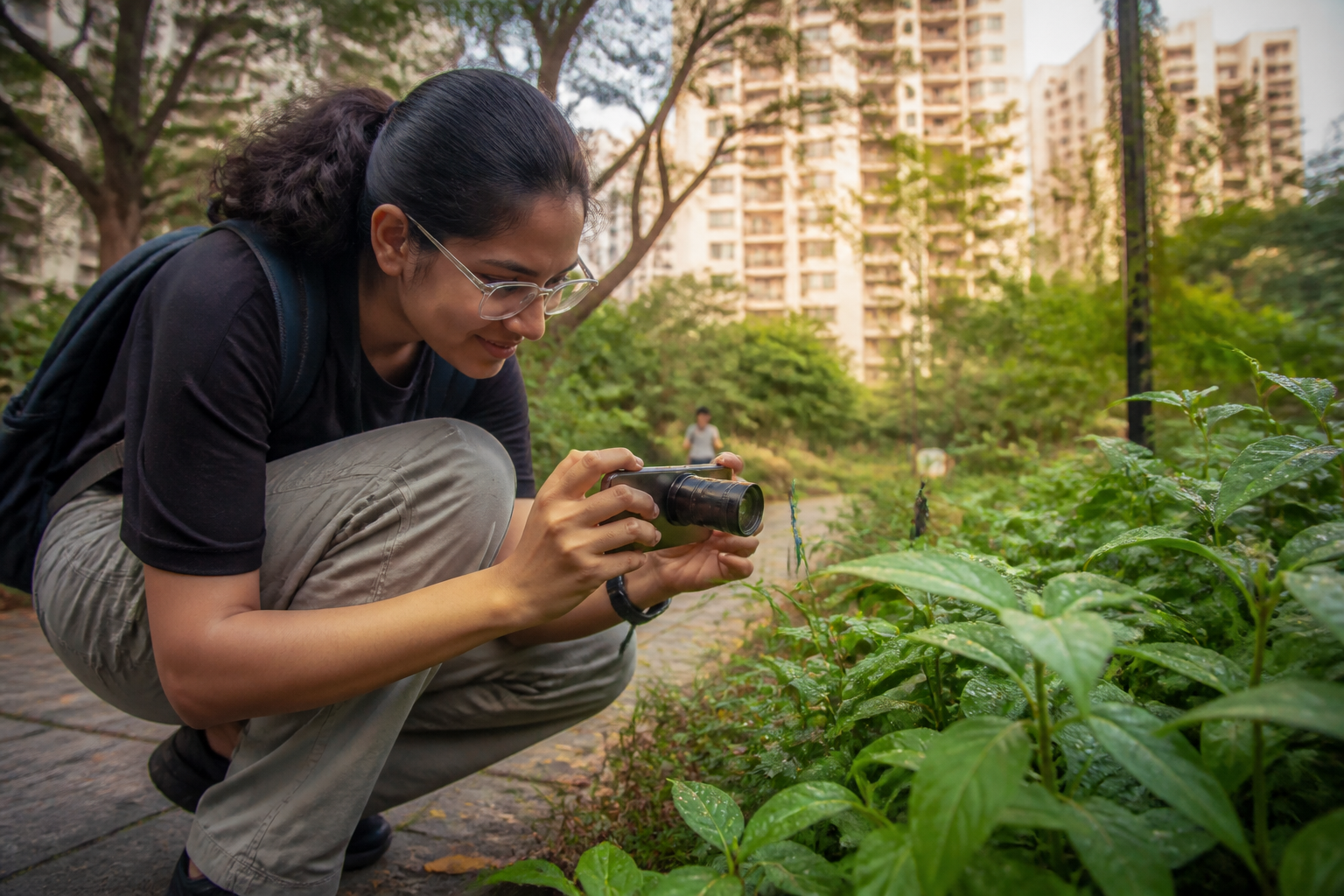
Urban insect biodiversity is becoming more visible in Mumbai as residents, children, nature educators and researchers turn their attention from birds and large wildlife to the smaller creatures living in parks, compounds and forests. The growth of insect walks, workshops, online courses and documentation campaigns is not only creating a new form of urban nature engagement; it is also opening a window into the health of ecosystems that cities often overlook.
The change can be seen in the way people now use public outdoor spaces. Instead of looking only upwards for birds, groups are crouching close to the ground to observe beetles, moths, dragonflies, stinkbugs, ants and other insects. Entomologist V. Shubhalaxmi, who has conducted workshops and walks for two decades, said more people were turning to insects because they were accessible subjects offering an unusually wide variety.
That variety is far larger than many city residents may assume. A major study published in June estimated that the world could have between 14 million and 20 million insect species, more than twice earlier estimates. By comparison, the number of recorded bird species is 11,131. Yet only about 1.2 million insect species have been formally described, leaving a substantial gap between the diversity that exists and the knowledge available about it.
This gap matters in cities because insects are not simply objects of close-up photography. They are decomposers, pollinators and pest controllers, and their presence can reveal changes in the environments where people live. Shubhalaxmi has compared insects to the first-floor occupants of a three-storey building developing cracks from the ground upwards. In that analogy, changes affecting insects may provide an early warning before ecological damage reaches the human level.
The urban spread of insect observation has been assisted by technology. Budget smartphones increasingly include macro lenses that allow users to photograph and examine creatures only a few millimetres in size. Meehir Pawar, a recipient of Sanctuary’s Young Naturalist Award and an expert in dragonflies and damselflies, said these devices enabled people to observe details such as the five-millimetre triangular head of an Indian Grass Mantis or the translucent margins of an Indian Green Tortoise Beetle.
The significance of the camera is not only technical. It changes the relationship between the observer and the insect. A creature that might otherwise be dismissed as frightening or unpleasant becomes identifiable through its shape, colour, behaviour and role in the local environment. Pawar said that fear and repulsion often gave way to awe and appreciation when people learnt more about insects. The process also helps correct common misconceptions, including the belief that dragonflies sting with their tails.
Children appear to be particularly receptive to this form of nature learning. Shubhalaxmi said younger people may have had fewer opportunities to develop insect-related fears, while also having more access to online information and first-hand encounters with nature. The experience can begin in an ordinary residential compound. Viyaan Bhatia, an 11-year-old from Chembur, began raising ant colonies after watching a YouTube video and now maintains six colonies.
His experience also illustrates that insect observation is not a purely individual activity. Friends who are not themselves interested in ants are willing to stop a game when he spots a queen. In a dense city, such small interruptions can turn a compound or neighbourhood open space into an informal site of environmental learning. The activity requires little equipment and does not depend on travel to a protected forest or a specialist institution.
Around this emerging interest, a more organised learning and research network is taking shape. Entomologist Eshaan Pahade established the Entomon Institute of Invertebrate Zoology in 2023 to focus on research and communication. In January, the institute began offering online courses covering subjects ranging from insect behaviour to forensic entomology, which studies arthropods as evidence in death investigations. Participants have ranged in age from seven to 82.
Online communities are adding another layer to the network. The Insect India Facebook group has 46,000 members, with Pahade estimating that around 2,000 are active. Smaller special-interest groups focus on ants, butterflies, moths and beetles. These communities can help residents identify what they encounter, but they also show how citizen observation is becoming a source of distributed knowledge rather than remaining limited to professional entomologists.
The unevenness of that knowledge is particularly visible in beetle documentation. India’s Nature runs an annual Beetle Mania campaign to celebrate and record Coleoptera, the largest order of animals, with nearly 400,000 described species. India is estimated to have 22,299 beetle species, according to the Zoological Survey of India. The fifth edition of the campaign, held from August 22 to September 13 this year, included webinars and encouraged participants to document sightings.
The campaign’s organisers say beetles remain poorly represented in citizen science. Ramnarayan Kalyanaraman, a co-founder of India’s Nature, said butterflies averaged about 461 research-grade observations per species on iNaturalist, while beetles averaged about 24. The comparison points to a major difference in public visibility and documentation between two groups that both occupy urban and rural landscapes.
Kalyanaraman attributed the gap to a lack of popular literature and field guides, especially in vernacular languages, as well as a shortage of outreach groups. Beetles also carry negative associations because some species are linked to crop and property damage, including the cotton boll weevil. Beetle Mania is attempting to address that perception by encouraging observation, documentation and public conversation around the group.
The campaign is also linking scientific recording with local knowledge. Its organisers are inviting species nominations for a Beetles of India pamphlet that will include regional names and local folklore. Jennifer Divyadarshi, a co-founder of India’s Nature, said folklore could connect people to nature and oral storytelling. For those working with rural communities, she added, local perspectives reveal deep relationships with the natural world.
This approach is relevant to urban nature work as well. A city’s biodiversity is not experienced only through formal parks, scientific institutions or designated conservation areas. It is encountered in housing compounds, roadside vegetation, neighbourhood gardens and forest edges. The stories people attach to species can determine whether an insect is noticed, tolerated, removed or protected. Documentation therefore involves not just identifying species but also understanding how communities interpret them.
The institutional challenge is that insects are easy to overlook in urban planning and environmental discussion. Large animals and visible green spaces are more readily represented in public campaigns, while insects are often treated as background life or as pests. The emerging network of walks, courses, online forums and documentation drives is beginning to fill that visibility gap, but the evidence in the supplied reporting does not establish how these activities are being incorporated into municipal planning or formal biodiversity management.
That uncertainty is important. The current movement is clearly expanding public interest and producing new observations, but its effect on long-term urban ecological monitoring remains to be measured. The reported disparity between butterfly and beetle observations shows that participation is not evenly distributed across species. It also suggests that access to field guides, language resources, identification tools and expert support can shape which parts of urban nature become visible.
The climate dimension makes the issue more urgent without making insects a simple measure of environmental health. Shubhalaxmi has called for more research into the impacts of climate change on insects, arguing that they could help identify ecological stress early. The supplied evidence does not specify the extent of those impacts in Mumbai or provide a city-level insect trend. What it does show is a growing effort to create the knowledge base needed to observe change.
Mumbai’s new insect interest therefore represents more than a niche hobby. It is a shift in who gets to participate in environmental observation and where that observation takes place. A child studying ants in Chembur, a smartphone user photographing a mantis, an online learner studying insect behaviour and volunteers documenting beetles are all engaging with the city as a living system.
The next question is whether this expanding public attention can become sustained citizen science and inform formal understanding of urban ecosystems. For now, the clearest development is that insects are moving from the margins of the city’s nature calendar into public view. The programmes, communities and documentation campaigns described in the reporting provide an early structure for that change; research on insect populations and climate impacts will determine how much more the city can learn from them.
