


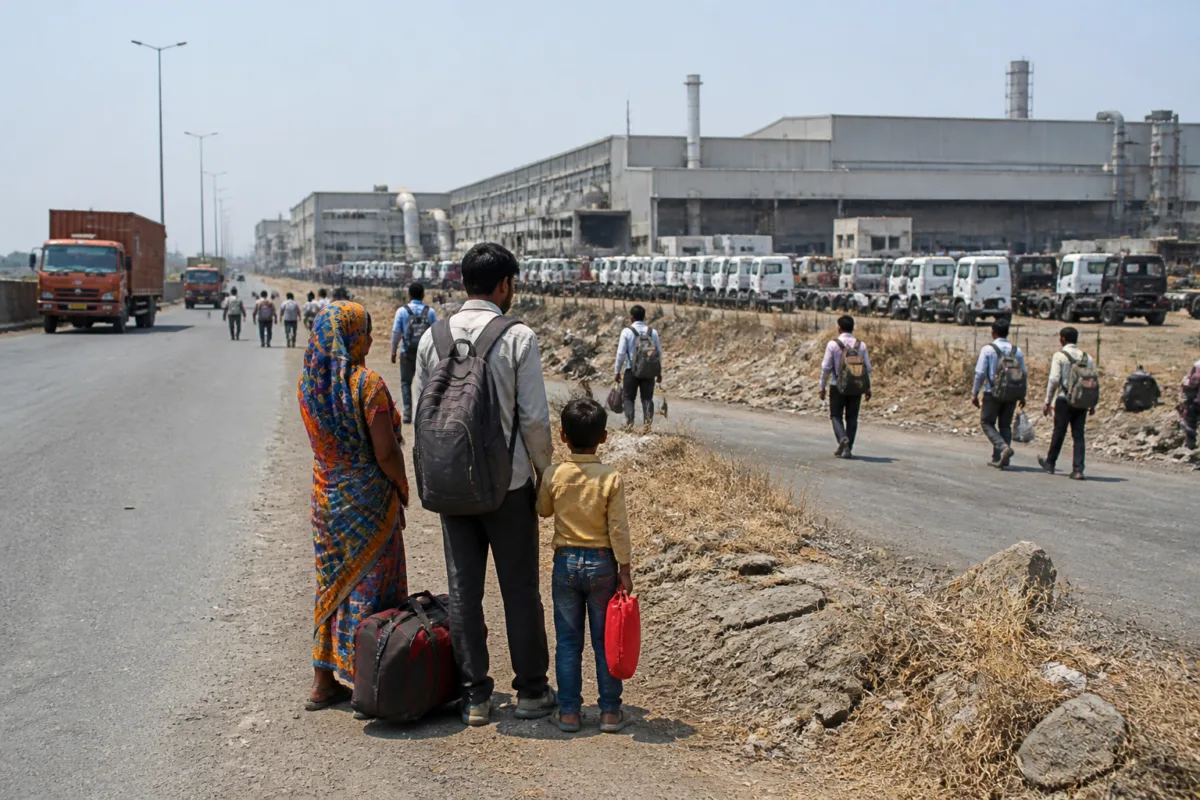
The movement of families from drought-hit Marathwada to Chakan is not simply a search for factory work. It is a visible connection between rural water distress and the capacity of an industrial settlement to provide affordable housing, transport and stable livelihoods to the people it attracts. A report by Sakal – Pune says families from Beed, Dharashiv, Latur, Parbhani, Jalna and Nanded are arriving in the Chakan area after weak farm incomes and limited village employment made it difficult to pay for food, education and household expenses.
Chakan’s industrial economy has created the pull. The area has employment across vehicle manufacturing, other production units, warehouses and construction. Young people, women and entire families are reportedly travelling there in search of whatever work is available. For workers from rain-dependent agricultural communities, the industrial belt represents one of the few visible places where wages can be found throughout the year.
But the same account also shows why employment alone does not resolve migration distress. Workers may find jobs in Chakan, yet rising rents, inflation and transport costs reduce the value of their wages. The result is a form of urban insecurity in which a family leaves its village because there is no dependable livelihood, only to face high living costs and uncertain work in the destination city.
This creates a less visible cost of industrial growth. Chakan can generate jobs without necessarily generating the social infrastructure required by a migrating workforce. When workers arrive with dependants, the demand is not limited to employment. It extends to rental rooms, drinking water, transport, schools, healthcare and access to basic public services. The supplied report does not provide figures for the number of migrants, their wages, rents or the availability of these services, but it describes the pressure created when industrial expansion moves faster than household affordability.
The migration described in the report begins with a rural crisis. Agriculture in the affected parts of Marathwada depends heavily on rainfall, and the report attributes the current movement to severe drought, water scarcity and inadequate employment opportunities. When agriculture cannot provide income and villages lack alternative work, families are forced to treat migration as a household survival strategy rather than an individual career choice.
That distinction matters for urban planning. A young worker who moves alone may be able to accept a temporary job and shared accommodation. A family arriving together has a different set of needs and constraints. Rent becomes a recurring expense, transport becomes necessary if homes are distant from industrial units, and school-going children make frequent movement more difficult. The report specifically notes that families are struggling to meet education and household costs, showing that the impact of migration is distributed across the household rather than confined to the worker.
Chakan’s industrialisation therefore operates as both an opportunity and a pressure point. It offers an employment destination for people displaced by rural economic distress, but it also absorbs that distress without necessarily changing its underlying causes. The industrial belt can provide wages; it cannot by itself restore village water security or create a viable local economy in drought-affected districts.
The pattern also raises a question about how employment centres are planned. Industrial areas are generally evaluated through investment, production and job creation. Those indicators are important, but they do not fully capture whether workers can live near their workplaces, whether wages cover housing and travel, or whether families can access services. In the account from Chakan, the gap between job availability and household affordability is central. A job that requires expensive travel or leaves little money after rent may prevent a family from achieving stability even when employment is technically available.
The institutional responsibilities are divided. Rural administrations and state agencies are responsible for drought response, drinking water supply and livelihood support in the source districts. Industrial-area authorities and local urban bodies must manage the consequences of population inflow in the destination. Employers influence wages and working conditions, while housing and transport systems determine how much of a worker’s income remains after reaching the workplace. The report does not identify specific government schemes, employer programmes or municipal interventions, so their role in this migration cannot be assessed from the supplied material.
What is clear is the relationship between water and mobility. Water scarcity is often treated as a rural development problem, while migration is treated as an urban labour-market phenomenon. The Chakan experience described by Sakal shows that they are part of the same regional system. A drought in one set of districts can increase demand for low-paid work, accommodation and transport in an industrial area located elsewhere. The pressure is transferred rather than eliminated.
The geography of the movement is also significant. The report names six districts—Beed, Dharashiv, Latur, Parbhani, Jalna and Nanded—as places from which workers and families are reaching Chakan. This indicates a broad regional pull rather than a single-village movement, although the supplied account does not quantify the scale or establish whether the migration is seasonal, temporary or permanent. That missing information is important because different forms of migration create different demands. Seasonal workers need flexible accommodation and transport, while longer-term family migration requires schools, health services and more secure housing.
The Chakan case also exposes the limits of measuring urban inclusion through employment numbers alone. Industrial development can expand the formal or semi-formal job market while leaving workers exposed to unstable earnings and high living costs. The report says migrants take whatever work they can find and struggle to manage on low wages. This suggests that access to work and access to a decent urban life are not the same thing, even though both are necessary for migration to improve household security.
For the source districts, the reported migration points to the consequences of insufficient local resilience. The families described are not leaving only because cities are attractive. They are leaving because drinking water, farm income and village employment are inadequate. The statement attributed to young people in the report—asking how families can survive when villages lack water and work—captures the basic condition behind the movement. It is an economic decision shaped by the absence of alternatives.
For Chakan, the immediate urban question is whether industrial growth can be matched by planning for workers who do not arrive alone and who cannot absorb unlimited housing and transport costs. The supplied report records the problem but does not establish the response of local authorities, industrial employers or housing providers. Those details will determine whether Chakan functions as a pathway out of rural distress or as another site where low-income families remain vulnerable.
The evidence currently confirms a clear chain: severe drought and weak rural employment are pushing families out of parts of Marathwada; Chakan’s industrial economy is drawing them in; and rent, inflation and transport costs are limiting the gains from migration. What remains unclear is the scale, duration and legal-employment profile of the movement, as well as the availability of public services in the destination. Those are the facts that need to be established as Chakan’s industrial expansion continues to absorb workers from water-stressed districts.

