


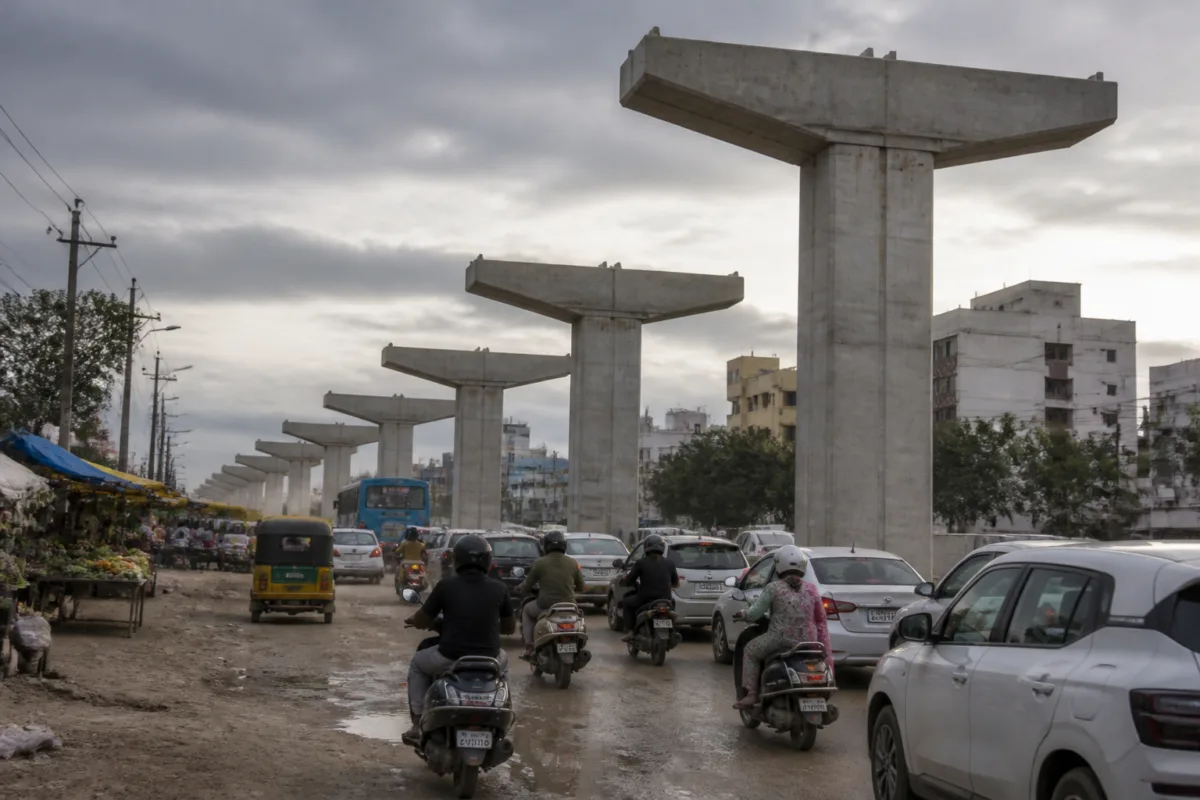
The Uppal elevated corridor was conceived as a solution to congestion on one of Hyderabad’s important eastern approaches. Eight years after construction began, however, its completed concrete piers are still not carrying traffic. Girder installation has yet to begin on the 6.2-kilometre Uppal–Narapally stretch, leaving commuters to navigate the same congested, dusty and damaged road below. The project’s latest delay is not merely a construction-site inconvenience. It shows how an urban mobility intervention can remain functionally absent even after a highly visible part of its physical structure has been completed.
According to a report by Telangana Today, the corridor began in 2018 and may now miss its revised June 2027 completion deadline. The report attributes the slowdown to an acute shortage of labour, particularly specialised workers from northern Indian states who returned to their native areas for Ganesh Chaturthi and extended their stay through Dussehra. A senior MMC engineer said the site was operating with a skeleton crew, while heavy machinery remained idle beside the completed pillar caps.
That explanation places the present delay within a wider implementation problem. Large elevated road projects are assembled through a sequence of interdependent activities: foundations and piers must be followed by the fabrication, transport and installation of girders, and then by the remaining road and traffic works. Completing one visible stage does not make the corridor operational. Until the deck and associated works are finished, the completed piers have no direct mobility value for motorists using the route.
The Uppal–Narapally corridor therefore illustrates the difference between construction progress and public service delivery. From the perspective of the road user, a pier is not a usable transport asset. The benefit begins only when the elevated structure can carry vehicles or when the ground-level arrangement is improved as part of the project. In this case, the report says the beam-less pillars are providing no relief, while the area below them has become a bottleneck for daily traffic.
The immediate effects are being experienced by several groups. Motorists travelling towards Yadagirigutta and Warangal, as well as those moving in the opposite direction, face exhaust fumes, potholes and traffic obstructions. The report also describes persistent dust and declining footfall for shopkeepers along the corridor, as customers avoid the congested stretch. This is an important urban dimension of delayed infrastructure: construction disruption is not confined to the carriageway. It changes how local businesses are accessed and how people choose to move through the area.
The available account does not provide traffic counts, travel-time comparisons, project costs or a quantified estimate of business losses. Those figures would be necessary to measure the corridor’s full economic and mobility impact. What the report does establish is the presence of recurring, visible costs: congestion for commuters, poor road conditions for motorists, dust around the construction zone and reduced customer access for traders.
The labour shortage also reveals the operational dependence of infrastructure projects on specialised workforces. The senior MMC engineer’s statement identifies workers from northern states as a critical part of the project’s construction capacity. Their extended absence has reportedly left the site with a skeleton crew and heavy equipment unused. The immediate issue is workforce availability, but the institutional question is how project schedules account for labour mobility, seasonal absences and the availability of replacement crews when specialised workers leave a site.
The report does not establish whether the labour shortage is the only reason for the delay. It identifies the shortage as the main bottleneck according to the engineer, but it does not provide a detailed project review covering contractor performance, material supply, design changes, payments, land constraints or coordination between agencies. Those factors should not be treated as causes without documentary or official confirmation. The evidence supports a narrower conclusion: the current site slowdown has been attributed by a senior engineer to labour constraints, and the resulting gap has stopped the project from moving from completed piers to girder installation.
The revised June 2027 deadline is itself significant because it indicates that the original schedule has already changed. The corridor started in 2018, but the source report does not state the original completion date or explain when earlier revisions were made. In September, Roads and Buildings Minister Komatireddy Venkat Reddy announced the revised schedule, according to the report. The possibility of another delay therefore places the project in a cycle where deadlines are revised before the public receives the intended mobility benefit.
For urban infrastructure agencies, this distinction matters because a revised date is not only an administrative milestone. It shapes how residents plan journeys, how businesses assess access and how traffic management is organised around a construction site. When a project remains incomplete, commuters continue to bear the conditions that the project was intended to address. In the Uppal–Narapally case, the result is a road corridor where the central obstruction is highly visible but the promised capacity improvement remains unavailable.
The project also raises questions about how construction zones are managed during prolonged delays. The report describes potholes, dust, exhaust fumes and traffic obstructions beneath and around the unfinished structure. It does not detail the traffic-diversion plan, dust-control measures, road-maintenance responsibility or the frequency of site-level reviews. These omissions are important because an extended project requires not only a construction schedule but also a continuing public-realm management plan. When work slows, the surrounding road cannot be allowed to function as though construction will finish on the original timetable.
The institutional responsibility is similarly layered. The project falls within the Roads and Buildings department’s public announcement framework, while the report quotes a senior MMC engineer on site conditions. The supplied material does not fully explain the division of responsibilities among the department, the executing agency, the contractor and local traffic authorities. That governance structure is central to understanding whether delays can be corrected quickly. A labour shortage may be visible at the site, but decisions on mobilisation, contract enforcement, revised schedules and traffic management sit within an administrative chain that the report does not fully map.
What is clear is that the corridor has entered a phase where physical completion of the piers could create an impression of progress without delivering operational progress. For citizens, the relevant measure is not how many pillars stand along the median but whether the project reduces congestion and improves movement. For traders, the relevant measure is whether customers can reach their shops without negotiating a dusty and obstructed corridor. For authorities, the relevant measure should be whether the next construction stage has a credible workforce and implementation sequence.
The Uppal elevated corridor’s significance therefore lies in the gap between an announced infrastructure solution and the lived experience beneath it. Hyderabad’s commuters are still exposed to the congestion that the corridor was intended to ease, while the surrounding businesses are absorbing the effects of prolonged works. The latest report confirms that girder installation has not begun and that the revised June 2027 deadline may be at risk. It does not establish a new completion date or a full explanation for the project’s history of delay. The next material developments will be the mobilisation of the required workforce, the start of girder installation and any formal update to the June 2027 schedule.

