


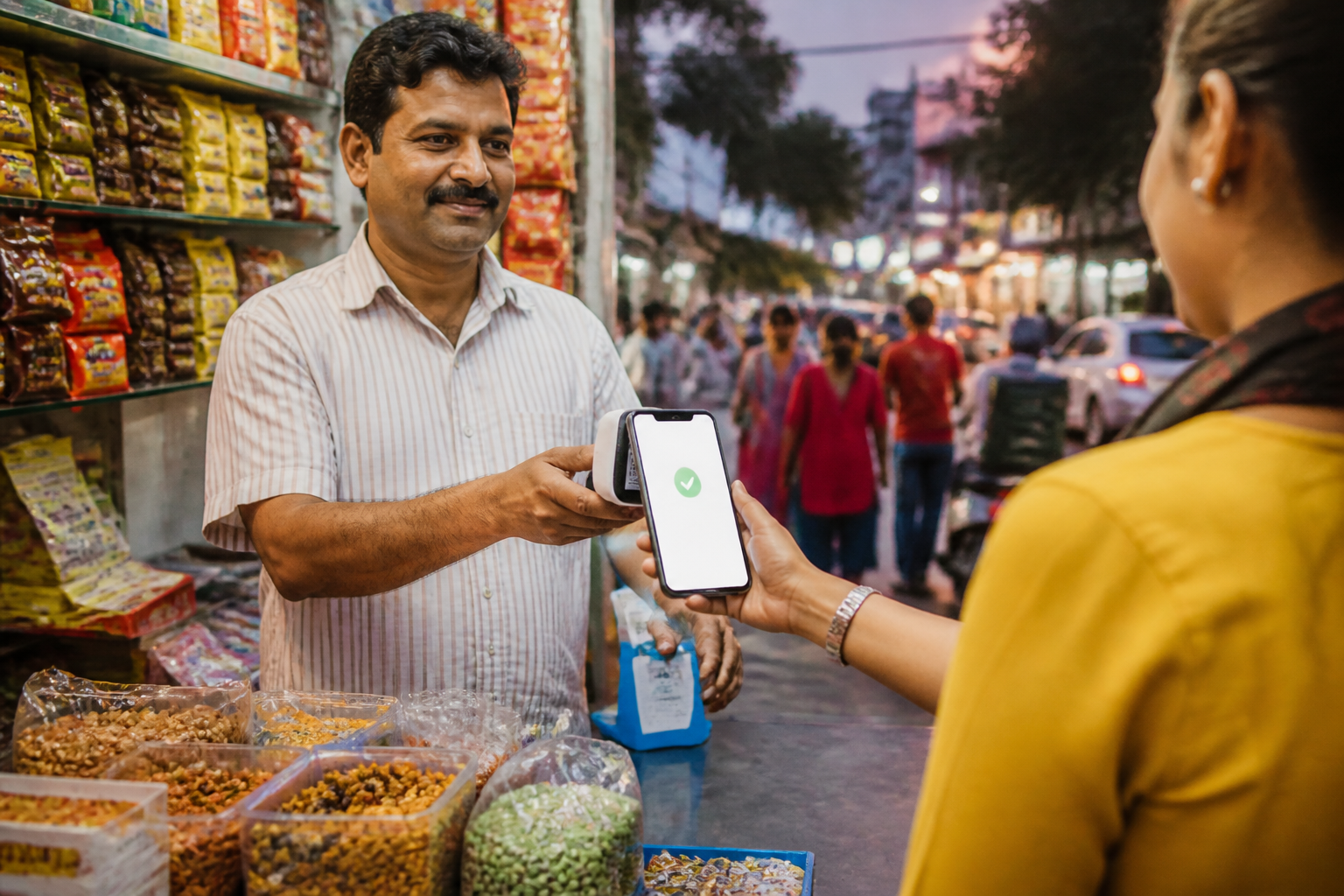
India’s decision to introduce a Merchant Discount Rate (MDR) on selected high-value UPI payments marks a significant change in how the country’s most widely used digital payment infrastructure may be funded. From October 15, merchants will pay a 0.4% fee on eligible person-to-merchant UPI transactions above Rs 2,000, subject to a maximum charge of Rs 300 for payments of Rs 75,000 or more. Consumers will not be charged, and person-to-person transfers will remain free.
The immediate market reaction was positive. Paytm shares rose as much as 6% in early trading, One MobiKwik Systems gained more than 5% and Pine Labs advanced nearly 3%, according to the Economic Times report. The movement reflected investor expectations that payment companies could finally earn recurring revenue from a portion of the UPI transaction value they process.
The more important story, however, is not the stock-market response. It is the gradual transition of UPI from a public digital utility whose expansion has been supported through government incentives into a payments ecosystem expected to build a more durable commercial model. That transition raises questions about who pays for digital infrastructure, how costs are distributed across the network and whether monetisation can be introduced without weakening UPI’s affordability and reach.
The structure of the new charge is deliberately narrow. Transactions up to Rs 2,000 will continue to carry zero charges and account for more than 95% of UPI’s person-to-merchant transaction volume, according to the government’s FAQ cited in the report. Small merchants under the person-to-person-to-merchant framework, including vendors receiving up to Rs 1 lakh a month through UPI QR codes, will also remain exempt.
This design protects the part of the ecosystem most closely associated with everyday digital payments: small-value purchases at neighbourhood shops, food stalls, service counters and other small businesses. It also means that the introduction of MDR is not a universal UPI fee. It is a selective charge aimed at larger-value merchant transactions, where the government and payment industry have identified greater capacity to support the cost of processing.
The NPCI has clarified that the fee will be borne by merchants and cannot be passed on to customers. In practical terms, a consumer paying for an eligible purchase through a UPI application should continue to see the listed price rather than a separate UPI transaction charge. Person-to-person transfers will also remain free. The distinction matters because UPI’s public acceptance has been built partly on its predictability: users can transfer money instantly without having to calculate a platform fee.
For merchants, the impact will depend on transaction size, business margins, payment volumes and how acquiring banks and payment companies implement the arrangement. Large merchants accepting higher-value UPI payments will become the principal fee-paying participants, while smaller merchants and low-value transactions will remain protected by the exemptions. The available material does not establish how individual merchants will respond or whether businesses will alter their payment preferences after the new framework begins.
The policy also reflects a larger institutional problem. UPI requires continuous investment in cybersecurity, fraud prevention, network capacity and operational resilience. As transaction volumes have expanded, the underlying infrastructure has had to support more users, more merchants and more frequent transactions. The government has said that reliance on subsidies alone is not viable for the next phase of growth and that a balanced, self-sustaining framework is needed.
The Reserve Bank of India has backed the move, saying that MDR on large-value UPI transactions could help the digital payments ecosystem scale, innovate and continue serving consumers and businesses across the country. RBI Governor Sanjay Malhotra had earlier stated that the costs of digital-payment infrastructure ultimately have to be borne by someone, while also emphasising the need to keep digital payments accessible, affordable and safe.
That position captures the central policy trade-off. UPI is not only a private payment product. It is a shared digital network that supports commercial activity across cities, towns and rural markets. Its value depends on broad acceptance, reliable settlement and user trust. But a network of that scale cannot expand indefinitely without a clear mechanism for financing technology upgrades, fraud controls, customer support and risk management.
The regulatory basis for the change comes from an amendment to the Payment and Settlement Systems Act, 2007, which creates a framework for imposing MDR on UPI and other notified electronic payment modes. This is significant because it moves UPI monetisation from an uncertain or discretionary support arrangement towards a formal legal and contractual structure.
The difference between those models is important for infrastructure planning. A subsidy can be revised through annual policy decisions and budgetary priorities. A transaction-based fee, by contrast, connects revenue directly to the value flowing through the system. The government has argued that this could encourage more companies to expand their operations and create a more competitive payments market. Whether that competition improves service quality or reduces costs for merchants will depend on how the framework is administered.
Brokerage estimates cited in the report indicate the scale of the potential revenue pool. Bernstein expects banks to receive about Rs 14,000 crore, payment applications around Rs 7,000 crore and the network about Rs 1,000 crore. These are brokerage estimates, not realised collections, and the final outcome will depend on the share of transactions that qualify, the distribution of fees and the behaviour of merchants and payment providers.
Emkay Global Research said the move could benefit Paytm and Pine Labs and estimated that Paytm could generate Rs 1,120 crore in UPI MDR revenue in FY28, while Pine Labs could generate Rs 155 crore in the same year. JM Financial estimated incremental revenue of Rs 2.1 billion for Paytm in FY27 and Rs 4.7 billion in FY28. The brokerage also noted that the notified rate was higher than its earlier modelling, although broader carve-outs reduced the share of eligible transaction value.
Other brokerages have similarly revised their views on Paytm. JM Financial raised its target price to Rs 2,150, while Jefferies raised its target from Rs 1,600 to Rs 2,100. Bernstein named Paytm its top pick and cited merchant lending, operating leverage and the potential introduction of UPI MDR among its reasons. These views are attributed to the respective brokerages and should not be treated as independent forecasts established by the announcement itself.
The immediate benefit for payment companies is the conversion of transaction volume into potential revenue. Before this change, a company could process a large amount of UPI payment value without earning a conventional MDR on much of that activity. The new framework creates a route to monetise selected flows. Payment firms will still need to compete on merchant acquisition, reliability, settlement services, fraud prevention and related financial products, but the core payment activity could begin contributing more directly to earnings.
For banks, the arrangement could create another revenue stream linked to merchant acquiring and payment settlement. For the NPCI, the change may provide an additional source of funding for the network. For merchants, it introduces a cost that did not previously apply to the eligible transactions, although small merchants and low-value payments remain outside the principal charge structure. For consumers, the stated policy outcome is continuity: no new UPI fee at the point of payment.
The urban significance of this shift lies in the role digital payments now play in everyday city economies. UPI connects formal businesses, informal vendors, transport users, service providers and consumers through a common payment interface. A change in its funding architecture therefore affects more than fintech balance sheets. It can influence how small businesses accept payments, how larger retailers manage transaction costs and how public and private institutions invest in digital commerce infrastructure.
The exemptions are intended to preserve inclusion, but their effectiveness will depend on implementation and monitoring. The government has specified thresholds for transaction value and small-merchant receipts, while NPCI has stated that merchants cannot pass the MDR on to customers. The supplied material does not provide evidence on enforcement mechanisms, dispute resolution or the treatment of merchants that operate across different categories.
What the announcement confirms is a controlled attempt to make UPI more financially sustainable without imposing a direct charge on consumers or disrupting the bulk of low-value transactions. What remains uncertain is the final distribution of revenue across banks, payment applications, network operators and merchants, as well as the extent to which the new model changes competitive behaviour.
The next important milestone is October 15, when MDR is scheduled to begin on the specified transactions. Its effect will be measured not only through the earnings of companies such as Paytm, MobiKwik and Pine Labs, but also through merchant adoption, payment reliability, fee compliance and the continued use of UPI for everyday purchases. The policy’s larger test will be whether a system built for universal digital access can develop a commercial revenue model without losing the affordability and reach that made it central to India’s payments landscape.

