


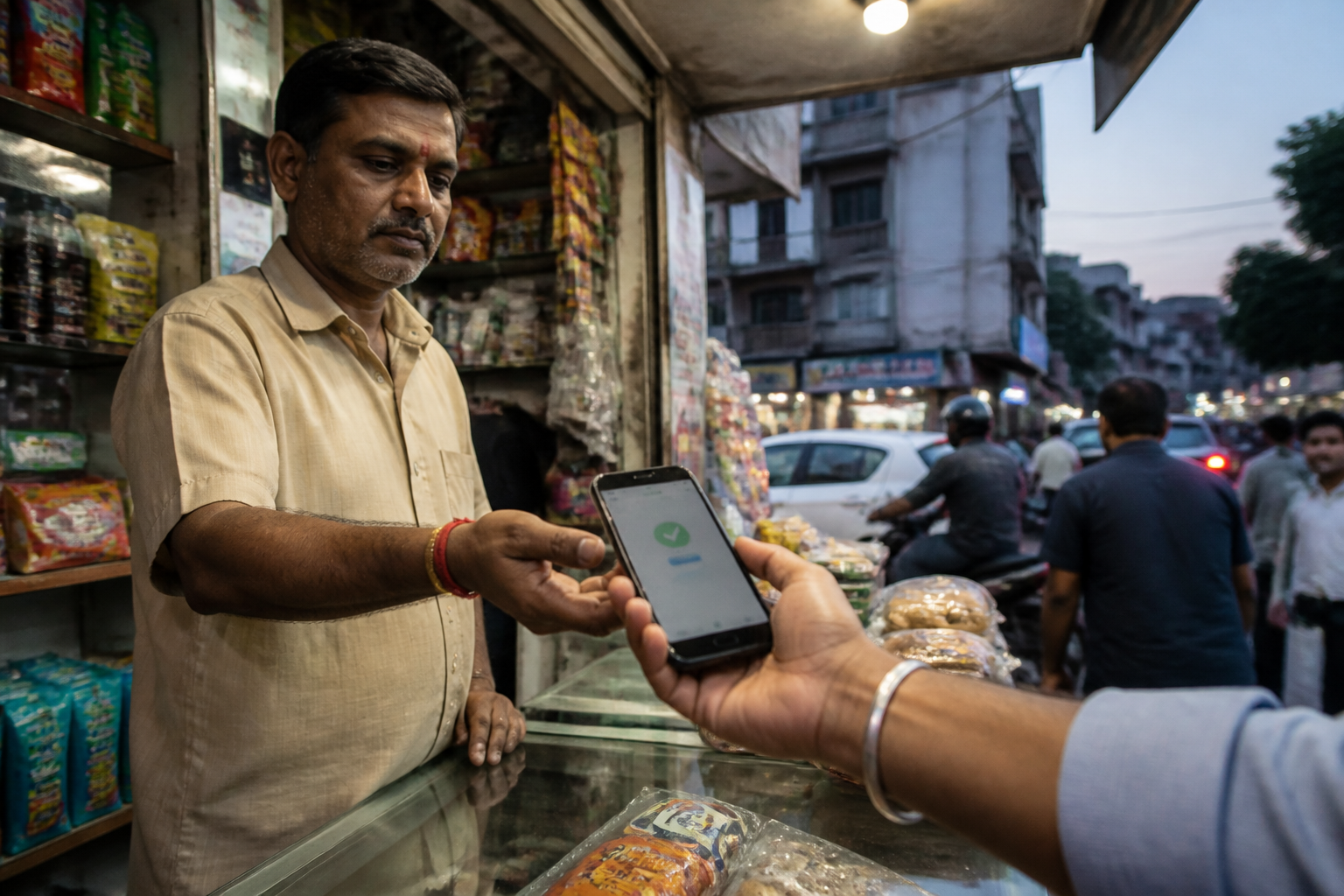
The UPI MDR debate is no longer only about whether merchants may eventually pay a fee on large digital transactions. It is becoming a test of how India funds the infrastructure behind instant payments, who carries the cost of keeping that infrastructure secure, and whether a system promoted as low-cost can remain dependent on public support as its volumes grow.
The immediate controversy follows a government notification issued on 14 September, according to a report by Aaj Tak Business. The notification makes clear that banks and payment systems cannot impose direct or indirect charges on UPI transactions of up to ₹2,000 or on RuPay debit-card payments. It does not, however, clarify whether transactions above ₹2,000 will attract a merchant discount rate, or MDR. That gap has become the centre of the current dispute.
MDR is the fee associated with processing a digital payment. In the UPI ecosystem, any such charge would affect the commercial relationship between merchants, banks, payment applications and the payment infrastructure operated by the National Payments Corporation of India, or NPCI. The supplied report says that a UPI and Services Steering Committee led by NPCI will decide the level of any MDR.
That institutional detail matters. A decision on payment charges would not be a simple price revision by one bank or one app. It would shape how the wider payment network is financed and how costs are distributed across the participants who use it. The notification therefore leaves an important policy question unresolved: whether the government intends to preserve a fully subsidised model, introduce charges only for certain transactions, or create a broader funding mechanism for the system.
Ashneer Grover, BharatPe co-founder and former Shark Tank India judge, has criticised the possibility of charging for UPI. In a post on X cited by Aaj Tak Business, Grover described any UPI charge as similar to tax collection and questioned why merchants or users should bear an additional burden when banks and public institutions are already profitable. He argued that UPI is widely regarded as a major Indian achievement but could now become subject to a new financial levy.
Grover cited figures that, according to the report, include a ₹2.87 lakh crore surplus transferred by the Reserve Bank of India to the government, total profits of ₹4.11 lakh crore for listed banks, and an NPCI surplus of ₹1,888 crore. The figures were presented as part of his argument that the need for an MDR has not been adequately explained. They do not, by themselves, establish the cost of operating UPI or determine how a future charge would be structured, but they focus attention on the relationship between the financial strength of major institutions and the continuing use of public support for digital payments.
The government’s stated rationale, as reported by Aaj Tak Business, is different. UPI has become large enough to require sustained spending on safe operations, cybersecurity and fraud prevention. The report says the government believes that relying only on subsidies may not be viable for the next phase of UPI’s expansion. This frames the issue as a funding problem rather than simply a question of whether digital payments should remain free.
That distinction is important because “free” at the point of use does not mean costless to operate. Payment networks require technology systems, connectivity, monitoring, fraud controls and institutional coordination. The supplied report does not provide a detailed cost statement for these functions, nor does it specify the proposed MDR rate, the transactions to which it would apply, or whether the fee would be paid by merchants, banks, payment apps or another participant. Those unresolved details make it impossible to assess the eventual burden from the available evidence.
The dispute also exposes the tension between adoption and sustainability in public digital infrastructure. UPI has been promoted as an accessible electronic payment channel, and the latest notification protects transactions up to ₹2,000 from direct and indirect charges. That threshold provides a clear safeguard for smaller-value payments. At the same time, uncertainty around transactions above the threshold creates a different concern for businesses that depend on digital payments for regular sales and collections.
For merchants, the practical question is not only whether a fee is introduced but how it is passed through the payment chain. A charge could be absorbed by banks or payment applications, recovered from merchants, or reflected in commercial arrangements between network participants. The report does not establish which model is under consideration. Without that information, the public debate risks treating “UPI charges” as a single policy when the eventual impact could vary substantially by transaction size, merchant category and payment instrument.
The comparison with cash adds another layer to the policy debate. Grover cited the cost of operating ATMs and cash logistics in India at ₹30,500 crore. He argued that if the objective is to reduce the cost of maintaining ATMs and encourage UPI, the government could close or optimise ATM infrastructure and focus more directly on digital payments. This is a policy argument, not evidence that ATM networks can be withdrawn without consequences. Cash remains part of the payment system described in the report, and no official decision to shut ATMs has been identified in the supplied material.
The comparison nevertheless reveals the competing infrastructure choices facing policymakers. Physical cash requires ATMs, replenishment, transport and logistics. Digital payments require network capacity, cybersecurity, fraud prevention and continuous investment. A lower visible cost for users in one system does not eliminate the underlying cost; it shifts who pays and through which institutional channel. The current UPI MDR debate is therefore also a debate over whether India should finance payment infrastructure through public subsidies, private fees or a combination of both.
The legal and administrative route described in the report adds to the significance of the issue. During Parliament’s monsoon session, Section 10A of the Payment Act was amended, according to Aaj Tak Business, creating a route for MDR to be imposed on electronic payments. The report says the NPCI-led UPI and Services Steering Committee will determine the charge. The available material does not include the text of the amendment, the government notification or the committee’s operating rules, so the exact scope of the authority and the consultation process remain unclear.
That lack of detail is central to the governance question. A payment charge affects more than the companies that process transactions. It can influence merchant acceptance, the attractiveness of different payment instruments and the cost of everyday digital commerce. The government has publicly linked potential charges to the need to fund security and future expansion, while Grover has questioned whether the financial case has been demonstrated. A credible policy framework would therefore need to make the cost base, subsidy arrangement and allocation of responsibilities visible to the participants affected by the decision.
The numbers cited in the dispute also need to be read in context. RBI surplus, bank profits, NPCI surplus and ATM operating costs describe different institutions and different functions. They cannot be directly compared without knowing what expenses, revenues, reserves and responsibilities each figure includes. The report uses them to present opposing arguments: one that the system can be funded without a new charge, and another that the scale and security requirements of UPI may eventually exceed what subsidies can support.
What the evidence establishes at this stage is narrower but still consequential. Payments up to ₹2,000 through UPI and RuPay debit cards are protected from direct or indirect charges under the reported 14 September notification. The treatment of UPI payments above ₹2,000 is not clear from the notification as described. A statutory change has reportedly created a route for MDR, and an NPCI-led committee is expected to determine the rate. The government’s justification is linked to cybersecurity, fraud prevention and expansion, while Grover has challenged the need and fairness of such a charge.
The next stage of the debate will depend on the publication of the detailed rules, the proposed MDR structure and the institutional explanation of how the money will be used. Until those details are available, the issue should not be reduced to a simple choice between free UPI and paid UPI. It is a question of how India allocates the cost of a digital public-facing network, and whether that allocation is transparent enough for merchants, consumers, banks and payment platforms to understand.
