


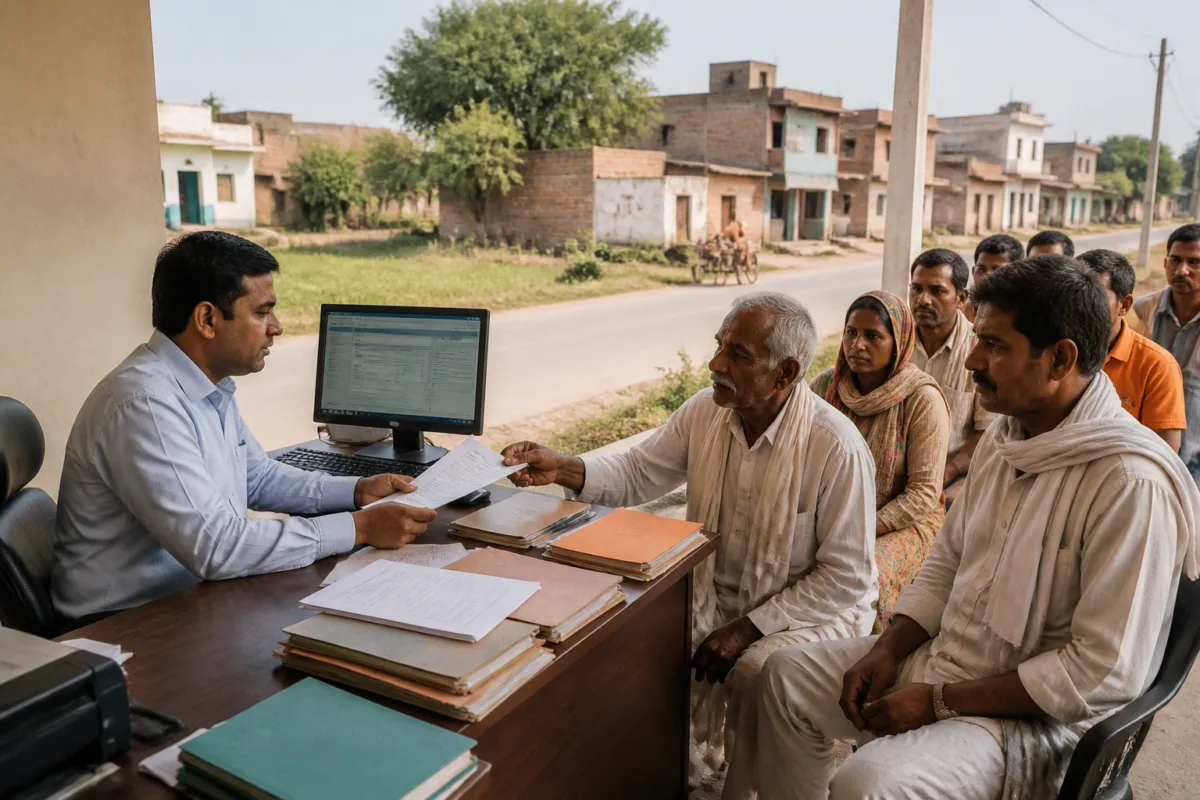
Uttar Pradesh’s revenue reforms are moving the state’s rural administration beyond traditional land-record maintenance towards a wider system of property documentation, digital farmer identification, direct welfare transfers and monitored grievance redressal. The reported preparation of more than 1.05 crore Gharounis and 1.44 crore Farmer Registry registrations shows the scale of that transition, but it also makes record accuracy, correction mechanisms and access for digitally excluded citizens central to its success.
The reforms matter because rural governance is built not only through roads, electricity and water infrastructure, but also through the documents that establish who occupies a home, who is recognised as a farmer and who is eligible for public assistance. For households that have historically relied on informal or fragmented records, a formal administrative entry can influence their ability to deal with government departments, establish claims and access services.
The SVAMITVA Scheme’s Gharouni initiative addresses one of the least formalised parts of rural property administration: residential holdings in inhabited village areas. According to the Revenue Department figures reported by the Times of India, more than 1.05 crore Gharounis have been prepared and distributed in Uttar Pradesh. These documents record rural residential property and provide households with documentary evidence concerning the homes they occupy.
That distinction is important. A Gharouni can improve the clarity of local property records and help identify the location and extent of a residential holding, but it should not automatically be treated as an unrestricted ownership guarantee or as a universal right to mortgage the property. Its legal effect depends on the applicable framework and the nature of the rights recorded. The immediate administrative gain is the creation of a more systematic record where documentation has often been incomplete or difficult to access.
This changes the role of the revenue system at the village level. Instead of treating property records as files maintained primarily for official use, the reform presents them as documents with direct relevance to families. A household may need reliable property information while dealing with a public authority, resolving a dispute or establishing the identity of its residence. The quality of the system will therefore depend not just on the number of Gharounis distributed, but also on whether discrepancies can be identified and corrected through an accessible process.
The second major pillar is the Farmer Registry. Uttar Pradesh has recorded more than 1.44 crore registrations, placing it first nationally according to the departmental figures cited in the report. The registry is intended to create a structured digital record of farmers and relevant agricultural details, allowing departments to verify identity and eligibility for schemes where registration is required.
The administrative problem it seeks to address is familiar across large rural systems. Farmers often interact with several programmes involving income support, agricultural inputs, insurance-related services and other assistance. Where information is fragmented or inconsistent, verification can be slow, applications can require repeated documentation and errors can affect access. A consolidated registry can reduce duplication and provide departments with a shared information base, subject to the rules governing individual schemes.
The scale of the registration drive is significant because Uttar Pradesh’s agricultural regions are not uniform. The western and central plains, eastern districts and Bundelkhand have different landholding patterns, agricultural conditions and livelihood pressures. A registry covering these areas can support more organised planning, but only if the underlying data reflects those differences and remains current.
That condition is crucial. A large database is not necessarily an accurate database. Farmer records can change as land is transferred, holdings are divided, cultivation arrangements alter or family circumstances change. The value of the registry will be measured by the ease with which citizens can correct errors, add eligible cultivators and receive assistance when digital procedures are difficult. If registration becomes a compulsory gateway without effective support, it could create a new administrative barrier rather than remove an old one.
The same question of delivery appears in the Mukhyamantri Krishak Durghatna Kalyan Yojana. The scheme provides financial assistance in eligible cases involving the death or disability of farmers and other covered persons associated with agricultural activity. The Revenue Department’s account says the mechanism has shifted from operation through an insurance company to direct transfer into the beneficiary’s bank account through the district magistrate.
This is more than a change in payment technology. The disbursement chain determines how responsibility is assigned and how an applicant can track a claim. With the district administration at the centre, the process links verification, approval and payment more directly. Bank transfers also create a documented transaction trail. Yet the system still depends on timely decisions, clear communication and accurate verification. Direct transfer can make payment more transparent, but it does not by itself guarantee that eligible families will receive assistance quickly.
Certification procedures provide another example of the state’s attempt to reuse verified information. The government has sought to simplify caste certificate applications by promoting Aadhaar linkage and reducing documentary requirements for eligible family members after one member has received a certificate. The intended benefit is to avoid repeatedly asking families to establish information that has already been examined by the administration.
Such simplification can reduce travel, paperwork and processing burdens, particularly for rural and economically weaker households. It can also make procedures more consistent across revenue offices. But a family member’s certificate cannot automatically establish every other applicant’s eligibility. Individual verification and applicable legal safeguards remain necessary, especially when Aadhaar-linked information is used. The reform’s administrative promise therefore rests on balancing convenience with the integrity of certification.
The Integrated Grievance Redressal System, or IGRS, forms the accountability layer of these changes. Revenue complaints may concern land records, property documentation, certificates, administrative decisions or welfare delivery. The reported system allows complaints to be registered and tracked, while multiple levels of scrutiny and monitoring by the Chief Minister’s Office are intended to improve disposal.
The distinction between disposal and resolution is important. A complaint can be closed on a digital platform without addressing the citizen’s underlying problem. Cross-checking, understandable responses and opportunities for further review are therefore as important as the existence of an online tracking number. For people in remote villages, a functioning grievance system can reduce dependence on repeated visits to government offices, but only if citizens can submit complaints easily and receive a meaningful response.
Taken together, the initiatives represent an institutional shift from paper-heavy administration towards linked records and more traceable service delivery. Gharounis provide a formal record for rural residential property. The Farmer Registry creates a digital identity framework for agricultural administration. Direct transfers seek to make welfare payments easier to track, simplified caste certificates reduce repetitive documentation, and IGRS monitoring makes pending grievances more visible to senior officials.
The shift also changes the risks the administration must manage. Paper records can be difficult to access, but digital records can spread an error quickly across multiple services. A missing entry, incorrect identity detail or outdated land-related record may affect eligibility, payment or certification. Personal information must also be handled within applicable legal and administrative safeguards. Citizens without smartphones, reliable internet access or digital literacy will need assisted channels rather than being expected to navigate every process independently.
The figures cited in the report—more than 1.05 crore Gharounis and more than 1.44 crore Farmer Registry registrations—demonstrate coverage, not necessarily outcomes. The next measure of performance is whether property disputes become easier to address, whether farmers face fewer repeated verification demands, whether eligible accident assistance reaches families promptly and whether caste certificate applicants experience genuinely shorter procedures. The supplied figures do not establish those outcomes yet.
That is the larger urban and development question raised by the reforms. Rural property documentation and agricultural databases are often treated as administrative back offices, but they shape how households interact with the wider state. They influence access to benefits, the reliability of planning information and the ability of local governments to understand the populations they serve. In a state as large and diverse as Uttar Pradesh, the quality of these basic records can affect the efficiency of many other public systems.
The reforms therefore mark a substantial expansion of the revenue department’s role, but their lasting significance will depend on implementation after registration or certification. Accurate records, regular updating, accessible correction procedures, privacy safeguards, assisted digital services and credible grievance resolution will determine whether the new systems reduce administrative burdens. The evidence currently confirms a large-scale move towards documented and digital rural governance; it does not yet establish how evenly that transition is working across districts or how consistently it is improving citizens’ everyday access to services.

