


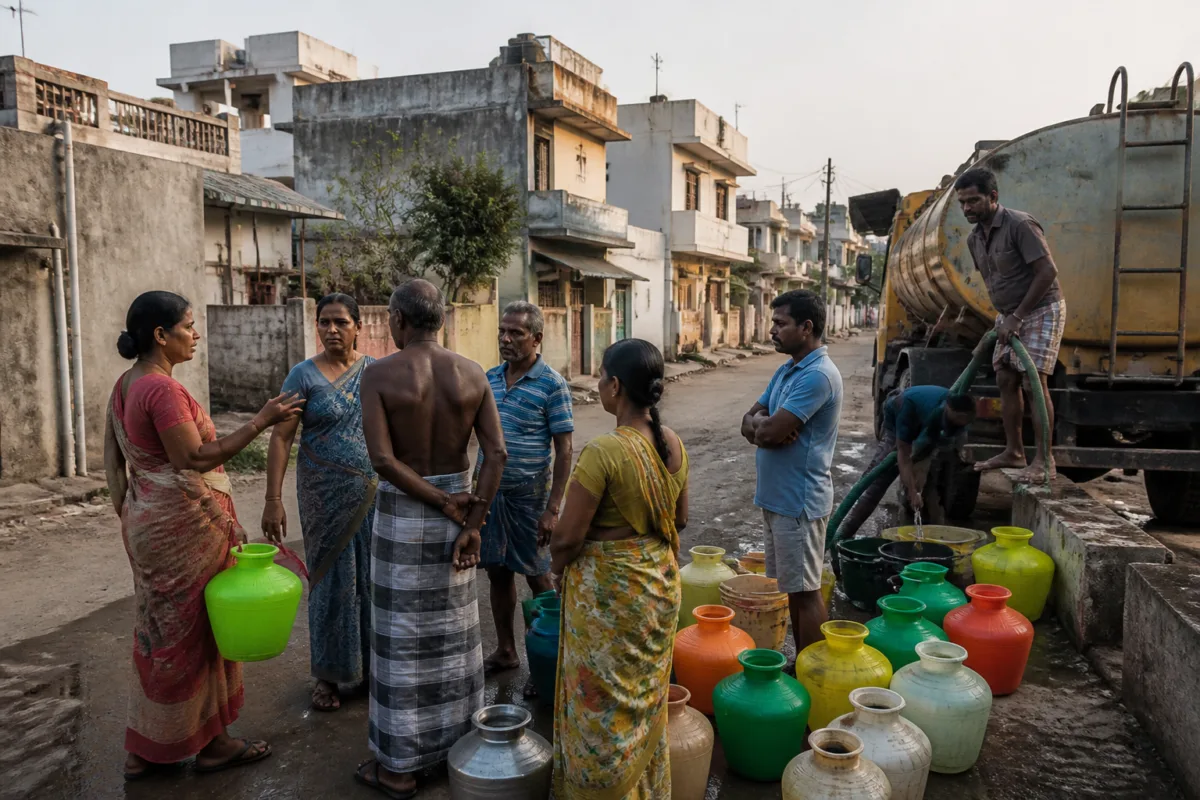
A disputed confrontation over a drinking-water complaint involving Tamil Nadu Deputy Speaker and Thuraiyur MLA Ravishankar has raised questions about how citizens can approach elected representatives with basic civic grievances. The allegation remains subject to verification because two videos attributed to the complainant present conflicting accounts of the incident.
According to a report by Dinamalar, Karthikumar, 48, a resident of Thuraiyur in Tiruchirappalli district, approached Ravishankar’s residence after repeated complaints about drinking-water problems in Neesavalar Colony allegedly produced no action. The report says a video subsequently circulated on social media showing Karthikumar being assaulted by Ravishankar and some of his supporters.
The report identifies Ravishankar as the MLA representing the Thuraiyur constituency, Tamil Nadu’s Deputy Speaker and the district secretary of his party. It also says that he had previously put up a banner asking constituency residents and party workers not to meet him at his residence or at the party office in Mannachanallur, a position that had attracted public discussion.
The account became contested after another video was released the following morning. In that recording, Karthikumar reportedly said that Ravishankar had not assaulted him and that the earlier video had been edited or misrepresented. A further video released later the same day carried a different account. In it, Karthikumar allegedly said that Ravishankar had assaulted him and that he had been threatened with harm to himself and his family if he did not deny the assault.
The report says Karthikumar later admitted himself to Tiruchirappalli Government Hospital for treatment. In his account to the newspaper, he said he had gone to Ravishankar’s house on the night of the reported incident after seeing a car outside and assuming that the Deputy Speaker was present. He said he intended to raise the drinking-water problem in his neighbourhood.
Karthikumar further alleged that he was assaulted without being asked the reason for his visit. He also alleged that Mannachanallur Inspector Krupanithi came to the hospital, threatened to register a case against him and took him to the Deputy Speaker’s residence. According to the report, Karthikumar said he was made to record a video denying the assault and was threatened before leaving the house.
These claims have not been independently established in the material supplied for this report. Dinamalar’s account does not include a police statement, a case number, a medical opinion, a response from Ravishankar or an official explanation from the Tiruchirappalli district administration. It also does not establish the circumstances in which either video was recorded or whether the footage was edited.
The episode nonetheless exposes a familiar governance problem: drinking-water complaints often become dependent on informal access to local political representatives when residents believe routine administrative channels have failed. The supplied report does not provide details of the water-supply disruption, the number of households affected, the responsible local body or the status of earlier complaints. Those gaps make it impossible to assess the underlying civic failure beyond Karthikumar’s allegation that repeated representations had not produced action.
The alleged involvement of a police officer, if established, would raise a separate question about the use of law-enforcement authority in a dispute involving a citizen and an elected representative. That claim also requires confirmation through an official police response, complaint record or other primary documentation. At present, the available account is based on the newspaper report and statements attributed to Karthikumar.
The report says the party leadership has ordered its disciplinary committee to investigate the matter. That inquiry is the only formal next step identified in the supplied material. Confirmation of the incident, the medical findings, any police action and the disciplinary committee’s conclusions will be necessary before responsibility can be established.

