


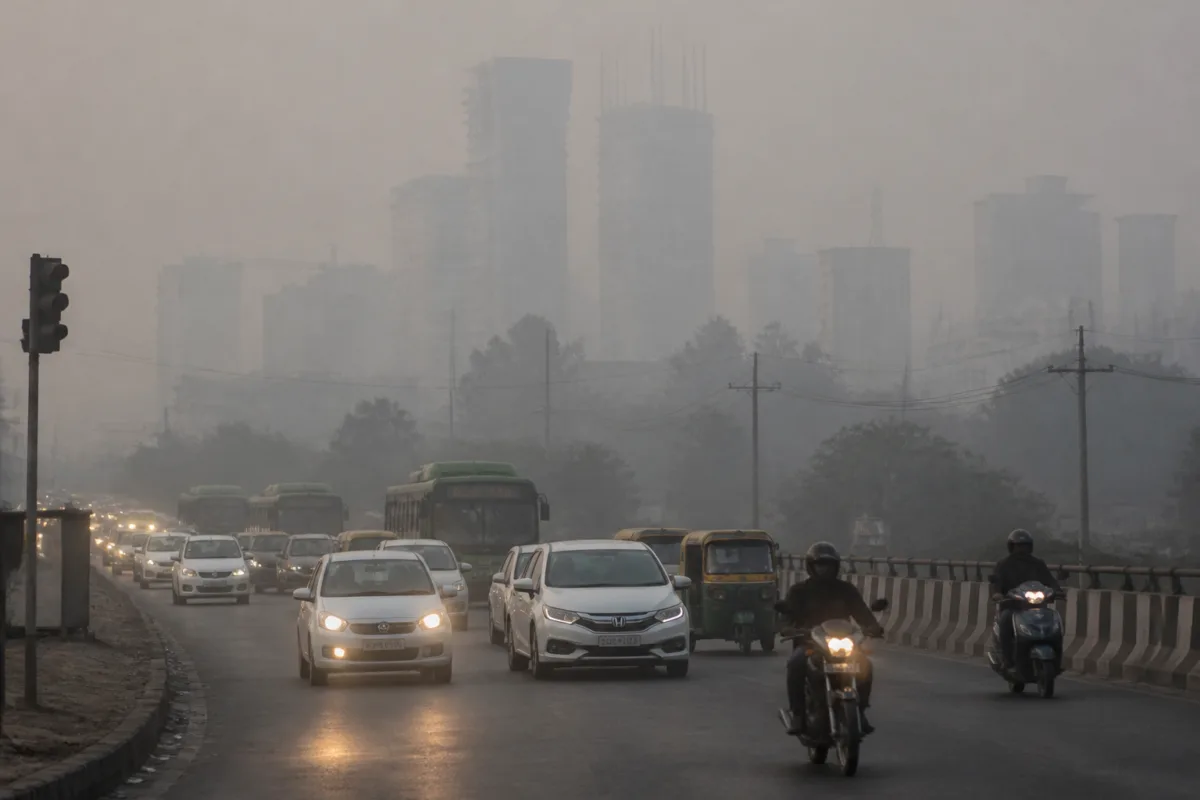
Delhi pollution is expected to remain in the very poor to severe category for at least the next seven days, with weak winds likely to slow the dispersal of particulate matter across the capital and neighbouring National Capital Region cities, according to the Air Quality Early Warning System cited by Live Hindustan.
The forecast comes after Delhi’s air quality remained above an AQI of 300 from November 2. The city recorded an AQI of 376 on Diwali, the highest reading for the festival since 2021, when the Diwali-day AQI was 381, the report said. The air-quality deterioration followed a fall in temperature and a reduction in wind speed, which allowed pollutants to remain trapped in the atmosphere.
The early-warning system estimates that wind speeds will generally remain below 10 kilometres per hour during the coming week. Under these conditions, pollutant dispersion is expected to remain slow, and Delhi’s air quality could cross an AQI of 400, classified as severe. The weather is also expected to turn colder, with light to moderate fog possible in the mornings as wind direction changes and light cloud cover develops.
Delhi experienced heavy haze and smog on Monday morning. Safdarjung recorded a maximum temperature of 30 degrees Celsius, 0.5 degrees above normal, according to the report. The combination of calmer winds, lower temperatures and morning fog can reduce the movement of pollutants near the ground, although the supplied report does not provide a separate quantified assessment of each factor’s contribution.
Pollution levels also rose sharply on Diwali night. The report, citing AQI.in data covering 5 pm on November 8 to 11 am on November 9, said Delhi’s AQI reached 1,760 at one point. It also reported that fine particulate matter, or PM2.5, reached 3,744 micrograms per cubic metre at Mundka at 2 am. The reading was 3,023 micrograms per cubic metre at Jawaharlal Nehru University at 4 am and 3,008 at the NSUT West Campus at 5 am.
According to the same report, PM2.5 levels crossed 2,000 micrograms per cubic metre at 11 Delhi Pollution Control Committee monitoring stations. The report noted that data for 10 pm was unavailable. It attributed the hourly air-quality figures to the Delhi Pollution Control Committee and stated that the PM2.5 concentrations were more than 62 times the applicable standard.
The deterioration extended across the wider NCR. On Monday, Faridabad recorded an AQI of 350, Gurugram 345, Ghaziabad 324 and Noida 334, all within the very poor category. Bahadurgarh in Haryana recorded an AQI of 400 and was reported as the most polluted city in the country that day. The report also said Punjab recorded more than 1,000 farm-fire cases in a single day for the first time this season, while attributing the exceptionally high Diwali-night pollution in Delhi to extensive firecracker use.
The Air Quality Early Warning System’s seven-day outlook and the monitoring data together indicate that residents in Delhi and adjoining NCR districts may continue to face highly polluted air while atmospheric conditions remain unfavourable. The next significant change will depend on wind speed, wind direction, temperature and the development of fog and cloud cover during the coming week.

