


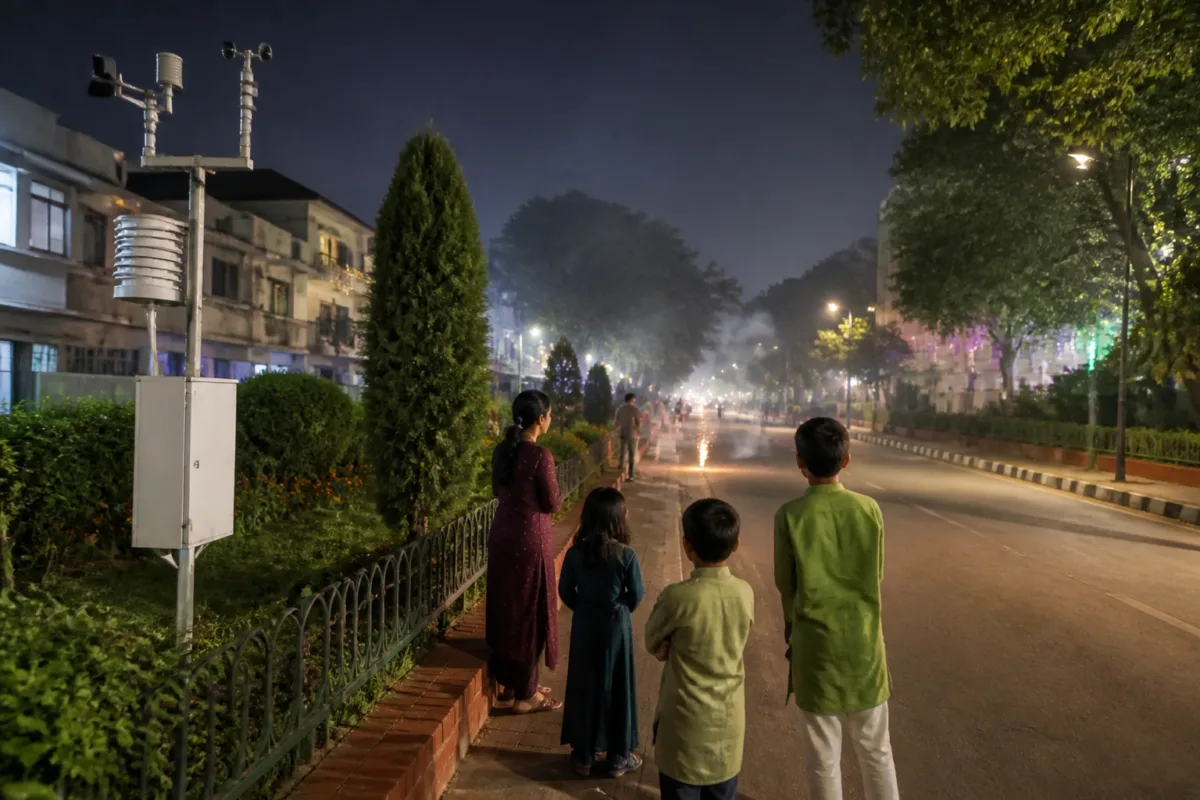
Chandigarh recorded its cleanest Diwali air quality in four years, with none of its six monitoring locations entering the severe pollution category and air quality returning to the satisfactory range by 3 am after a brief spike during the permitted firecracker window.
According to data from the Chandigarh Pollution Control Committee (CPCC), pollution levels rose across all six monitoring stations after firecracker activity began between 8 pm and 10 pm. The highest AQI was recorded at Sector 25 at 326, followed by PEC-12 at 312, IMTECH-39 at 310 and Sector 53 at 304. All four locations briefly entered the very poor category.
Sector 17 recorded an AQI of 170 and Sector 22 recorded 158, keeping both locations in the moderate category. The AQI scale classifies readings of 51-100 as satisfactory, 101-200 as moderate, 201-300 as poor, 301-400 as very poor and readings above 400 as severe.
Four of the six monitoring locations recorded lower AQI levels than during Diwali 2025. Sector 22 showed the largest improvement, falling from 234 last year to 158 this year. IMTECH-39 declined from 318 to 310, while Sector 17 fell from 183 to 170. Sector 53 remained at 304 and PEC-12 remained at 312.
Sector 25 was the only location to record a year-on-year increase, with its AQI rising from 296 in 2025 to 326 this year. Despite that increase, the location did not enter the severe category.
The improvement was more pronounced when compared with Diwali pollution levels in 2023 and 2024. Sector 22 recorded AQI readings of 392 in 2023 and 395 in 2024, compared with 158 this year. At Sector 53, the AQI fell from 453 in 2023 and 350 in 2024 to 304 this Diwali.
Baseline air quality before the celebrations was also relatively better. On November 1, the AQI ranged from 77 at Sector 53 to 133 at IMTECH-39. Before the firecracker window on Diwali, most monitoring locations were in the satisfactory category, although some were in the moderate range.
The CPCC attributed the controlled pollution episode to residents adhering to the prescribed two-hour firecracker period and a considerable reduction in firecracker use compared with previous years. The committee also said favourable weather conditions helped air quality recover after the temporary spike.
The results show how the duration of high-emission activity, background pollution levels and weather conditions combined to shape Chandigarh’s Diwali air quality. Although four locations entered the very poor category during the evening, the city avoided the severe readings recorded at some locations in earlier years.
The CPCC said the public response reflected growing environmental awareness, particularly among young people and schoolchildren. It will continue Green Diwali campaigns in schools and other awareness initiatives aimed at encouraging more eco-friendly celebrations.

