


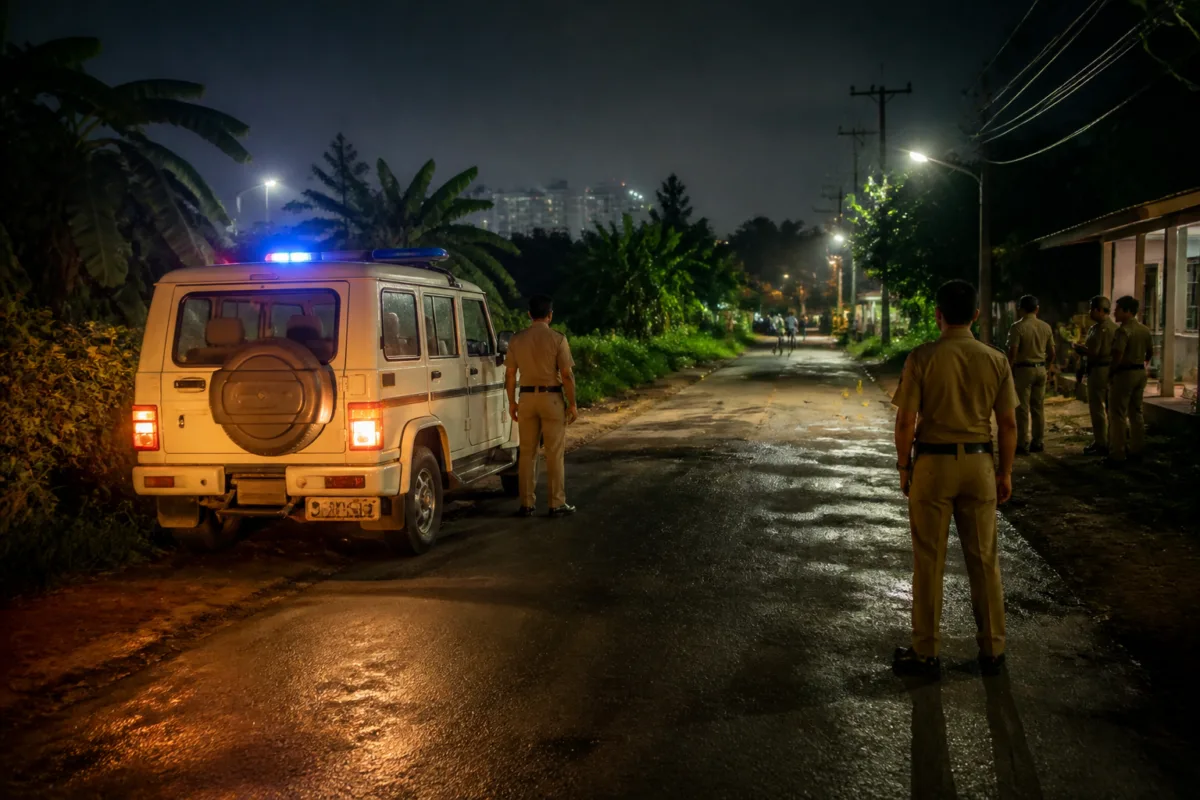
The reported death of a rape-and-murder accused in a police firing operation in Raiganj has brought West Bengal’s emerging encounter model into focus, with the incident becoming the fourth such death reported since the Bharatiya Janata Party government took office around six months ago. The immediate police account is that Dilip Roy fired at officers during a late-night operation in North Dinajpur district and was killed when police returned fire. The larger question is how a state responds to serious crimes when investigation, arrest and trial are increasingly accompanied by a public promise of force.
According to a report by Anandabazar, Roy was identified during the investigation into the death of a 12-year-old girl who had been missing for two days. Her body was recovered from the Kulik forest area on Friday, after she had left home on a bicycle. The report said investigators examined closed-circuit camera footage and saw a neighbour, identified as Roy, riding the girl’s bicycle. Police subsequently used mobile tower location information to trace him to the Gauri gram panchayat area near Raiganj.
Police conducted an operation there late on Sunday night. The police account, as reported by Anandabazar, is that Roy opened fire after realising that officers had arrived. A bullet hit the wheel of a police vehicle, following which police fired back and injured him. He was taken to Raiganj Medical College, where doctors declared him dead. The account remains a police version of the confrontation; the report does not provide an independent reconstruction of the firing or details of a judicial or departmental inquiry.
The case is significant because it did not end with an arrest and a prosecution. The death of the accused before a court could examine the evidence closes the conventional criminal justice process in that case, even though the investigation into the alleged rape and murder may still continue. It also leaves questions about the recovery of weapons, the sequence of the firing, the presence of witnesses and the forensic record to be answered through official procedures rather than through the encounter narrative alone.
The Raiganj incident follows three other encounter deaths described in the report. On 8 July, Prabhas Mondal, the principal accused in the rape and murder of a 13-year-old girl in Baruipur, South 24 Parganas, was allegedly killed after attempting to take a police firearm and shoot during a crime-reconstruction exercise. On 27 October, Prahlad Das, who was accused of raping and murdering a minor relative in Gaighata, North 24 Parganas, was similarly reported to have seized a weapon and fired at police during a reconstruction. The same day, Samaul Sheikh was killed in Murshidabad in a confrontation during the reconstruction of a murder case, according to the report.
These incidents share a notable operational pattern in the account: each involved an accused person allegedly attacking police during a reconstruction or arrest-related operation. In two of the cases, the police version involved the accused taking or attempting to take an officer’s firearm. In Raiganj, the reported confrontation took place before arrest. The similarities do not establish that the incidents were identical, but they make the documentation of procedure particularly important. The central issue is not simply whether police officers have a right to defend themselves. It is whether each use of lethal force can be independently examined and demonstrated to have met the legal and operational standards governing armed policing.
West Bengal Chief Minister and police minister Suvendu Adhikari has defended the police response. The report quoted him as saying that police do not shoot every accused person, but have the right to retaliate in self-defence when attacked. He also said officers had been given operational latitude in cases involving alleged rapists and murderers, drug traffickers and Bangladeshi infiltrators, and that prior approval from a superior would not be required in some such cases. He said firearms had not been issued to police officers to be kept in their pockets.
That political framing marks a shift in the meaning of an encounter. A police firing may begin as an operational event, but it becomes a governance model when political leaders publicly define broad categories of suspects for whom force is presented as an expected response. The distinction matters because police powers are ordinarily exercised through evidence collection, arrest, custody, prosecution and trial. When the political message gives prominence to immediate punishment, the public’s understanding of justice can move away from adjudication towards executive action.
The report also records opposition criticism. Trinamool Congress general secretary Abhishek Banerjee questioned the government’s encounter model after another minor was allegedly raped in Purba Bardhaman and a local youth was arrested. He argued that encounter deaths had not stopped sexual violence and cited figures of more than 2,500 rape cases, over 600 murders and more than 34,000 serious crimes in recent months. Those figures are political claims as presented in the report, and the supplied material does not identify the underlying official dataset or explain the counting method. They therefore require separate verification before being used as a measure of crime trends.
The dispute exposes the difference between visible enforcement and effective crime prevention. An encounter is an event that can be communicated immediately: an accused person is located, police report an attack, and the suspect dies. Preventing sexual violence is institutionally more demanding. It requires timely registration of complaints, investigation, protection of victims and witnesses, forensic capacity, prosecution and a court process capable of reaching a lawful conclusion. The Raiganj report says Roy had previously faced allegations of sexual offences and had allegedly avoided arrest on two occasions. It also says local mediation meetings had settled both matters. If established through records, that history would point to an earlier breakdown in formal reporting and enforcement, rather than only a failure at the moment of the final police operation.
That detail places local governance alongside policing. The report says the earlier allegations were resolved through community-level meetings, described as salish. Such informal settlements can prevent cases from entering the formal system, particularly when victims or families face social pressure, economic dependence or fear of retaliation. The supplied account does not establish why those settlements occurred or who participated in them. It does, however, raise a structural question: whether the state is addressing the conditions that allow repeated allegations to disappear from official records, or only responding with force after a serious crime has escalated.
The Raiganj investigation itself shows the importance of ordinary urban and regional infrastructure. The accused was reportedly identified through road-facing CCTV footage, while mobile tower location data helped police trace his whereabouts. These tools can strengthen investigations, but they do not replace the need for a documented chain of evidence. CCTV footage must be preserved and authenticated; digital location information must be interpreted carefully; forensic findings must be recorded; and the accused’s death must not prevent the state from establishing what happened to the victim and whether others were involved.
The wider regional context in the report shows that encounter policing is not limited to West Bengal. It lists recent police shootings or confrontations in Bihar, Madhya Pradesh, Assam, Andhra Pradesh, Haryana, Uttar Pradesh, Gujarat, Delhi and Punjab. The circumstances described vary widely, from alleged attempts to seize police weapons to confrontations during transport or arrest operations. Some suspects were killed and others injured. The common thread is the use of a police encounter narrative to explain lethal force, often before the public has access to a full independent account.
This pattern makes institutional review more important than political messaging. In each death, records should establish who authorised the operation, what intelligence was available, whether officers followed arrest and search procedures, whether firearms and ammunition were accounted for, whether medical assistance was provided promptly, and whether an independent inquiry was initiated. The supplied report mentions questions from families of those killed, even where relatives also said the accused had received punishment. That response reflects public anger over grave crimes, but it cannot substitute for a lawful determination of how the death occurred.
The state’s stated zero-tolerance approach also contains a category problem. Rape, murder, drug trafficking and alleged illegal migration are different offences with different evidence requirements, investigative methods and legal processes. Grouping them together under a single promise of police latitude risks treating a political priority as an operational standard. Effective policing depends on precision: identifying the offence, securing evidence, protecting victims, arresting suspects lawfully and presenting the case before a court.
For cities and towns, the issue is not abstract. Raiganj’s roads, cameras, mobile networks, police stations, medical college and local administrative bodies form the practical system through which residents experience safety and justice. When that system produces a death before trial, public confidence depends on transparency at every stage. The same infrastructure that helps identify a suspect must also help preserve evidence about the police operation.
The evidence supplied in the report confirms that West Bengal has seen a sequence of police encounter deaths under a government that has publicly endorsed a tougher policing approach. It also confirms that the latest case involved a child’s alleged rape and murder, a police claim of retaliatory firing and a death before arrest. What remains unresolved in the supplied material is whether independent inquiries have been completed, whether the police accounts have been corroborated, and whether the state’s approach has reduced serious crime. Those are the questions that will determine whether the encounter model is a short-term enforcement message or a lasting transformation of criminal justice in West Bengal.

