


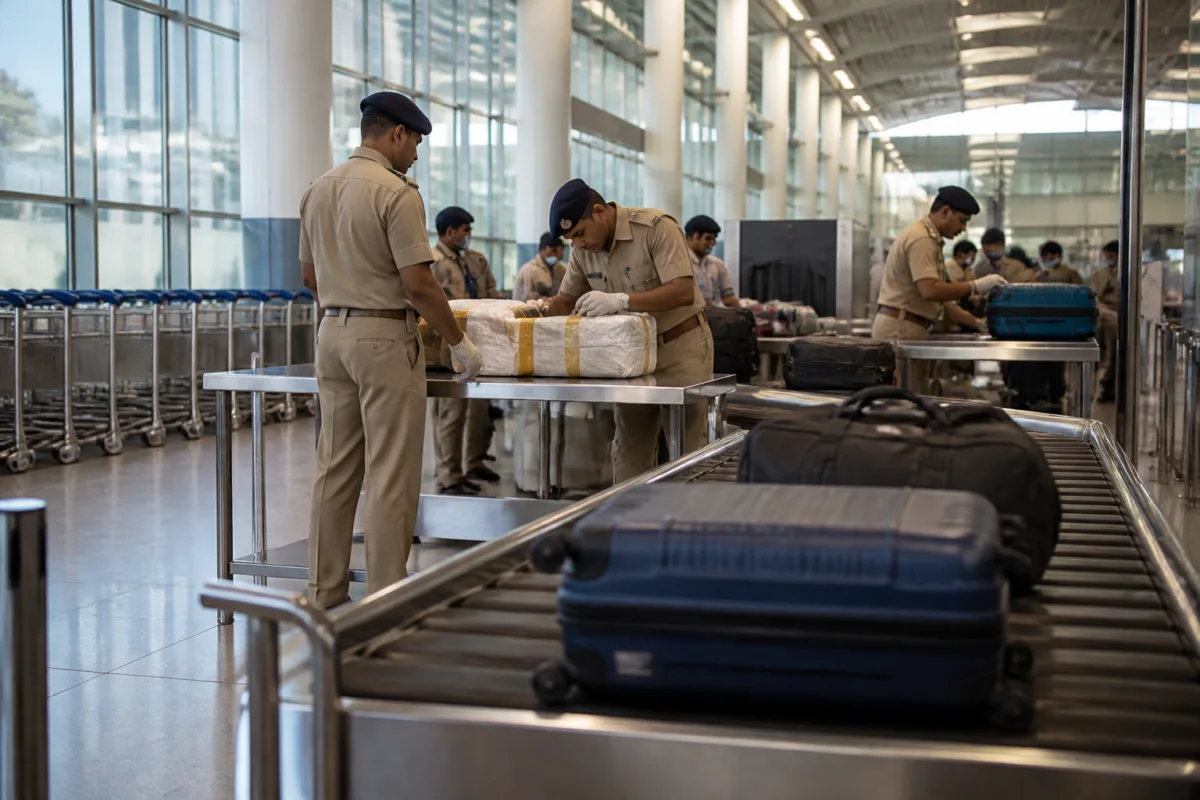
Customs authorities are reported to have increased surveillance at major Indian airports over the alleged movement of hybrid cannabis from Thailand and Bangkok during the winter and festival season, but the central claims in the report require confirmation from an official customs statement or other primary document.
The report by Nav Gujarat Samay – Ahmedabad says the heightened watch covers Ahmedabad and Surat as well as airports in Mumbai, Delhi, Chennai and Bengaluru. It attributes the information to sources in a central agency and says agencies are monitoring passengers arriving from Thailand and Bangkok, along with suspected carriers listed by enforcement teams.
The report does not identify the officials who ordered the surveillance, provide a customs circular or disclose the number of passengers, parcels or seizures covered by the alleged operation. It also does not establish whether customs authorities have formally classified the winter period as a higher-risk season for hybrid cannabis trafficking.
According to the report, the alert follows the arrest of a young man and woman from Surat at Ahmedabad airport four days earlier in connection with the alleged seizure of hybrid cannabis worth approximately ₹13 crore. The report does not provide the date of the seizure, the investigating agency, the sections of law invoked, the quantity recovered or details of the court proceedings. These details require verification before they can be treated as established facts.
The report further says that travellers visiting Thailand and Bangkok may be offered financial incentives to carry cannabis packets into India. It attributes this claim to unnamed central-agency sources and says some passengers may be used as carriers without fully disclosing the contents of their luggage. The report does not name an accused person, identify a case file or provide an official account of how such a network allegedly operates.
If confirmed, the reported surveillance would extend beyond passenger screening. The article says customs officials have also been instructed to monitor foreign parcels arriving through foreign post offices and air-cargo channels. It does not specify whether these instructions were issued nationally, which customs zones are covered, or whether any new screening procedure has been introduced.
The reported focus on airports points to the role of international passenger and cargo gateways in enforcement against narcotics trafficking. Ahmedabad and Surat are presented as important points of attention in Gujarat, while Mumbai, Delhi, Chennai and Bengaluru are identified as other major airports under observation. The material supplied does not include comparative seizure data for these airports or evidence showing that trafficking has increased during the current winter season.
The report also links the alleged supply chain to concerns about cannabis consumption among teenagers, college students and young people living in paying-guest accommodation. It says sources have reported cannabis use at private parties and in hookahs or cigarettes after tobacco is removed. These are source-attributed claims, and the report does not provide health department data, police records, school or college surveys, or named experts to establish the scale of the alleged consumption.
The article says drug sellers may target areas near educational institutions and places with a high concentration of teenagers because of the prices allegedly available for cannabis. Again, it does not identify specific locations, cases or enforcement records. Without such evidence, the claim should be understood as an allegation contained in the source report rather than as a verified description of a wider pattern.
The report also refers to the continued use of hookahs at private parties despite Gujarat’s restrictions on hookah bars. It says imported hookahs from Dubai, Muscat and Sharjah are available in the market at prices ranging from approximately ₹1,000 to ₹10,000, with flavours and charcoal also readily available. The report does not clarify whether these products are legally imported, seized by authorities or connected to the alleged cannabis trafficking network.
From an urban governance perspective, the report raises questions about how airport customs, postal authorities, air-cargo operators, local police and agencies responsible for narcotics enforcement coordinate their work. It also raises a separate public-health and youth-safety concern, but the supplied material does not contain verified information on treatment demand, consumption trends or the effectiveness of current prevention programmes.
The distinction between an enforcement alert and a confirmed trafficking trend is important. A surveillance instruction may reflect a precautionary response, intelligence input or a specific investigation; it does not by itself prove that demand or trafficking has increased across the country. Similarly, a reported seizure can establish an individual case only after the relevant agency and court records confirm the facts.
Primary-source confirmation is therefore needed on the alleged ₹13 crore seizure at Ahmedabad airport, the identity and role of the investigating agency, the reported instructions covering five major airports, and the monitoring of foreign-post and air-cargo parcels. Customs authorities would also need to clarify whether the alert is temporary, seasonal or part of a wider enforcement operation. Until those details are confirmed, the claims should remain attributed to the source report rather than presented as settled facts.

