


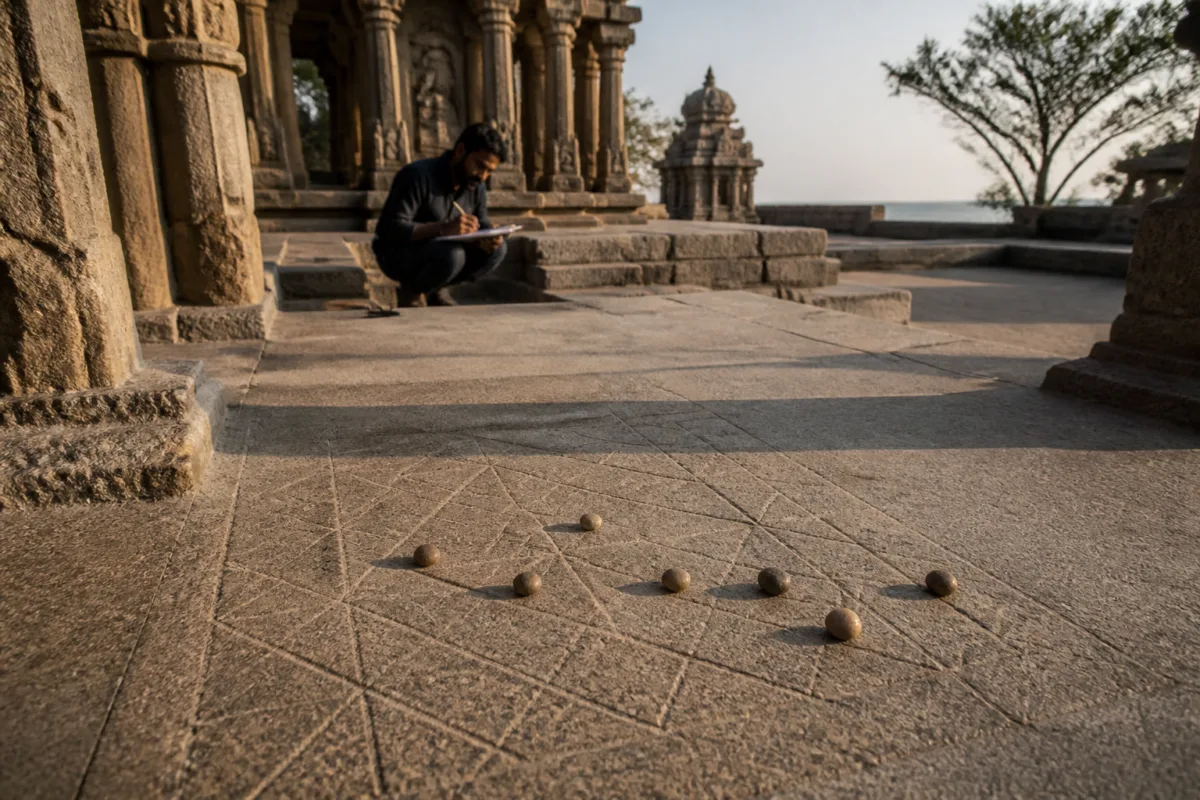
Across India, researchers are finding that temple floors, fort shelters, university grounds and other stone surfaces preserve more than architectural traces. They also carry evidence of play. Centuries-old boards for games such as dahdi, navakankari, pallanguzhi and aadu puli attam are being documented across historic sites, offering a rare view of how people used built spaces when they were not engaged in ritual, work or formal administration.
The research is significant because the markings are easy to overlook. Visitors generally look upwards at gopurams, sculptures and deities, while the evidence of everyday life lies at their feet. Vinita Sidhartha, who has spent 25 years researching and reviving traditional games through her organisation Kreeda, has searched temple complexes and other historic locations for boards carved into stone. R G Singh and Dharmendra Raghu of the Mysuru-based Ramsons Kala Pratishtana have documented boards at more than 100 temples, mostly in Karnataka, as well as in Odisha, Maharashtra, Uttar Pradesh and Tamil Nadu.
Their work changes the way these sites can be read. A temple is not only a monument or a religious destination. It can also be understood as a social and cultural hub whose platforms, shaded corners and circulation spaces accommodated waiting, conversation, learning and play. The position of a board may reveal the people who used a space and the time they had available there.
## Reading the floor as an urban record
The locations of the boards are among the most revealing details. Dharmendra says researchers usually find them on elevated platforms or in shaded places where people could sit comfortably. In forts, the markings occur at vantage points with wide views. At Salem Fort, Sidhartha found two boards in a small lookout shelter, suggesting that guards may have used the space during periods of surveillance.
This is a different kind of architectural evidence from an inscription commissioned by a ruler or a carved image designed for public display. Game boards are informal marks associated with ordinary users. They are not necessarily intended to communicate authority or permanence. Yet their survival gives them value because they register how people occupied the spaces created by formal architecture.
Some discoveries also expose the complex history of construction and reuse. At the Erikatarama temple in Madurantakam, Sidhartha found a game etched on a compound wall. Her explanation is that a horizontal stone may have been reused during renovation. At Delhi’s Jawaharlal Nehru campus, she found a board behind foliage at a location later identified as an old quarry. The markings therefore belong not only to the visible monument but also to the layers of material movement, alteration and redevelopment that shaped the site.
The board found beneath Krishna’s Butterball in Mamallapuram raises a similar question about sequence. Sidhartha located a dahdi board in a space so narrow that even reaching a hand inside was difficult. Since it would have been impractical to carve and use the board after the massive rock occupied the spot, she argues that the game was etched before the Butterball came to rest there. The source report notes that the rock may, according to legend, have been in place before the 12th century, but the precise age of the board is not established by that possibility alone.
The Saluvankuppam temple near Mamallapuram provides another important link between archaeological discovery and informal cultural history. Its dahdi board was unearthed after the 2004 tsunami. Sidhartha’s research on the board was published in the CSMVS Journal last month. Dahdi, also described as three nested squares, resembles the European family of games associated with nine men’s morris. Similarities do not by themselves prove direct transmission, but they invite questions about how games, artisans and design practices travelled across regions.
## Games, artisans and the movement of knowledge
The distribution of similar boards across distant temples offers one possible explanation for the role of travelling craftsmen. Sidhartha believes that artisans involved in temple construction or renovation may have carried game designs with them. Some boards have deep, precise lines that appear to require skilled hands and appropriate tools. If that interpretation is correct, the markings are evidence not only of leisure but also of labour mobility and the circulation of technical knowledge.
This matters because conventional accounts of historic construction often focus on patrons, architects and monumental form. The game boards introduce another group into the story: the workers who moved between building sites and left behind small, unofficial traces of shared practices. The boards may show how cultural forms travelled through construction networks rather than through formal institutions alone.
The evidence is not always easy to interpret. Singh says one board can accommodate several games, while the rules of many everyday games were transmitted orally rather than recorded in a written manual. Researchers compare the markings with anthropologists’ records, rules noted by British writers, texts such as Krida Kausalya and Manasollasa, and recent academic research. They also depend on living memory. Autorickshaw and taxi drivers near temples in Karnataka and Tiruvannamalai have helped identify rules for games such as chowkabara, which some drivers play while waiting for passengers.
That relationship between physical evidence and living knowledge is central to the research. A stone pattern can survive after its users, language and purpose have disappeared. Conversely, a community may remember a game without recognising that its board remains carved into a nearby monument. In Hampi, the researchers found women using leaf sap to draw boards on marble temple floors, showing that game spaces could be recreated through temporary materials as well as permanent carvings.
The newest discoveries also demonstrate how incomplete the record remains. In December 2025, Singh and Raghu found a navakankari board near the entrance gopuram of the Jalakanteshwara temple in Vellore. More recently, they encountered two arrowheads pointing towards each other on a temple floor in K R Nagar near Mysuru. They have not yet determined the rules associated with that marking and are testing different interpretations.
## What the games say about shared space
The games themselves reveal different forms of social organisation. Aadu puli attam places three tigers against 15 goats. The goats must cooperate to trap the tigers, while the tigers must avoid being surrounded. Sidhartha sees in the game a community structure in which collective action can overcome a stronger threat. That interpretation should not be treated as proof of the original makers’ intention, but the board does establish that strategic play was part of the social life of these sites.
Pallanguzhi, a traditional counting game from Tamil Nadu, is part of the wider Mancala family. V Balambal, former history professor at the University of Madras and author of Folk Games of Tamil Nadu, says such games have been used to teach arithmetic and develop mental skills in parts of Africa and the West Indies. She has conducted workshops for children with special needs and visually impaired children, describing pallanguzhi as an inclusive game.
Paramapadam, which influenced modern snakes and ladders, carried an explicitly moral structure in the account provided by Balambal. Honesty and kindness moved players up, while lying, stealing and greed sent them down. Modern versions, she says, have removed those lessons. The contrast points to how games change when they move from community settings into commercial or standardised formats.
The temple boards therefore complicate the idea that heritage is preserved only through monumental architecture. They record systems of learning, cooperation, morality and recreation. They also point to a form of public life that was less dependent on purpose-built recreational infrastructure. A shaded platform, a fort lookout or a temple entrance could become a place for play because people adapted the space to their needs.
## The conservation problem is also a social problem
Most visitors today do not know that these games exist, and even archaeologists may initially mistake the markings for architectural plans. That lack of recognition creates a conservation risk. A board that is not identified as cultural evidence can be overlooked during cleaning, paving, renovation or routine visitor management. The source material does not establish how many boards have been damaged or lost, but it makes clear that the documented record is incomplete and that many rules remain unknown.
The issue is not simply whether every marking should be preserved as an artefact. It is also whether historic sites are being interpreted narrowly, with attention concentrated on monumental and religious features while ordinary forms of use remain invisible. If the floor is treated only as a surface to walk across, an important part of the site’s history disappears from view.
Sidhartha believes traditional games are vanishing faster than classical art forms because children are losing opportunities for unstructured play. Her organisation conducts school workshops and runs an experience centre. The Mysuru trust works with craftspeople and classrooms, including projects with dhurrie weavers to explore how traditional techniques can be used to create game boards. It has also trained teachers to introduce the games to children.
These revival efforts connect heritage conservation with contemporary education and craft practice. They do not restore the original social conditions in which temple games were played, but they keep the designs, rules and associated skills in circulation. They also demonstrate that conservation can involve use and transmission, not only physical protection.
The broader urban question is how cities and institutions recognise informal evidence of public life. Temples and forts are often managed as heritage destinations, while campuses, streets and waiting spaces are governed through separate systems. Yet the game boards show that people have historically made meaning in the gaps between formal functions. Their presence records an older form of shared space in which architecture supported pause, observation, conversation and play.
The research confirms that traditional games in India are also a record of the built environment. The boards document where people sat, how artisans moved, how materials were reused and how knowledge travelled between generations. What remains uncertain is the precise age and rules of many markings, as well as the number of sites that have yet to be documented. The next stage of the work will depend on continued field searches, local knowledge and the ability of heritage institutions to recognise the floor as an archive rather than merely a surface.

