


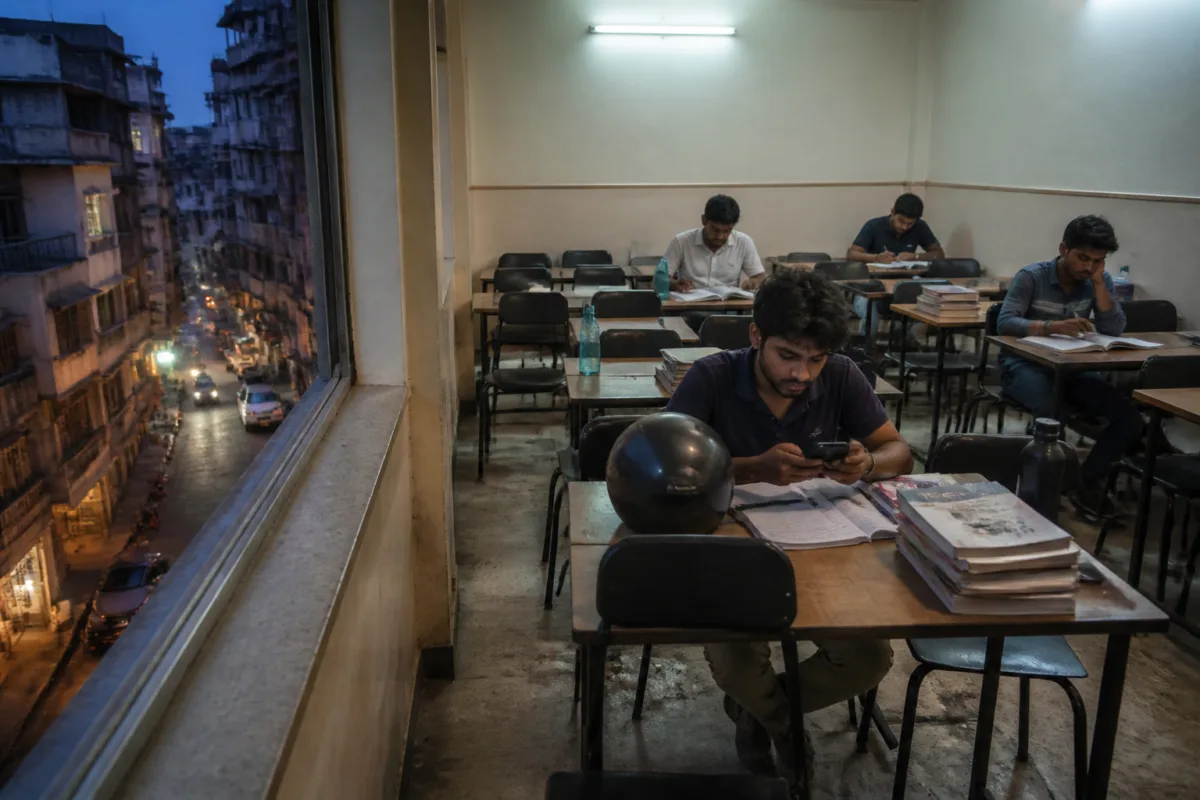
Pune’s MPSC student crisis is no longer only about delayed examinations. It is becoming a test of whether the city’s education ecosystem can absorb students whose families are facing crop failure, debt and shrinking incomes in rural Maharashtra. As examinations, results and appointments remain uncertain, students preparing in Pune are being forced to choose between paying for accommodation and study facilities, taking precarious part-time work, or returning home before their preparation is complete.
A report by Sakal – Pune describes students leaving or preparing to leave the city because their families can no longer regularly finance rent, meals and study-room fees. The accounts come from students preparing for Maharashtra Public Service Commission examinations and from the director of a study centre. Together, they show how a disruption in one system—competitive recruitment—can quickly affect another: Pune’s low-cost rental rooms, messes, study centres and service jobs that support thousands of aspirants.
The immediate pressure is visible in areas such as Sadashiv Peth, Narayan Peth and Navi Peth, which are identified in the report as long-standing centres for competitive-examination preparation. These neighbourhoods do not function only as residential areas. They also contain the rooms, messes, photocopy shops, libraries and study spaces that make it possible for students from rural and lower-income families to live in the city while preparing for government recruitment examinations.
That model depends on continuity. Students and their families must be able to estimate how long preparation will last, when an examination will take place and how much time may pass between an examination, its result and appointment. When those stages become uncertain, the monthly cost of remaining in Pune continues even though the income or institutional milestone that justified the expense is no longer predictable.
The Sakal report says several MPSC examinations have been postponed and that results and appointments from examinations already held have been delayed. One student, identified as Santosh Patil, said he works as a food-delivery worker from 8 pm to midnight to pay for his mess and study-centre bills. Other students are reported to be working in hotels, photocopy shops and tea stalls while continuing their preparation.
This is not simply a story about students finding temporary employment. It is about the loss of study time and the conversion of an intensive preparation schedule into a survival schedule. A student who works during the day and studies late at night may remain physically present in Pune, but the conditions required for sustained preparation are weakened. The report describes this as a cycle of work, fatigue and study, with consequences for both physical and mental well-being.
The rural shock behind this urban pressure is equally important. The report records accounts from students whose families depend on farming in Akola and Beed districts. In one account, a student said the family’s crop on three acres had failed after inadequate rainfall and that debt had accumulated. Another student from Asola village in Beed described reduced farm income and a shortage of drinking water in the village, where the family reportedly had to pay five rupees for a pot of water.
These details show why the cost of living in Pune cannot be separated from conditions in the countryside. For many aspirants, urban rent is financed through seasonal agricultural income, family savings or regular transfers from parents. When drought or a failed crop removes that income, the student’s urban accommodation becomes the first visible monthly burden. The city then experiences the effect as empty beds, unpaid fees, lower spending at messes and study centres, and students returning to villages.
The report says one student, Pramod Chole, had not seen an examination take place after 14 June and was concerned about paying for another two months in Pune before an examination scheduled for 3 January. The same report also describes students leaving after paying the month’s room rent. These accounts capture the mismatch between a fixed urban expense and an uncertain examination calendar. A room, a meal plan and a study seat are paid for continuously; the opportunity they support may be postponed without a corresponding reduction in cost.
The effect is already being noticed by providers serving the student population. Suryankant Darade, director of Dnyanvruksh Study Centre, said more than half the seats at the facility were vacant because students had returned to their villages. That account does not establish the total number of students who have left Pune, but it indicates that the disruption is affecting the local education economy beyond individual households.
Pune’s role as a competitive-examination centre has been built around this interdependence. Students from rural areas come to the city for access to coaching, study spaces, peer networks and an environment organised around examination preparation. Their presence supports a wider chain of small urban businesses. When examinations are delayed, the impact is distributed across that chain, but the greatest burden falls on students who cannot afford to wait indefinitely.
The institutional issue is the gap between examination administration and the lived economics of preparation. A postponed examination is often treated as an administrative change in a calendar. For a student, it can mean additional months of rent, food, transport, study-centre charges and lost employment opportunities. The report includes the account of a student who left a part-time job to prepare for an examination, only for the examination to be postponed; when she tried to return, someone else had been hired. She was then left without both the expected examination milestone and the earlier income source.
This gap becomes sharper when results and appointments are also delayed. Preparation is usually understood as an individual responsibility, but the pathway to public employment is governed by institutions whose timelines determine how long candidates remain economically exposed. Students may not know whether to continue paying for a room, return home, seek employment or prepare for a later cycle. Each option carries a cost, and the cost is not shared equally across social or economic groups.
The experiences of women students add another layer to the housing question. A student identified as Pooja Deshmukh said living expenses in Pune are particularly high for women and described receiving a call from home asking her to return because the family could no longer send money. The report does not provide a comparative breakdown of expenses by gender, but her account indicates that access to safe and affordable urban accommodation is part of the examination system’s practical infrastructure.
The city’s study centres and rental market therefore operate as informal extensions of the public recruitment system. They provide the physical setting in which candidates wait for examinations and results. Yet the report offers no indication of a formal support mechanism that adjusts for prolonged delays, drought-related household distress or the loss of part-time employment caused by rescheduling. The absence of such information is itself significant: the financial risk appears to be carried primarily by students and their families.
The available evidence does not establish whether every postponed examination will be rescheduled within the timelines described by students, or how many candidates have left Pune. It also does not quantify the fall in occupancy across the city’s study centres, the number of affected households or the total economic impact on local businesses. Those gaps matter because individual accounts, while compelling, cannot by themselves measure the scale of the disruption.
What they do establish is the structure of the problem. Rural climate and income stress can reduce the flow of money to students. Examination delays can extend the period during which students must pay urban living costs. Uncertain results and appointments can weaken their ability to plan. The resulting pressure is then visible in Pune through vacant study seats, students taking night work and candidates returning to villages.
The larger urban question is whether a city that functions as a gateway to public employment can remain accessible when the public recruitment process becomes unpredictable. Pune’s competitive-examination economy is sustained not only by coaching institutions but also by affordable rooms, meals, transport, libraries, study centres and flexible work. If any one of these becomes unaffordable, preparation becomes harder; when rural incomes fall at the same time as examination timelines slip, the entire arrangement becomes fragile.
For now, the evidence points to a crisis of continuity rather than a single departure from the city. Students are not necessarily abandoning their ambitions; many are being forced to reorganise them around drought, debt, work and administrative uncertainty. The developments that require monitoring are the dates of upcoming MPSC examinations, the release of pending results and appointments, and whether students who have returned to their villages can afford to come back when the examination cycle resumes.

