


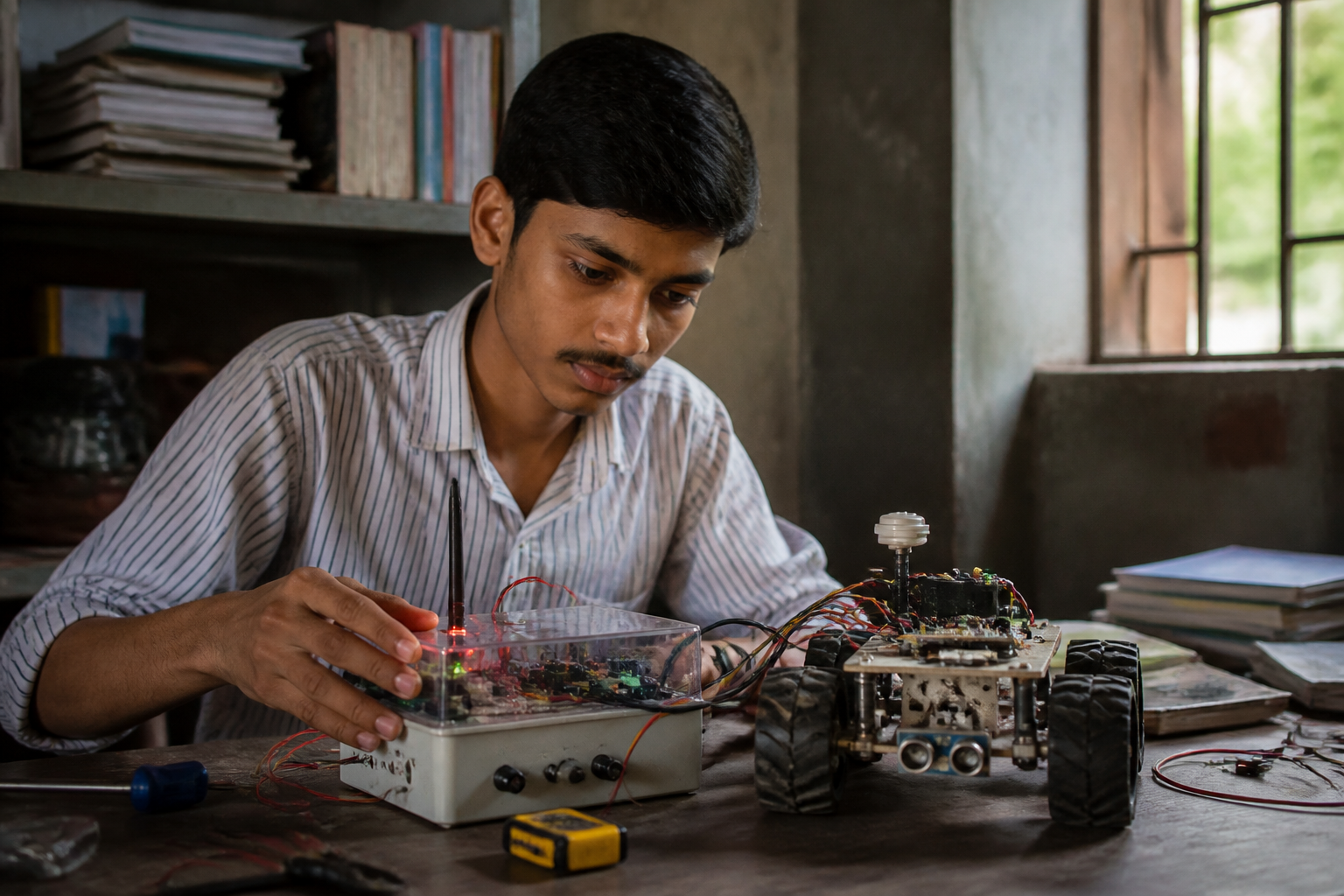
A Class 10 student from Birbhum has designed a disaster management device intended to help rescuers locate people trapped under rubble and exchange information during emergencies. The reported invention is ambitious, but its larger significance lies in the problem it identifies: rescue operations can become difficult not only because buildings collapse or access routes are blocked, but also because reliable information about trapped people, rescue teams and medical supplies may be unavailable.
Faizul Sheikh, a student from Masterpara in Kirnahar, Birbhum, has proposed what the report calls a “decentralised wireless disaster management and relief supply network”. The system is described as a combination of electronic components and computer instructions. Its stated purpose is to identify the location of people caught in a disaster and transmit that information to rescue teams.
The immediate trigger for the project was the devastation caused by a landslide in Nepal, according to the report published by Sangbad Pratidin – Bengal. Images of the disaster led Faizul to consider how people trapped beneath debris could be located more quickly. His response was to design a system that could support communication between a person in danger, a receiving device and a central control mechanism.
The proposal has three main components. The first is a central control device. The second is a signal-collecting device connected to an unmanned vehicle. The third is a signal-transmitting device carried by, or kept near, the person affected by the disaster. The reported design also includes circuits, microcontrollers, wires, sound indicators, light signals and other electronic equipment.
This architecture reflects a basic but important division in disaster response: someone or something must send a signal, another device must detect it, and an operational centre must interpret and act on the information. In Faizul’s proposal, the unmanned vehicle would carry the signal collector, allowing it to be used in areas where direct access may be difficult or unsafe. The report does not establish the device’s operating range, battery life, resistance to dust or water, ability to function through concrete, or performance in a real disaster site. Those details would be essential before the system could be assessed as a deployable rescue technology.
The distinction between a concept and a field-ready device is particularly important in disaster management. A system may function in a controlled demonstration but face very different conditions amid collapsed structures, damaged power networks, obstructed roads, heavy rain, smoke, noise or unstable surfaces. The supplied report describes Faizul’s design and objectives, but it does not provide test results, an engineering assessment, a demonstration under disaster conditions or confirmation that a public agency has adopted the technology.
Even with those limitations, the proposed network points to an institutional challenge that affects urban and rural disaster response alike: information must move across several levels at the same time. A trapped person or an emergency signal must be detected. Rescue teams must receive a usable location. Command personnel must know where teams have reached and whether assistance has been delivered. Medical supplies may also need to be directed to specific locations. A communication breakdown at any one of these stages can reduce the value of information collected elsewhere.
Faizul’s concept is not limited to locating people. According to the report, it is also intended to exchange information about when and where rescue teams arrive, how far rescue work has progressed and whether medical equipment has reached people in danger. This makes the proposal more than a locating device in its stated design. It is conceived as a small coordination network linking people in distress, moving equipment and a central response mechanism.
That coordination function matters because disaster response is rarely a single action. Finding a person is only one stage. Rescue workers must reach the location, assess the risk, remove obstacles, provide medical support and communicate the outcome. The proposed use of sound and light signals suggests an attempt to create multiple ways of communicating information. The report, however, does not specify how the signals would be authenticated, prioritised or integrated with existing emergency control rooms.
Faizul has also considered connecting the technology to devices such as wristwatches, mobile phones and helmets. These possible connections could allow the system to operate through equipment that people may already carry or wear. At present, the report describes this as a plan under consideration rather than a completed deployment. It also says that he is attempting to operate the system through wireless communication so that reaching people during disasters becomes easier.
The wireless element raises practical questions that the available account does not answer. A disaster can damage communication infrastructure or interrupt electricity supplies. A system designed for such conditions would need an independent power source, reliable local communication and a way to continue working when parts of the network fail. It would also need to distinguish between a genuine distress signal and a damaged or inactive device. None of these technical specifications is provided in the report, so they remain questions for further development rather than established features of the invention.
The proposal also reveals how disaster technology is often shaped by a simple ground-level observation: families and responders need to know where people are. Faizul’s reported motivation came from seeing people search for relatives after a disaster and remain distressed when they could not find them. That human problem is translated into a technical one involving location signals, data transfer and coordination. The value of the idea therefore lies not only in its electronic components but in the connection it makes between personal loss and the organisation of rescue work.
Faizul is a student at a private school, and the report identifies his father, Firoz Sheikh, as an Indian Army employee and his mother as Abira Khatun. It also describes his interest in experimenting with technology from a young age. These details provide the personal context for the project, but they do not by themselves establish the technical reliability of the system. The central question for any future development will be whether the design can move from an individual experiment to a tested and maintainable tool.
That transition would require more than assembling electronic parts. It would involve defining the system’s operating conditions, testing it in controlled environments, documenting its accuracy and assessing whether rescue agencies could use the information it produces. It would also require clarity about who operates the central control device, who maintains the signal transmitters, how devices are distributed and how data reaches responders when normal communications are unavailable. The supplied report does not state that such an institutional framework has yet been created.
The proposed network nevertheless places an important issue on the urban technology agenda. Cities increasingly depend on connected systems, but disasters can expose the weakness of those connections. A device that aims to support rescue in rubble must function at the point where buildings, roads, communication and public safety intersect. Its success would depend not only on the device itself but on the surrounding response system: trained personnel, access routes, equipment, decision-making procedures and communication protocols.
For now, the evidence confirms that a Birbhum student has designed and is developing a concept for a decentralised wireless disaster-response network. It does not confirm that the system has been independently tested, adopted by a rescue agency or proven in an actual disaster. The next meaningful milestones would be a documented prototype demonstration, technical evaluation and evidence of how the device performs under conditions resembling a collapsed or inaccessible site. Those steps will determine whether the reported invention remains an educational experiment or develops into a usable tool for disaster management.

