


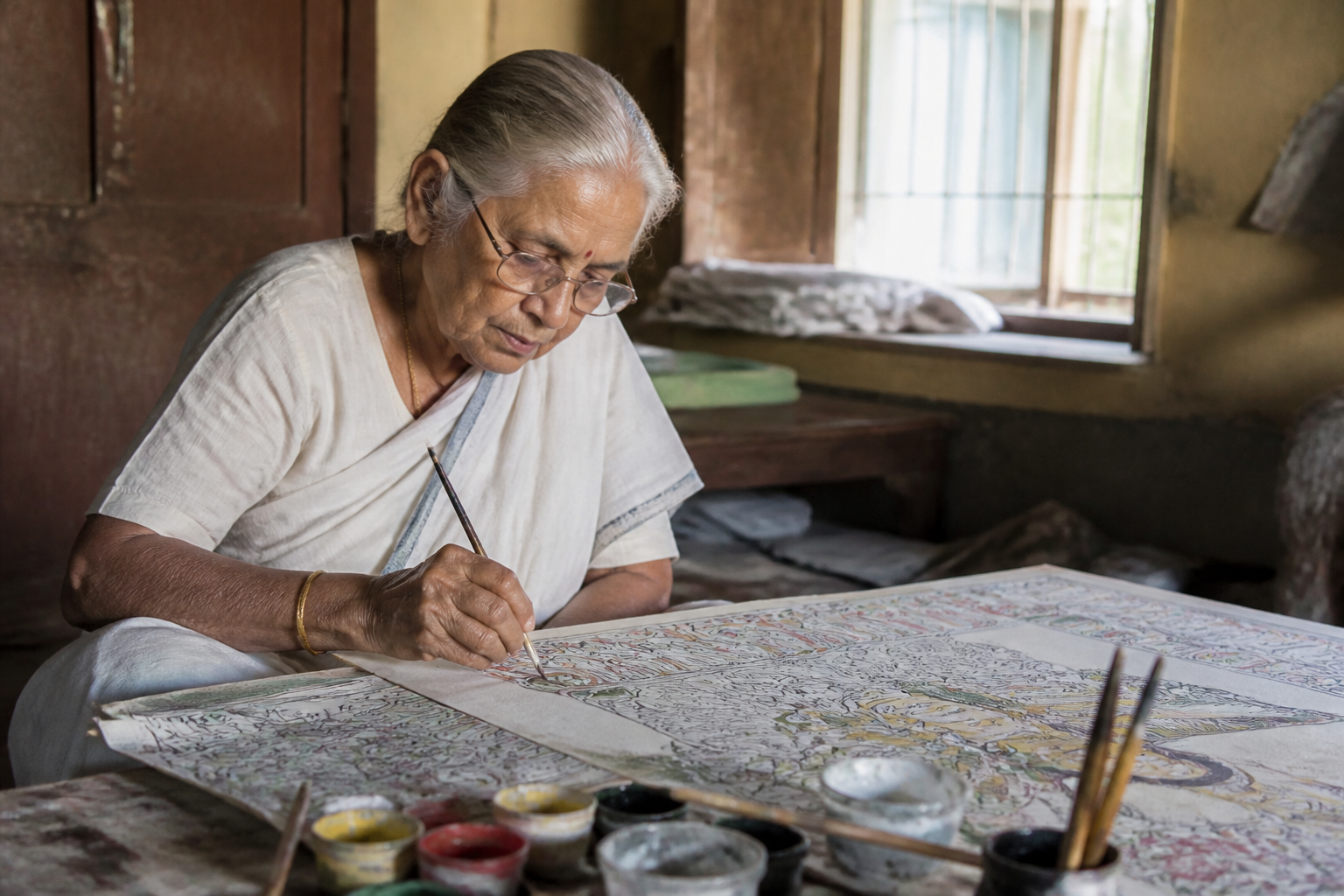
Reba Pal’s room in Ghurni’s potters’ colony in Krishnagar contains the tools of a tradition that is losing its place in Bengal’s festive economy. For nearly five decades, the 80-year-old artisan has painted chalchitra, the decorative backdrop placed behind a Durga idol. Her work has reached major puja installations in Kolkata, but the market around it has narrowed as computer-generated designs and digital prints become faster and cheaper alternatives.
Pal’s story is not only about the survival of one traditional art form. It also reveals how an urban craft ecosystem can weaken when the skills, time and labour required to make an object by hand are no longer reflected in its price. A chalchitra may carry cultural and visual significance, but Pal said she earns barely Rs 400 to Rs 500 for a piece after preparing the paper, applying several layers of colour and completing the fine decorative work. The income is low even though the process remains labour-intensive.
That gap between cultural value and economic value is at the centre of the craft’s decline. Pal told The Statesman that she had practised the art for 50 years, but that demand was now very low because people gave greater importance to computer-generated designs. Her account places technological substitution inside a specific local economy: Ghurni’s potters’ colony, a place where craft knowledge has historically been linked to household work, seasonal demand and networks extending to Kolkata’s idol-making districts.
Pal learnt chalchitra while assisting her husband, Shasthi Pal. After his death about 22 years ago, she continued the work independently. The transition from helping within a household to carrying the craft alone is significant because traditional production often depends on knowledge being transferred through families and close working relationships. In Pal’s case, the practice survived through personal commitment, but the system around it did not provide a reliable path for continuity.
Her creations were once supplied to artisans in Kumartuli and Bidhannagar in Kolkata, and some were used in prominent puja installations. One of her pieces has also been collected by a school for preservation in a museum. These links show that the craft has not been confined to a single room or a single neighbourhood. Its circulation has connected Krishnagar’s artisan base with the wider cultural and commercial geography of Kolkata’s Durga Puja economy.
Yet recognition and demand have not moved together. A work can be displayed, collected or associated with a prominent festival and still provide little financial security to the person who makes it. Pal’s experience indicates that visibility alone does not guarantee a sustainable livelihood. The continuing presence of a craft in public celebrations may conceal the precarious conditions under which its practitioners work.
The production process helps explain why digital alternatives exert pressure on hand-painted chalchitra. Pal joins sheets of paper, prepares the surface, applies base colours and gradually adds details, moving from one shade to another before completing fine lines and decorative patterns. Each stage requires time and concentration. The final object is therefore the result of accumulated manual work rather than a quickly reproduced image.
Digital prints change that calculation. They can offer standardised designs at a lower cost and with shorter production timelines, according to Pal’s account. For organisers and artisans working under seasonal deadlines, speed and price can outweigh the value of a hand-painted backdrop. The result is not necessarily an abrupt disappearance of the traditional form, but a steady reduction in the number of orders that allow practitioners to continue making it.
This is where the condition of the individual artisan becomes a question of urban economy. Traditional craft is often discussed as heritage, but it also functions as work. It depends on orders, intermediaries, household labour, access to buyers and the ability to earn enough to keep practising. When those links weaken, the loss is not limited to an image or technique. It affects the economic viability of the locality in which the knowledge is held.
Pal now depends on occasional orders from familiar clients and a few organisations. Her children are married and live separately, leaving her to spend much of her time alone. She said she enjoys the work and feels restless when she cannot do it. Her attachment to the craft is connected both to its intrinsic value and to her late husband, who encouraged her to continue. That personal bond has helped sustain the practice, but it cannot substitute for a functioning market or institutional support.
The report also points to a gap in formal recognition. Pal said she had received no special government assistance or recognition for her craft. Her only support was an old-age pension, which she said had been Rs 1,000 a month, with a possible increase expected. The account does not establish whether any broader scheme is available to other chalchitra practitioners, but it does show that, in her case, public support has not been linked specifically to preserving or strengthening the craft.
That distinction matters. An old-age pension addresses basic income support, while craft assistance would need to address the conditions that allow production to continue. Those conditions include access to orders, opportunities to teach and learn, spaces for making and storing work, and connections with the institutions and festivals that use decorative art. The supplied report does not identify a dedicated programme for these needs, leaving the craft dependent on irregular demand and personal networks.
The question of training is equally difficult. Pal feels unable to train newcomers because of her age, the limited interest in the work and its poor economic prospects. This creates a cycle in which a declining market discourages new learners, and the absence of new learners makes the existing knowledge more vulnerable. A craft may survive in the hands of one experienced practitioner, but it cannot become sustainable unless the next generation sees a credible livelihood in learning it.
The location of Pal’s work is important to this cycle. Ghurni’s potters’ colony is not simply a backdrop; it is the physical setting in which artisanal knowledge is produced and maintained. Such neighbourhoods connect homes, workshops, suppliers, clients and cultural networks. When demand falls, the impact can extend beyond the individual maker because the local ecosystem loses one more specialised activity and one more reason for younger residents to remain connected to it.
At the same time, the report does not support a simple opposition between technology and tradition. Digital designs have become part of the market because they meet practical requirements of cost, speed and reproducibility. The challenge is that hand-painted chalchitra is being asked to compete on terms that do not account for the time, skill and cultural meaning embedded in the work. The central issue is therefore not whether digital tools exist, but whether the economic system leaves room for a slower form of production.
Durga Puja provides a seasonal platform for this question to become visible. As demand for decorations rises, the work of artisans enters public celebrations, but the people behind that work can remain economically invisible. Pal’s creations have travelled to important puja locations, yet her earnings remain modest and her orders uncertain. The festival economy can showcase craft without necessarily securing the conditions required for its survival.
What the evidence confirms is limited but clear. An ageing Krishnagar artisan continues to practise chalchitra; demand for hand-painted work has declined in her experience; digital prints have become more important to buyers; the income from each piece is low; and she has not received special government assistance or recognition. The report also establishes that younger people are not being drawn to the occupation in sufficient numbers.
What remains uncertain is the scale of the wider craft community, the number of active chalchitra painters, the volume of annual demand and the availability of public or institutional programmes beyond the support described by Pal. Those gaps matter because preservation cannot be assessed through individual resilience alone. The next question for cultural institutions, festival organisers and local administrations is whether the craft can be connected to a stable market before its remaining practitioners are no longer able to work.
For now, Pal continues to paint in Ghurni, sustained by habit, memory and a sense of purpose. Her brushwork keeps the tradition present, but her experience also shows the limits of relying on individual dedication to preserve a craft whose economic foundations are weakening.

