


Thirthahalli’s sand crisis has exposed a breakdown between legal supply, environmental approvals and enforcement, with illegal extraction reportedly continuing in the taluk’s rivers and streams while authorised quarries remain unopened. The situation affects more than the availability of a construction material: it links river protection, public revenue, small transport businesses and the safety of local building work.
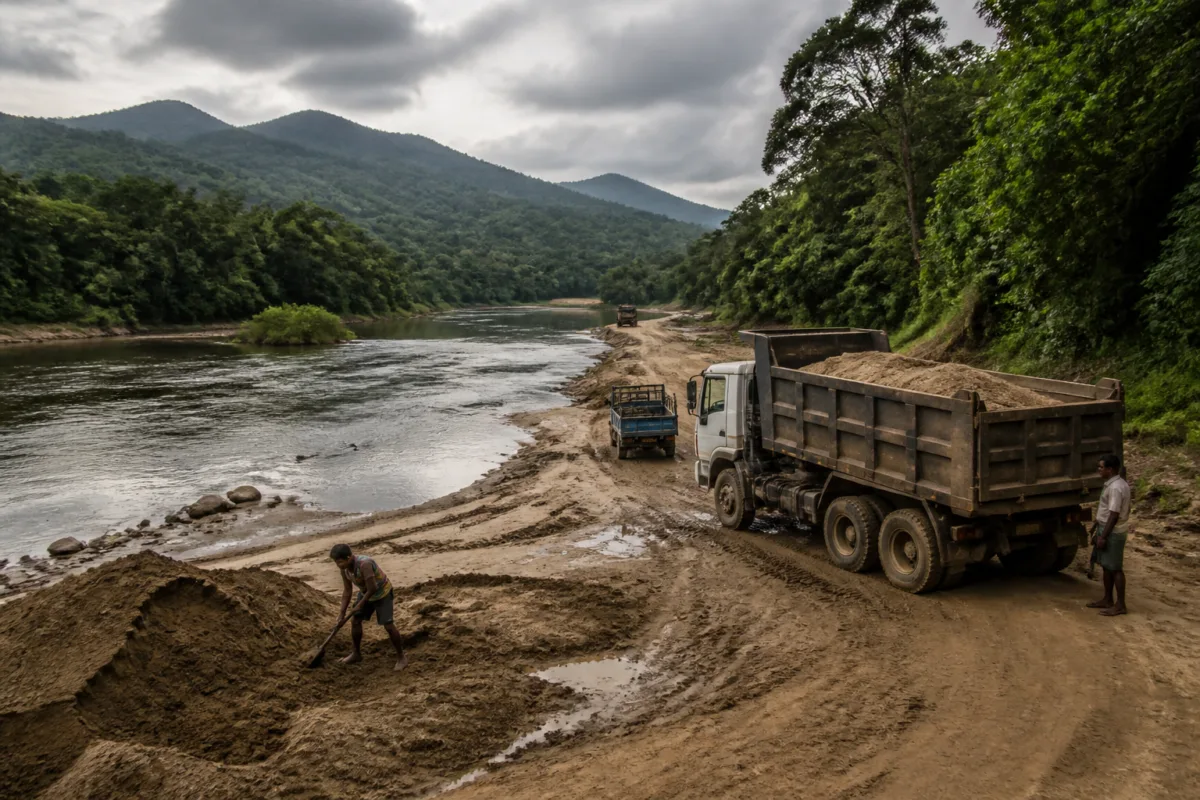
A report published by Prajavani on November 3 said sand was being moved late at night from major rivers and streams in Thirthahalli, Shivamogga district. Local residents cited in the report alleged that hundreds of loads were being transported despite repeated complaints, while the authorities concerned had failed to act. The report identified the Tunga, Malathi, Meenukoli, Gopinatha Halla, Brahmi and Kuntehalla watercourses as locations where illegal sand extraction was taking place.
The reported shortage has developed alongside a stalled legal-supply system. The Department of Mines and Geology completed the auction process for sand quarries identified for 2024-25, but the quarries had not begun operations even after the process was completed. According to the report, environmental clearance is required before the contracted quarries can start, and proposals seeking the necessary approvals have been submitted to the government.
The result is a gap between formal allocation and actual availability. The report said Thirthahalli has 16 sand quarries among 27 quarries in the district for which contracting procedures have taken place. However, the contracted sites remain unable to operate while approval processes continue. This means that the existence of an auction or contract has not translated into a dependable legal supply for households, builders or transport operators.
The numbers cited in the report illustrate the scale of the disruption. Sand was distributed through royalty bills for only 36 days in 2024 and six days in 2025, according to the report. For the rest of those periods, residents faced what the report described as an artificial shortage. Public estimates placed the government’s daily revenue loss at more than ₹25 lakh, although the report attributed this figure to local residents rather than to an official revenue assessment.
That distinction matters because legal sand supply is not only a commercial arrangement. Royalty payments represent a public-revenue mechanism through which the state records and regulates extraction. When authorised supply disappears while construction demand continues, the market does not necessarily stop. It can shift towards informal extraction and unrecorded transport, making it harder to track volumes, enforce environmental conditions or establish accountability for damaged riverbeds.
Prajavani reported that residents had complained about night-time movement of sand vehicles in areas including Tudanakallu, Peeranagudde, Sarala, Chittebailu, Araga, Kushavathi, Hunasavalli, Hedururu, Buklapura, Baggodige, Mandagadde, Holekoppa, Melige, Mahishi and Kudige. The report said lorries, pickups, tempos and tippers were allegedly being used to transport the material. These allegations were not accompanied in the supplied report by details of seizures, criminal cases or an official enforcement audit.
The environmental dimension is especially significant because the reported extraction locations are connected to the Western Ghats landscape. The report said that 37 per cent of the area falls within an ecologically sensitive zone identified by the Western Ghats Ecology Expert Panel chaired by K. Kasturirangan. The report did not specify the exact boundaries applicable to each quarry or extraction site, nor did it provide an official assessment of ecological damage. But the combination of sensitive terrain, river sand extraction and delayed regulatory approvals makes the clearance process central to the dispute rather than a procedural footnote.
Environmental clearance is intended to establish whether extraction can proceed, under what conditions and with what restrictions. In this case, the delay has produced an administrative paradox: legal operators cannot begin without approval, while local accounts cited by the report say illegal operators are continuing to move sand. The supplied report does not establish why the approvals have been delayed, which agency is responsible for the pending decision or whether applications were incomplete. Those details will be necessary to determine whether the bottleneck lies in documentation, environmental assessment, interdepartmental coordination or another administrative step.
The effects are also being felt by people who had operated within the legal system. The report said Thirthahalli has 180 lorries and that six had been seized after their owners were unable to repay loans. It also said some lorry owners had moved into masonry work or driving for Ola and Uber, while others were leaving the area. These accounts indicate how a disrupted material market can affect transport assets and household incomes beyond quarry operators themselves. The report did not provide the names of the lenders, the dates of the seizures or an official figure for the number of affected workers.
At the same time, the shortage is increasing the risk of poor-quality material reaching construction sites. The report said soil-mixed sand was being transported and sold, following an earlier instance in Tudanakallu village where soil was washed to recover sand. Customers were reportedly unable to obtain clean sand despite paying for it. Construction workers cited in the report said slabs and walls built using soil-mixed sand had developed cracks, and claimed that concrete slabs made with material containing more soil could have their durability reduced by 50 per cent. They also warned that excess soil could increase the likelihood of faster corrosion of reinforcing steel.
Those technical claims require independent engineering verification before they can be treated as measured performance findings. Nevertheless, the underlying supply problem is clear from the reported pattern: when legal material is unavailable, buyers may have fewer ways to verify the source and quality of what they purchase. For individual house builders, small contractors and informal construction workers, the absence of testing or traceability can transfer the consequences of a regulatory failure directly to the building site.
The case also highlights the institutional fragmentation of sand governance. The Department of Mines and Geology is involved in identifying and auctioning quarries, while environmental authorities must clear extraction proposals. District administration and enforcement agencies are expected to prevent unauthorised mining and transport. Construction buyers and transporters operate at the end of this chain, often with limited visibility into whether the material is legally sourced or technically suitable. A delay at one stage, combined with weak action at another, can therefore create a market in which legal operators lose viability while illegal supply remains profitable.
The report said the government has received proposals to grant environmental approval for the contracted sand quarries. It also quoted the authorities as saying that action is being taken to prevent illegal activity. However, the supplied material does not identify the officials who made that statement, specify the enforcement measures being used or state a deadline for the quarries to open. It also does not establish whether the reported revenue loss has been formally calculated by the government.
What the evidence confirms is a persistent mismatch between demand for construction sand and the state’s ability to provide a regulated supply. It also records allegations of illegal extraction across named rivers and villages, delayed quarry operations, financial stress among lorry owners and concerns about construction material quality. What remains unclear is the status of each environmental application, the scale of confirmed illegal mining, the number of enforcement cases and the technical impact of soil-mixed sand on structures.
The next important developments are therefore administrative and documentary: decisions on the pending environmental clearances, the start dates for the 16 Thirthahalli quarries, the publication of enforcement data and any official assessment of the claimed revenue loss and ecological impact. Until those processes produce verifiable results, Thirthahalli’s sand crisis will remain a problem in which the legal supply system is visible on paper but absent from the ground.

