


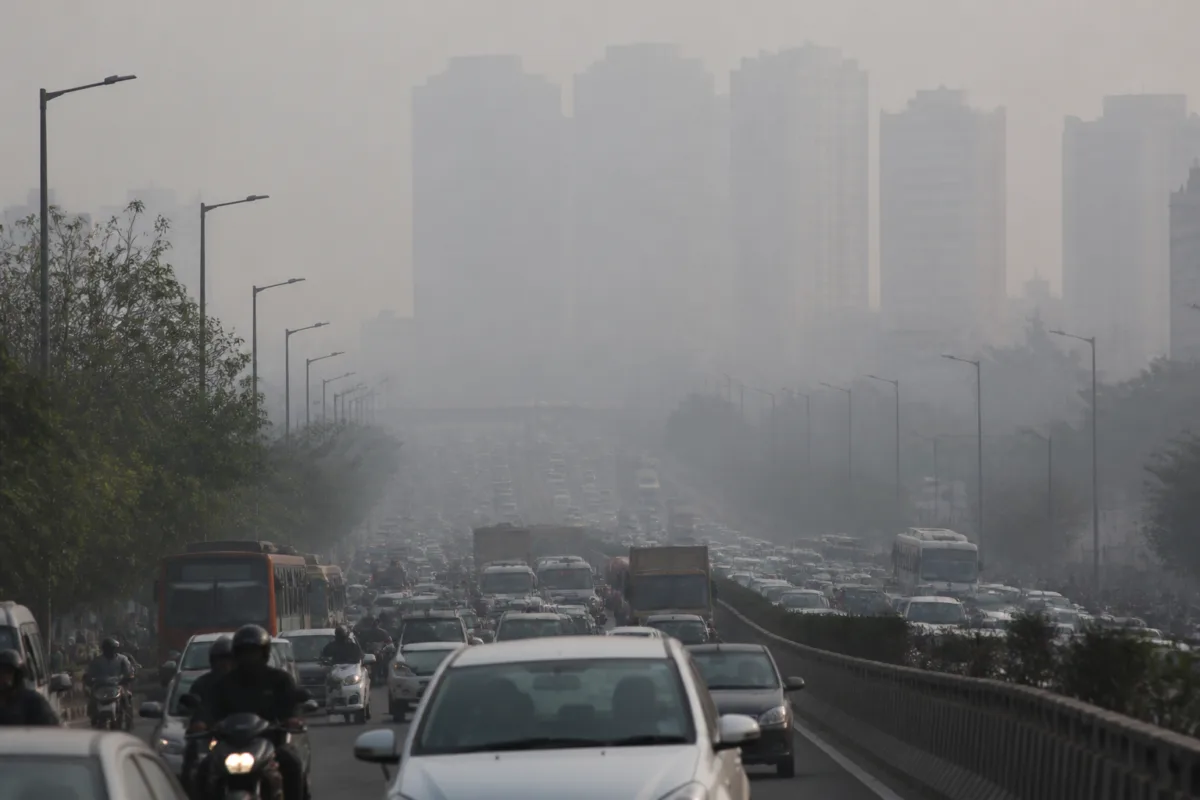
Delhi’s air quality deteriorated sharply on Wednesday, with the citywide Air Quality Index (AQI) reaching 373 at 7:05 am and 21 of 59 monitoring stations recording readings in the severe category. The level remained in the Central Pollution Control Board’s very poor range, as PM2.5 emerged as the main pollutant at 54 monitoring stations.
The latest reading followed Tuesday’s 24-hour average AQI of 350, which was reported as the worst level recorded in the previous 287 days. Under the CPCB classification, an AQI between 301 and 400 is considered very poor, while readings from 401 to 500 fall in the severe category.
Punjabi Bagh recorded the highest AQI among the monitoring locations at 452, followed by Jahangirpuri at 450 and IIT Delhi at 446. Five stations recorded air quality in the poor category, while 23 stations were in the very poor category, according to the report.
The Air Quality Early Warning System has forecast that Delhi’s air quality will remain in the very poor category between November 4 and November 6. It has also indicated that conditions could fluctuate between the very poor and severe categories over the following six days. The system has warned that firecracker use during Diwali could lead to a further deterioration in air quality.
Satellite data from NASA recorded 1,561 farm-fire incidents in Punjab and Haryana between October 1 and November 3. Punjab accounted for 1,406 incidents and Haryana for 155, while 167 incidents were recorded on November 2. The corresponding figure for the same period last year was 2,068 incidents.
The report cautioned that year-on-year comparisons of satellite-detected fires need to account for changes in the timing of stubble burning. In 2025, 98% of fires detected by Meteosat during the period were recorded after 3 pm, compared with 94% in 2024. Satellite observations may also undercount incidents because many fires now occur around 1:30 pm, after the satellite passes over the relevant area.
Weather conditions also remained relevant to Delhi’s pollution episode. The India Meteorological Department recorded a minimum temperature of 16.1 degrees Celsius at Safdarjung, 0.8 degrees above the seasonal average. Palam recorded 16.9 degrees Celsius, 0.7 degrees above normal, while Lodhi Road recorded 16.1 degrees Celsius, 3.1 degrees above normal. The Ridge station recorded 16.4 degrees Celsius, 0.7 degrees below normal, and Ayanagar recorded 16.6 degrees Celsius, 0.4 degrees above the seasonal average.
No rain was recorded at any of these five weather stations in the 24 hours up to 8:30 am on Wednesday. The air-quality warning system’s forecast for very poor conditions through November 6 remains the next official milestone for monitoring Delhi’s pollution levels.

