


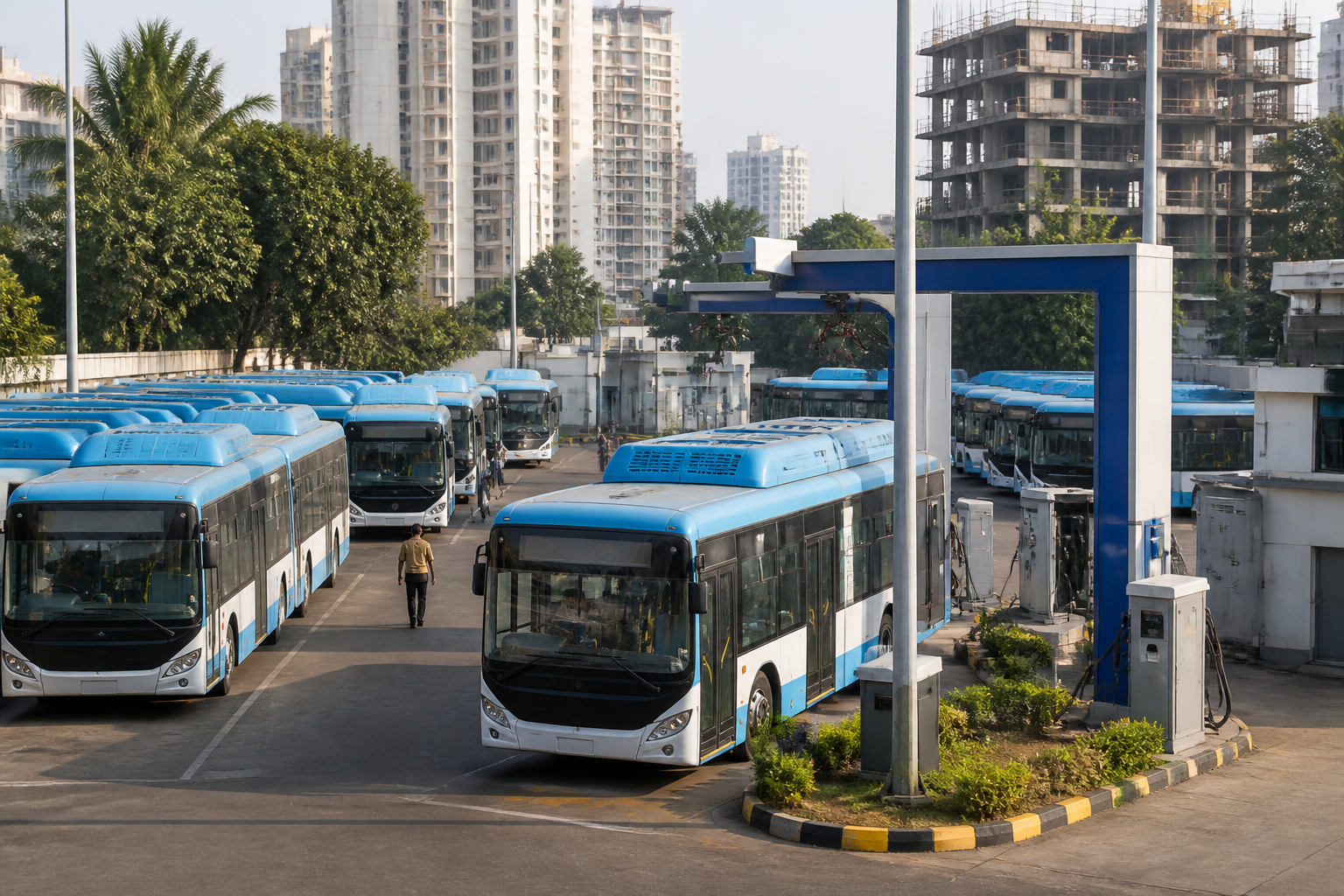
Thane’s plan to add 180 air-conditioned electric buses to its municipal transport service has brought a familiar urban question into sharp focus: how should cities pay for cleaner public transport when fare revenue does not cover operating costs? A proposal before the Thane Municipal Corporation’s general body reportedly estimates that operating the buses under a gross cost contract, or GCC model, will cost Rs 1,117.49 crore over 12 years. Ticket revenue is expected to reach about Rs 666 crore, leaving the civic body to absorb a gap of roughly Rs 451 crore.
The proposal is part of a larger procurement supported by the 15th Finance Commission. Thane has been approved for 303 electric buses, of which 123 have already arrived, according to the report. The remaining 180 buses are at the end of the tender process. They are expected to comprise 100 nine-metre buses, 70 12-metre buses and 10 double-decker buses, all described as air-conditioned electric vehicles.
That mix indicates that the project is not simply a replacement exercise. It is also an attempt to expand the capacity and range of the Thane Municipal Transport service. The smaller buses are likely to serve routes where manoeuvrability and lower capacity are important, while the larger and double-decker vehicles are intended for corridors that can support higher passenger volumes. The supplied report, however, does not provide route plans, deployment schedules, projected daily ridership or service-frequency targets. Those details will be important in judging whether the projected fare income is realistic.
The financial structure is based on payment to operators for each kilometre run. Following negotiations after the tender, the reported rates are Rs 75 per kilometre for the nine-metre buses, Rs 84.33 per kilometre for the 12-metre buses and Rs 146.61 per kilometre for the double-decker buses. Together, the 180 vehicles are expected to generate a monthly operating bill of Rs 7.76 crore, or Rs 93.12 crore a year.
Against this, the transport administration expects monthly ticket revenue of about Rs 4.62 crore and annual revenue of approximately Rs 55.50 crore. The resulting first-year operating deficit is estimated at Rs 37.61 crore. Over 12 years, the difference between the projected contract expenditure and fare income is reported at around Rs 450 crore, or about Rs 451 crore when the proposal’s total figures are considered.
The gap is the central issue in the proposal, but it should not be read only as evidence of an inefficient service. Urban bus systems frequently perform functions that cannot be measured through fare recovery alone. They provide mobility to people who do not own private vehicles, connect residential areas to employment and education, and can reduce dependence on more polluting modes. The report itself identifies pollution reduction as one of the reasons for bringing electric buses into the municipal fleet.
At the same time, a clean-transport objective does not remove the need for financial discipline. A recurring subsidy must be understood in relation to the wider financial position of the transport undertaking and the municipal corporation. The report says the transport service is already under financial pressure. It does not provide the undertaking’s overall annual deficit, existing subsidy obligations, passenger numbers or debt position. Without those figures, it is not possible to determine how large the new commitment would be in the corporation’s full transport budget.
The GCC model also changes the way the municipality carries operational risk. Under this arrangement, the civic body pays an agreed rate for bus operations, while the service is provided by selected companies. The report says negotiations were conducted with the two lowest bidders. AeroEagle Automobiles is reported to have received the rate determination for the 100 nine-metre buses, while CLL Facilities is associated with the 70 larger buses and 10 double-deckers. The contractor-selection process is described as being in its final stage, with approval of the 12-year expenditure still required from the general body.
The kilometre-based payment mechanism makes service planning especially important. If buses travel more kilometres, the operating payment rises. If they travel fewer kilometres, the city may provide less service but may also generate less fare revenue. The supplied material does not state the annual kilometres assumed for each bus category, the minimum service obligations, maintenance responsibilities, battery-replacement provisions or penalties for missed trips. These are not minor contractual details: they determine whether the quoted rates translate into dependable public transport or simply a large fixed commitment.
The reported financial projections also include a significant uncertainty. The operating cost may rise with future electricity prices, inflation-index changes and higher taxes. That means the Rs 1,117.49-crore figure should be understood as a projected commitment rather than an immutable ceiling, unless the contract contains protections that are not described in the report. The same source does not indicate whether ticket fares are fixed for the full contract period or whether the corporation has a defined fare-revision mechanism.
The administration has reportedly said that a fare increase could reduce the deficit to some extent. That statement highlights the tension between cost recovery and accessibility. Higher fares may improve the financial position of the service, but they can also make buses less affordable for regular commuters. The available information does not specify the current fares, the proposed increase, passenger categories, concessions or the expected effect of a fare revision on ridership. Consequently, the precise financial benefit of such a measure remains unestablished in the supplied material.
The proposal therefore places three separate decisions before Thane’s elected body. The first is whether the city should expand its electric-bus fleet. The second is whether the operating contract offers sufficient value and safeguards over 12 years. The third is how much of the service’s cost should be recovered from passengers and how much should be funded through the municipal budget.
These decisions are often combined under the broad label of sustainable transport, but they involve different measures of success. A transport project can reduce tailpipe emissions and still impose an unsustainable fiscal burden if service levels, ridership and contract terms are poorly aligned. Conversely, a service can require subsidy while delivering substantial public value if it is reliable, well used and integrated with the city’s wider mobility network. The supplied report does not establish where Thane’s proposal sits on that spectrum.
The immediate significance of the proposal lies in the fact that the municipal corporation is being asked to approve a long-term obligation before the full operating record of the expanded fleet is available. The 123 buses already received may provide an initial basis for assessing reliability, utilisation and passenger response, but the report does not provide performance data from those vehicles. Such information would be relevant to evaluating the projected revenue from the additional 180 buses.
The general body’s decision will therefore be the next formal milestone. The proposal reportedly seeks approval for expenditure of Rs 1,117.49 crore over 12 years, while the contractor-selection process remains at its final stage. Until the proposal, tender documents and contract conditions are publicly examined, the headline numbers establish the scale of the commitment but not its final financial or operational outcome. What is clear is that Thane’s electric-bus expansion has moved beyond a procurement question: it is now a test of how the city balances cleaner mobility, passenger affordability and the limits of municipal finance.
