


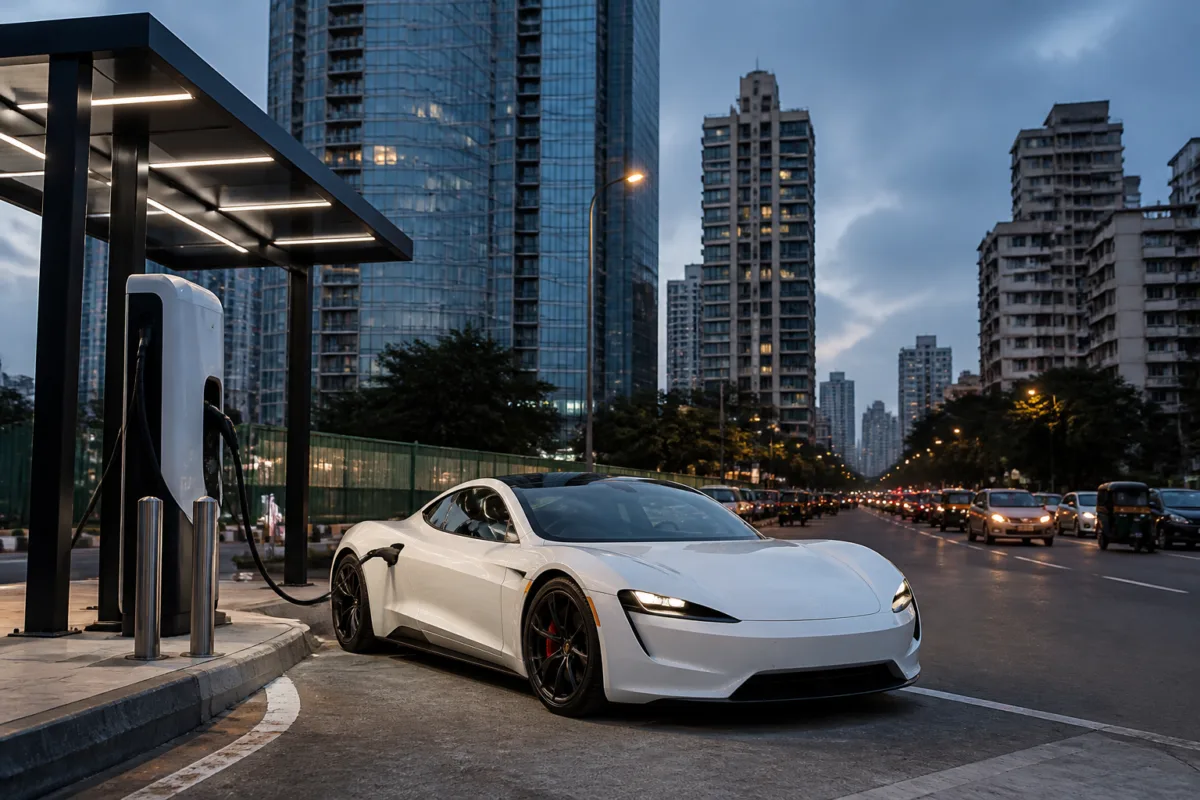
Tesla’s Roadster reservations in India are turning an ultra-luxury electric sports car into a test of whether the country’s premium EV market can support products that demand more than affluent buyers and headline-making performance. The company has opened reservations for Performance and Thrust configurations, while a proposed Rocket version could be offered to selected customers by invitation. But production, final pricing, technical specifications and Indian delivery timelines remain unsettled.
The Roadster matters to India’s urban transport system less as a likely mass-market vehicle than as a stress test for the ecosystem around luxury electric cars. Its proposed performance levels, specialised engineering and high entry payments expose the practical requirements of premium EV ownership: adequate charging access, reliable customer support, distribution reach and regulatory clarity for technologies that move beyond conventional automotive propulsion.
According to the report by The Hindu BusinessLine, Indian customers can reserve the Performance and Thrust configurations with an initial payment of ₹5.01 lakh. Performance requires a further ₹45.05 lakh within 10 days, taking the deposit to ₹50.06 lakh. Thrust requires another ₹2,45,24,000, bringing its deposit to ₹2,50,25,000. Tesla has not announced final selling prices for either configuration.
The Performance version is described as focusing on electric propulsion and aerodynamic grip, with a claimed zero-to-60 mph time below 1.6 seconds. The Thrust version adds rocket-inspired propulsion assistance and has a claimed time below 0.9 seconds. These claims remain tied to a product whose production specifications are still subject to confirmation.
A third version, called Rocket, could potentially be made available to selected Indian buyers by invitation. An industry source familiar with developments told BusinessLine that access for Indian customers was “definitely possible” but would be invitation-only. The same source described the proposed vehicle as incorporating rocket-derived propulsion technology intended to enable flight.
That prospect is not yet an established product outcome. The proposed flying capability remains subject to technical validation and regulatory approvals. The distinction is important because a vehicle designed for road use and a vehicle capable of flight would operate within very different safety, certification and operating frameworks. The supplied report does not establish whether the Rocket version has secured any Indian approval or whether deliveries have been committed.
Tesla is targeting Roadster production for 2028, initially with left-hand-drive vehicles. Indian deliveries have not been scheduled. That timeline places the Roadster within a market that is still building its premium EV infrastructure and customer base, rather than entering a mature electric-car network.
Tesla’s recent registration numbers show why the company is receiving attention. Vahan data compiled as of October 11 showed 646 Tesla registrations in India during April–September 2026, compared with 69 during the same period a year earlier. That represented an 836 per cent increase, while Tesla’s share of India’s luxury electric-vehicle market rose from 2.5 per cent to 14.6 per cent.
The monthly figures also point to a sharp acceleration. Tesla registered 296 vehicles in September, ahead of Mercedes-Benz’s 128. Yet the comparison needs to be read alongside differences in market maturity and distribution. Tesla has seven centres in India, while several established luxury manufacturers operate networks of more than 50 outlets. Those companies also have longer-standing customer relationships and repeat-purchase networks.
This difference is central to Tesla’s Indian challenge. A high registration-growth percentage can signal strong early demand, but it does not by itself establish whether the company can maintain sales across cities. Luxury car purchases are influenced by service availability, access to test drives, repair infrastructure, resale confidence and the convenience of dealing with a familiar network. Tesla’s direct-to-consumer model places greater responsibility on the company to create that awareness and support system as it expands beyond its initial markets.
The company’s existing Indian product range provides a more practical base for that expansion. Tesla currently sells the five-seat Model Y from ₹50.89 lakh and the six-seat Model Y L from ₹61.99 lakh. The larger Model Y L is aimed at Indian families seeking additional passenger and luggage space. It has a claimed 100-km/h time of 4.5 seconds with Complimentary Acceleration Boost and up to 681 km of WLTP range.
The Model Y range also illustrates the difference between introducing a premium EV and creating an electric mobility system around it. A sports car may attract attention through acceleration and design, but family-oriented vehicles depend more heavily on routine charging, dependable inter-city travel and access to service. The market’s ability to absorb more Tesla models will therefore depend partly on whether the supporting network expands at the same pace.
Tesla currently operates 20 Supercharger stalls across five stations and 28 Destination Charger stalls across seven stations in India. Three additional charging sites are planned by December. The company has said it intends to expand charging infrastructure across major cities and connecting highways, but it has not disclosed a numerical expansion target.
The absence of a disclosed expansion target makes it difficult to assess whether infrastructure growth will match the company’s product ambitions. The current network may support a limited premium customer base, but the report does not establish its utilisation, geographic coverage, reliability or ability to support future Roadster deliveries. It also does not provide a city-wise breakdown of charging demand or the number of Tesla owners relying on home charging.
Home charging presents another institutional and built-environment challenge. Restrictions imposed by residential societies on installing home chargers remain an obstacle to wider EV adoption. This issue is particularly significant in Indian cities, where many luxury-car buyers live in apartment complexes and gated communities rather than independent homes. The availability of a public fast-charging station cannot fully substitute for convenient overnight charging at a resident’s regular parking space.
The question, therefore, is not simply whether an Indian buyer can reserve a Roadster. It is whether urban housing, commercial properties, charging operators and local authorities can accommodate increasingly diverse EV requirements. A vehicle with extreme performance specifications may need a different ownership ecosystem from a family SUV, while both still depend on the same basic urban systems: electricity connections, parking infrastructure, roads, service facilities and clear safety rules.
Tesla’s registration growth gives the company an important opening in India’s luxury EV market, but the figures also underline the need for institutional depth. Seven centres and the current charger network may be sufficient for an early expansion phase, yet the report provides no confirmed schedule for Roadster deliveries or a quantified plan for the next stage of charging growth.
The Roadster’s India reservations thus reveal two parallel developments. One is the arrival of a highly specialised electric vehicle aimed at a very small customer segment. The other is the effort to build confidence in a broader premium EV ecosystem. The first can generate attention quickly; the second will determine whether that attention becomes sustained urban demand.
What is confirmed is that Tesla has opened reservations, disclosed large initial payments for two configurations and recorded a substantial year-on-year rise in Indian registrations. What remains unresolved is whether the Roadster will enter India, when deliveries could begin, what its final specifications and prices will be, and whether the company’s charging and service network will expand sufficiently before then. Those milestones will show whether Tesla’s luxury EV momentum represents a durable market shift or an early surge concentrated around limited availability.

