


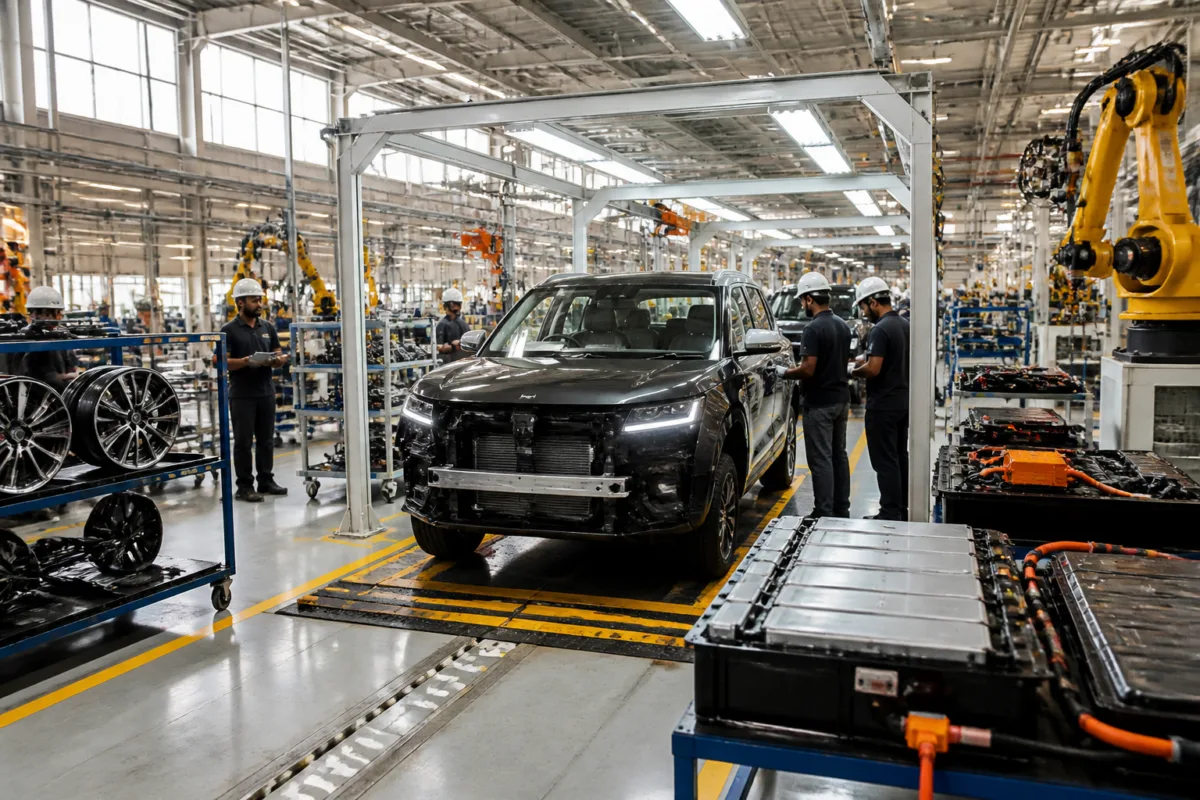
JSW Motors’ first plug-in hybrid SUV is more than a new entrant in India’s crowded passenger-vehicle market. The vehicle, scheduled to be unveiled next month, is also the first visible product of a manufacturing and technology ecosystem that the JSW Group is building across suppliers in India, Europe, Japan, China and South Korea. Its success will therefore be measured not only by sales, but by how effectively a new Indian carmaker can combine imported platforms, local engineering, connected-car systems and domestic production.
The company has partnered with more than 50 suppliers and technology firms for the programme. The SUV is based on a platform from China’s Chery Automobile, but JSW Motors says the vehicle has been engineered and calibrated for Indian roads with local suppliers. That distinction is central to the company’s proposition: it is using an established international base while attempting to localise the systems, components and software that determine how the vehicle performs in Indian conditions.
JSW Motors chief executive Ranjan Nayak told Economic Times that the company chose a proven platform to bring plug-in hybrid and electric technology to Indian customers from the beginning. He said the engineering, software, suppliers and factory being built around the platform are rooted in India. The company’s stated aim is to increase Indian supplier participation over time and create a domestic chain that can support plug-in hybrids, battery-electric vehicles and range-extended electric vehicles.
This approach places the vehicle within a broader industrial transition. India’s passenger-vehicle market is increasingly shaped by SUVs and electrification, but advanced vehicles require capabilities that extend beyond conventional assembly. High-voltage batteries, thermal systems, electronic control units, driver-assistance systems, connectivity and software must work together reliably. JSW Motors is attempting to assemble that capability through a network that includes Motherson, Uno Minda, Tata Elxsi, Bharti Airtel and KPIT Technologies in India, alongside Bridgestone, Kwangjin, Saint-Gobain, FEV, BASF and IDIADA.
The localisation programme covers a wide range of components. Alloy wheels are being developed with JJF Castings, tyres with Bridgestone, and fluids, lubricants, adhesives and sealants with Castrol, Fuchs, Henkel and BASF. Motherson and Uno Minda are part of the supply base for the 12-volt battery, low-voltage electricals, chassis, thermal systems, body components and interior parts. The company has also said that the powertrain is calibrated for E20 fuel and BS VI Phase 2 standards, with FEV, HORIBA and the Automotive Research Association of India supporting validation.
These details show that localisation is not limited to replacing imported physical parts. It also involves adapting a vehicle’s operating systems to Indian fuel standards, road conditions, climate and usage patterns. JSW Motors said software for 16 electronic control units, covering areas from the powertrain to infotainment, has been adapted for India. Tata Elxsi is developing the cabin interface, while KPIT, L&T Technology Services, Jayem Auto and IDIADA are supporting the programme.
The company’s connected-car architecture adds another layer to the industrial story. Its telematics control unit, which links the vehicle to the cloud, is being localised with Tata Elxsi. Airtel SIM cards will connect vehicles through Indian networks. JSW Motors said data generated by connected-car systems, including footage from in-car cameras, will be hosted on Amazon Web Services servers located in India. According to Nayak, the data will not be transferred to, stored in or accessed from another country, and its storage, processing and sharing will be governed by company security policies and Indian law.
That arrangement makes data governance part of the vehicle’s product architecture. Connected vehicles increasingly depend on cloud infrastructure for diagnostics, software functions and user services. By keeping the stated data operations within India, JSW Motors is presenting domestic control of vehicle data as part of its value proposition. The supplied report does not establish how these systems will be regulated in practice or what specific consumer controls will be offered, but it confirms that data location and access have been considered at the programme level.
The manufacturing base is planned for Chhatrapati Sambhajinagar in Maharashtra. The greenfield facility is backed by a cumulative investment plan of more than Rs 27,000 crore and is spread over 600 acres. JSW Motors said the plant will have installed capacity for 500,000 vehicles a year, with room for expansion. It will include a press shop, paint shop and vehicle assembly bays, as well as an in-house supplier park.
The scale of the proposed facility matters because the plant is intended to support more than one launch. The plug-in hybrid SUV is described as the first of several advanced electrified vehicles planned by JSW Motors. The company has said that battery-electric vehicles, range-extended electric vehicles and other clean-energy models will follow. It also said that the supplier ecosystem being assembled for the first vehicle will serve future models.
A supplier park within the manufacturing premises can reduce logistics complexity between component production and vehicle assembly. It can also allow the manufacturer to coordinate quality, sequencing and future localisation more closely. However, the supplied material does not provide production-start dates, annual output targets for the first model, employment projections or details of the incentives supporting the facility. Those issues will be important in assessing how quickly the announced capacity becomes operating capacity.
The plant also connects JSW Motors’ passenger-vehicle plans to the wider industrial base of the JSW Group, a Mumbai-headquartered conglomerate with businesses in steel, energy and infrastructure. The company is entering the passenger-vehicle sector at a time when Tata Motors and Mahindra & Mahindra, the other prominent homegrown manufacturers identified in the report, are expanding on the strength of SUVs and electric vehicles.
JSW Motors is not entering with a conventional internal-combustion vehicle as its first product. Its choice of a plug-in hybrid places the company between established petrol and diesel technologies and fully battery-electric vehicles. The company’s stated future portfolio includes both battery-electric and range-extended models, suggesting that it is treating the first SUV as a platform for a wider electrified product strategy rather than as a standalone launch.
The technology partnerships indicate how vehicle manufacturing is changing. Chips from Qualcomm, Mobileye, NXP and Infineon are being integrated through JSW’s own software. The company is also in advanced talks with Google and OpenAI for independent future products involving software-defined vehicles, autonomous driving and agentic integration. These discussions are described by the company but do not amount to confirmed production arrangements in the supplied material.
Design and manufacturing are being coordinated through Dassault Systèmes’ 3DEXPERIENCE platform under a partnership announced in March 2026. The use of such a platform reflects the growing importance of digital engineering in complex vehicle programmes. It allows the company to connect design, engineering and manufacturing processes, although the report does not provide measurable information on how the platform has affected development time, cost or quality.
The larger urban and infrastructure question is how new vehicle manufacturing capacity changes the industrial geography of a city and region. A 600-acre plant with an internal supplier park is not only an assembly site. It requires transport links, power, water, worker mobility, logistics services and supporting industrial activity. The supplied report confirms the proposed scale and location but does not detail the facility’s infrastructure demand or its implications for surrounding communities.
For Chhatrapati Sambhajinagar, the project represents an attempt to anchor a new manufacturing ecosystem rather than simply host a final-assembly operation. The depth of that ecosystem will depend on how many components and software functions can be developed locally, how suppliers scale with future models and whether the proposed capacity is utilised. Those outcomes remain unestablished because the first vehicle has yet to be unveiled.
What is clear is that JSW Motors is using its first SUV to combine global technology with Indian adaptation. The platform comes from Chery, electronic components come from several international companies, and specialist engineering support is spread across multiple countries. At the same time, the company is localising software, connectivity, vehicle components, fuel calibration and data hosting, while building a large manufacturing base in Maharashtra.
The next significant milestone is the planned unveiling of the plug-in hybrid SUV next month. That event should establish the vehicle’s final specifications and provide the first public test of how the company’s international platform, Indian engineering and proposed manufacturing ecosystem have been brought together.

