


Mahindra’s possible initial public offering for its electric three-wheeler business is more than a corporate fundraising question. It offers a window into how India’s urban commercial-mobility market is moving from early adoption towards a scale-led contest involving operating costs, manufacturing capacity, domestic supply chains and access to capital.
Mahindra Last Mile Mobility Chief Executive Officer Suman Mishra said the business is looking at a listing in about 18 months, but would proceed only if it is ready and has a clear funding requirement. The company does not need to rush, she said, because its parent group can finance expansion. That qualification is important: the proposed IPO is being presented as an option linked to growth and capital strategy, not as a necessity for survival.
The business is also being supported by a market where the financial case for electric three-wheelers is especially visible. Mishra said rising fuel prices linked to the Iran war were encouraging customers who had been undecided about switching to electric vehicles to make the transition. For commercial drivers covering long daily distances, the operating-cost calculation can become more immediate than in private-car ownership. “When you drive 150 kilometres per day, you start seeing the economic savings immediately,” she said at a Bloomberg-hosted event in Mumbai.
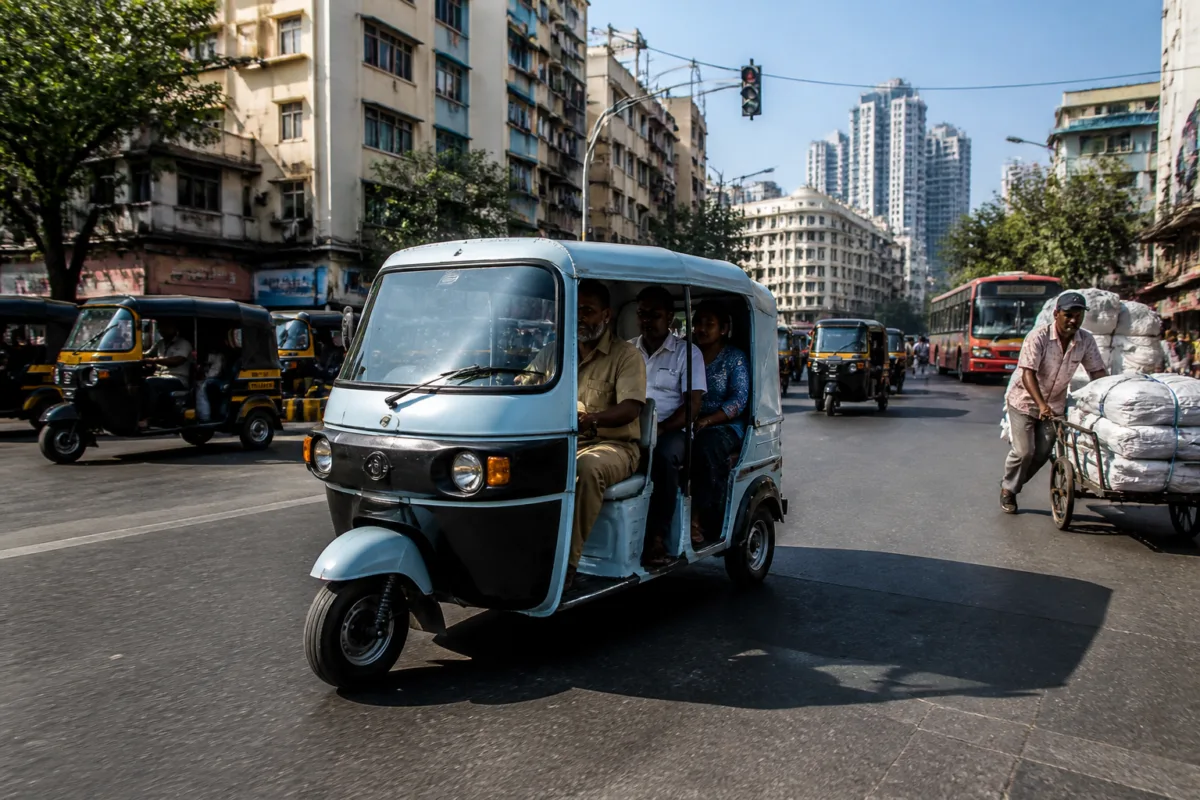
That usage pattern places electric three-wheelers at the centre of a practical urban transition. These vehicles are used for passenger movement and goods transport, often in dense areas where short- and medium-distance trips are frequent. The supplied report does not provide a national fleet total, charging network assessment or city-level adoption figures, but it does indicate that commercial utilisation is making fuel savings a direct business consideration for drivers.
## The business case is being built around utilisation
Mishra said more than 45% of India’s larger three-wheelers are electric. The figure, as reported by Economic Times from the Bloomberg event, points to a market segment where electrification has advanced beyond a marginal role. It also suggests why manufacturers are treating three-wheelers differently from other vehicle categories: high daily usage allows operators to evaluate vehicles through recurring fuel and operating expenses rather than only through purchase price.
The same economics can make the segment sensitive to changes in fuel prices. The report links the current increase in demand to a fuel crisis associated with the Iran war, while also noting that customers who were previously undecided are now switching. This does not establish that higher fuel prices alone will sustain demand. It does show that the purchase decision is closely connected to the cost of keeping a commercial vehicle on the road.
For cities, that distinction matters. Electric three-wheelers are not simply consumer products; they are working assets embedded in local transport and delivery systems. A vehicle’s ability to operate reliably, earn revenue and control daily costs can influence whether drivers adopt it. However, the supplied material does not establish how charging access, battery replacement, financing terms, resale values or maintenance costs vary across cities. Those factors remain outside what can be concluded from the reported comments.
Mahindra’s proposed listing therefore sits at the intersection of two kinds of scale. The first is operational scale: producing enough vehicles to meet demand and support a larger manufacturing footprint. The second is financial scale: deciding whether expansion is best funded through the parent group or through public-market capital.
## An IPO would formalise the expansion question
Mahindra raised ₹322 crore in the summer from investors led by Lightrock at a valuation of ₹10,822 crore, according to a July filing cited in the report. That funding provides a recent reference point for the company’s ability to attract institutional investment. A future public listing would represent a different stage of market scrutiny, requiring the business to present a sustained growth story, a credible path to profitability and a clear use for the capital raised.
Mishra said the decision will depend on the company’s funding needs and its ability to demonstrate sustained growth. The statement makes the proposed timetable conditional. Eighteen months is the period under consideration, not a confirmed listing date, and the business has not committed to proceeding regardless of market conditions or its own readiness.
The parent group’s willingness to fund the business gives Mahindra an alternative to a rushed public offering. Mishra said, “The group is going to fund us no matter which way.” This arrangement can allow the electric three-wheeler business to prioritise production and market development before seeking public investors. It also means that a listing would need to offer a strategic advantage beyond simply supplying cash, although the source does not specify what those advantages might be.
The company is evaluating locations for a larger manufacturing facility after investing in capacity expansion. The report does not identify the locations under consideration, the proposed plant size or the number of vehicles involved. Even so, the decision signals that management is planning around higher production requirements rather than treating current demand as a short-lived spike.
That distinction is significant for urban mobility. Manufacturing capacity affects how quickly operators can replace conventional vehicles, how consistently manufacturers can supply fleets and whether demand can be served beyond early-adopter markets. But capacity alone does not guarantee adoption. The business must also manage component availability, vehicle economics and the ability of operators to finance purchases.
## Localisation has advanced, but key dependencies remain
Mahindra’s electric three-wheeler manufacturing is reportedly 70% to 75% localised. At the same time, the company relies on imports for battery cells and semiconductors. This combination captures a central feature of the electric-vehicle supply chain: local assembly and sourcing can progress while some of the most strategically important components remain externally dependent.
For a commercial vehicle maker, that dependence can affect production planning and costs. Battery cells are central to vehicle performance and range, while semiconductors are required for electronic systems. The supplied report does not identify the countries of origin, contract structures or disruption risks connected to these imports. It does, however, establish that Mahindra’s current localisation level does not mean complete domestic control over the supply chain.
The proposed larger facility will therefore be evaluated against more than floor space and assembly capacity. The company’s ability to scale will also be tied to the availability of imported and locally sourced components. The source does not say whether the prospective IPO would fund battery-cell manufacturing, semiconductor sourcing or any other specific supply-chain intervention, so no such conclusion can be drawn.
Profitability is another unresolved part of the expansion story. Mishra said the business has not yet turned a profit without government incentives, but expects to achieve profitability in a couple of years. This places the company at a transitional point: demand and investment are expanding, yet the underlying business has not fully demonstrated independent profitability after excluding policy support.
That qualification is particularly relevant for electric mobility businesses. Incentives can help reduce the gap between the upfront cost of electric vehicles and conventional alternatives, but a durable commercial model ultimately depends on vehicle sales, utilisation, production efficiency and recurring operating economics. The report does not identify the incentives involved or quantify their contribution to Mahindra’s results. It does establish that the company’s profitability target remains ahead rather than already achieved.
## Competition is expanding the market—and raising the test
Competition from Bajaj Auto and TVS Motor is intensifying in three-wheelers. Mishra described the entry of these companies as positive for adoption, arguing that competition generated market credibility and demand and helped Mahindra scale up. “Once they entered this space, competition generated market credibility and demand, and therefore we were able to scale up,” she said.
This is a notable interpretation of competition in an emerging vehicle segment. Rival manufacturers can divide sales, but their presence can also reassure buyers that electric three-wheelers are becoming an established category rather than a single-company experiment. For commercial drivers, more recognised brands may improve confidence around service, availability and long-term product support, although the supplied material does not provide evidence on those specific outcomes.
The competitive environment also changes the meaning of a potential IPO. A public listing would not simply monetise the growth already achieved. It would place the business under greater pressure to maintain growth while competitors expand, production increases and profitability remains a stated future objective. Mahindra’s decision will therefore depend on whether its electric three-wheeler operation can show that demand is broadening into a repeatable market rather than responding only to temporary fuel-price pressure.
The available evidence confirms that Mahindra is preparing for expansion, considering a larger manufacturing facility and evaluating a public listing in roughly 18 months. It also shows that the business combines strong reported adoption in larger three-wheelers with partial localisation, imported battery cells and semiconductors, reliance on government incentives for current profitability, and growing competition. What remains uncertain is whether the IPO will proceed, how much capital would be sought, where additional capacity would be located and when the business will achieve profitability without incentives. Those are the milestones that will determine whether Mahindra’s electric three-wheeler operation becomes a durable pillar of India’s urban mobility transition or remains primarily a high-growth expansion story.

