


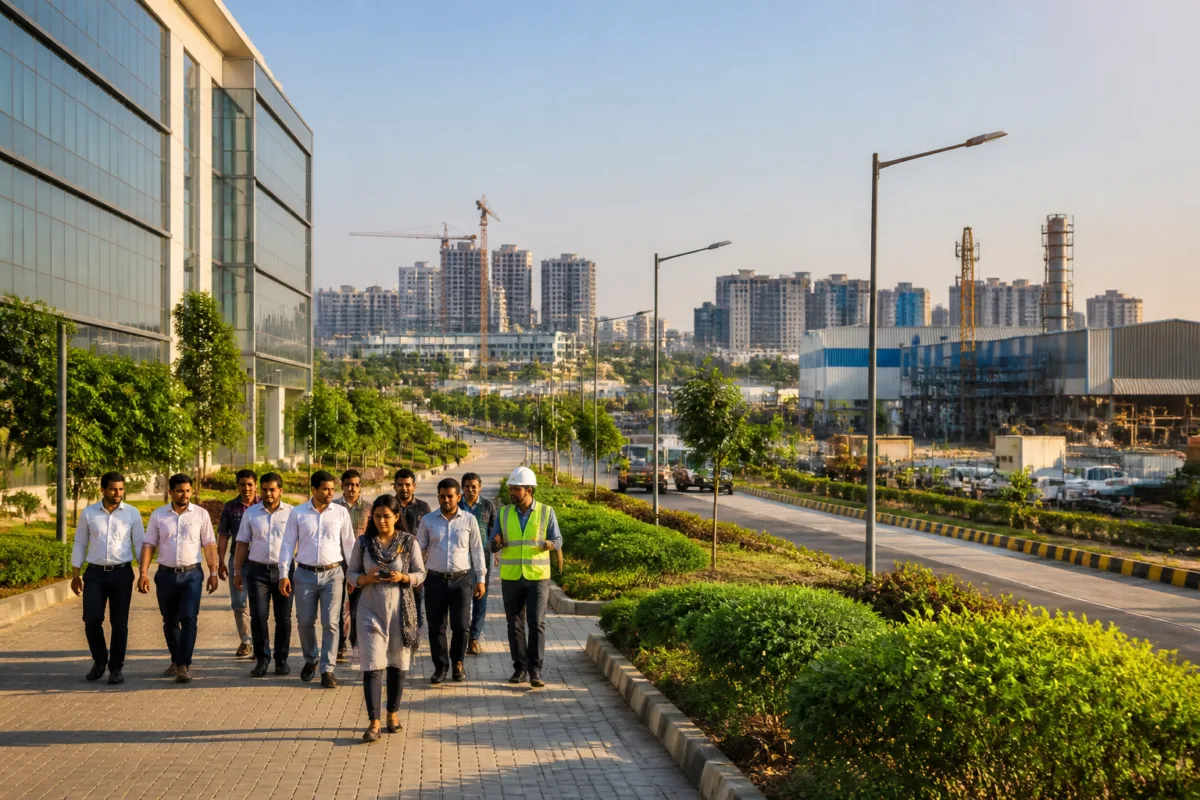
Telangana’s investment strategy is entering a more demanding phase: moving from large commitments announced at summits to projects that are built, staffed and integrated into the state’s urban and industrial geography. B. Ajith Reddy, CEO of Invest Telangana, told Deccan Chronicle that the state’s priority after securing investment commitments of nearly $69 billion last year is to convert investor interest into partnerships, projects, employment and economic growth.
That shift matters because investment announcements are only the first administrative step in a much longer chain. An MoU may signal intent, but it does not by itself create a factory, an office, a data centre, an industrial park or a job. Telangana’s stated challenge is therefore not simply attracting capital. It is coordinating land, power, policy, infrastructure, skills, local institutions and project execution across locations that extend beyond Hyderabad.
The proposed Telangana Global Summit 2026 is being positioned as the next stage of this process. According to Reddy, the previous year’s Telangana Rising Summit established the state’s long-term framework, Telangana Rising 2047, including an ambition to build a $3 trillion economy by 2047 and reach an intermediate milestone of $1 trillion in 2034. The new summit is intended to focus less on unveiling a vision and more on translating that vision into implementation.
This is also a change in the state’s investment narrative. Telangana is not presenting itself only as a destination for a few established sectors. Its existing strengths include aerospace, space and defence, life sciences, information technology and global capability centres. The state is also seeking investment and institutional attention in areas such as artificial intelligence, animation, visual effects, gaming and comics, electronics, data centres and textiles.
The diversification agenda has a direct urban dimension. Each sector requires a different combination of land, electricity, connectivity, workforce, housing and civic services. A data centre has different infrastructure requirements from a life sciences facility. Aerospace and defence manufacturing requires specialised industrial ecosystems, while creator-economy businesses depend more heavily on talent, digital connectivity and urban amenities. A single investment policy cannot address all these requirements equally.
Reddy said the government is therefore consulting investors and industry associations while revisiting policies for sectors including data centres, electronics, aerospace, textiles and AVGC. He said the policies are being developed through consultations with companies already operating in Hyderabad and are expected to include incentives related to power, power tariffs and available land banks.
This approach places implementation capacity at the centre of investment policy. The question is not only whether incentives are attractive on paper, but whether the state can provide them at the time and location required by a project. Land availability, reliable electricity and suitable industrial sites are administrative and infrastructure questions as much as they are investment questions.
The state is also considering industrial parks close to Hyderabad. That focus could support faster project execution by locating new activity near an existing economic base, but the supplied material does not establish how many parks are planned, their precise locations, their capacity or their implementation timelines. What it does show is that Telangana is attempting to connect investment promotion with spatial planning rather than treating projects as isolated commitments.
The larger structural proposal is Telangana Rising 2047’s division of the state into different development zones. Under the framework described by Reddy, services and non-polluting industries would be located in one zone, manufacturing in another, and agriculture and allied sectors in a separate zone. The objective is to distribute economic activity and create a more deliberate geography of growth.
The proposal is significant because Hyderabad currently functions as the state’s most visible investment platform. A decentralised model would require more than announcing Tier II cities as future growth centres. Warangal, Mahbubnagar and Nizamabad are identified in the interview as cities that could emerge as such centres, while the government is also focusing on moving more IT companies into Tier II towns. The supplied material does not provide targets for the number of companies, jobs or projects to be shifted, but it makes the institutional intention clear: future growth is not meant to remain concentrated in the capital region.
For those cities, the practical test will be whether investment decentralisation is matched by urban capacity. New employment centres generate demand for housing, public transport, roads, water supply, waste management, education, healthcare and commercial space. If those systems do not expand alongside industry and services, the result can be a relocation of jobs without a corresponding improvement in the quality or affordability of urban life.
The summit’s proposed programme reflects this broad implementation agenda. Reddy said organisers expect between 600 and 700 international delegates, including diplomats, commercial representatives, defence attachés, consuls general and senior executives from Europe, North America, Japan, South Korea, Singapore and other countries. The state is also planning a Raksha Expo, a pharma and life sciences expo, a focus on the creator economy and AVGC, and the co-location of IndiaJoy.
A climate conclave is also planned, with the stated intention of turning discussions involving policymakers and climate experts into an action plan. The interview does not specify the action plan’s targets, funding or responsible agencies. That absence is important: climate discussions become operational only when they are linked to measurable commitments, implementation authority and monitoring. At this stage, the supplied evidence establishes the proposed forum, not its eventual outcomes.
The Telangana Innovation Startup Challenge is another mechanism connecting policy ambitions to public administration. According to Reddy, the government has identified public problems and invited young innovators and startups to propose solutions. Promising ideas could be developed into prototypes, with the government potentially awarding contracts. This model places procurement alongside entrepreneurship, although the interview does not state the procurement rules, sectors covered or number of contracts under consideration.
The emphasis on contracts and implementation distinguishes this agenda from a purely promotional summit. It suggests an effort to connect investor engagement with government action, whether through sector-specific policy, industrial land, power-related incentives, public procurement or project partnerships. The effectiveness of that approach will depend on what happens after the event: which commitments are assigned to departments, how projects are tracked and when employment or production begins.
Telangana’s investment framework is therefore combining three layers. The first is sectoral promotion, covering established strengths and newer areas such as AI and AVGC. The second is spatial planning, through industrial parks and development zones intended to spread activity beyond Hyderabad. The third is institutional execution, involving customised packages, investor consultations, public problem-solving and the conversion of MoUs into projects.
The numbers in the interview show the scale of the ambition, but also the gap between ambition and delivery. Nearly $69 billion in investment commitments were secured at the previous summit, while the state’s long-term targets are measured in trillions of dollars and decades. Against those figures, the immediate administrative unit of success is much smaller: a project reaching financial closure, land being made available, construction beginning, operations starting and people being hired.
The state’s own language acknowledges this sequence. Reddy said interests must become partnerships, partnerships must become projects, and projects must become employment and economic growth. That formulation provides a useful measure for assessing future updates. Announcements of new MoUs will be less informative than evidence showing how many existing commitments have advanced through each stage.
The focus on execution also raises questions about accountability. The interview identifies Invest Telangana, the state government, industry partners and sector-specific consultations as parts of the investment framework. It does not provide a public monitoring system, project-wise conversion rate or deadline for implementing the commitments. Without such information, it remains difficult to distinguish between a commitment that is active, one under negotiation and one that has stalled.
For Hyderabad, the strategy could reinforce the city’s role as an anchor for high-value sectors while creating pressure to extend infrastructure and industrial capacity. For Tier II cities, it could offer a route to stronger economic bases if investment is accompanied by adequate urban services. For the state administration, the central challenge is coordinating these outcomes across departments and locations rather than treating each investor or summit as a separate transaction.
The evidence currently confirms a policy shift in emphasis, not yet a completed transformation. Telangana is moving its public investment pitch from the size of announced commitments towards the credibility of implementation. The next meaningful indicators will be the conversion of the previous summit’s commitments into operational projects, the details of revised sector policies, the development of industrial parks, and the measurable progress of growth beyond Hyderabad.

