


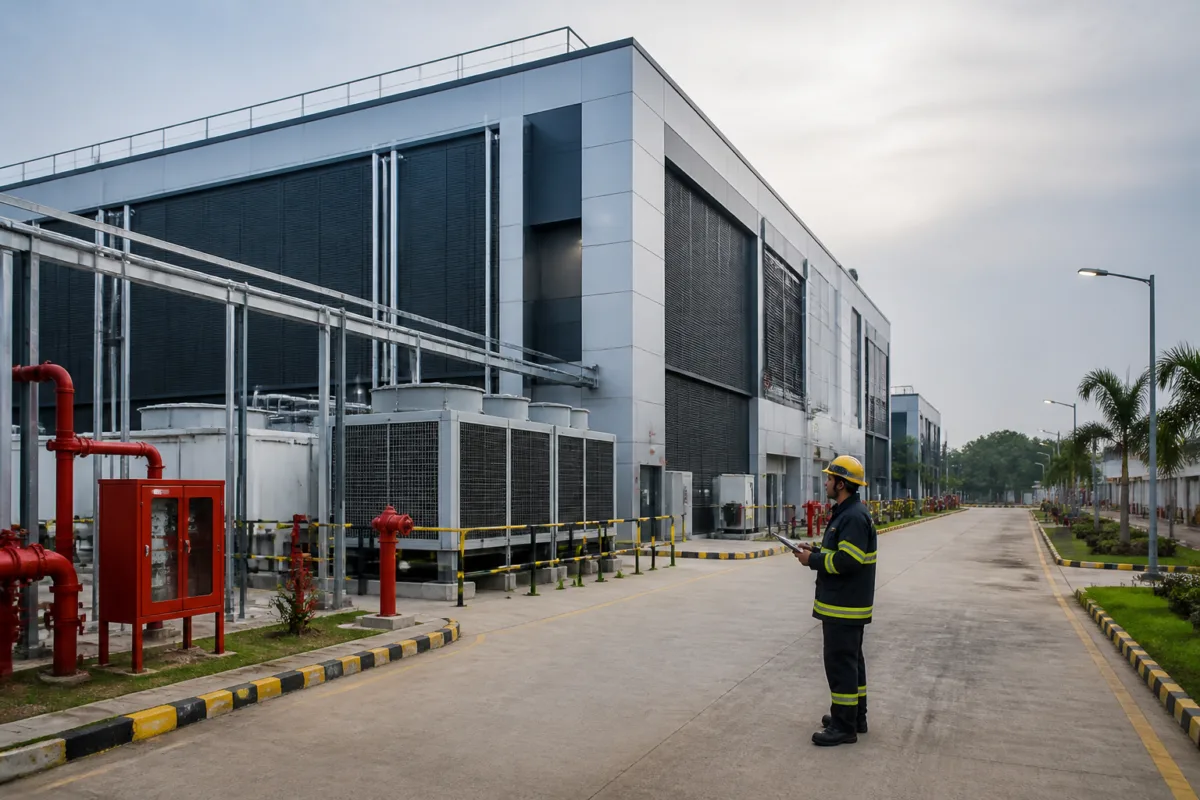
Telangana’s Fire Department has issued specialised fire and life-safety guidelines for data centres, setting out detailed requirements for Fire No Objection Certificate applications and emergency protection systems across the state. The rules will apply to applications for provisional Fire NOCs submitted on or after November 6.
The guidelines were issued through a circular dated October 28 by Telangana Fire, Disaster Response, Emergency and Civil Defence Department Director General Vikram Singh Mann, according to an official release. They are intended to support faster scrutiny and processing of Fire NOC applications while accounting for the specific operational and safety conditions of data centres.
The department said the initiative is aimed at strengthening fire prevention, improving emergency preparedness and ensuring compliance with prescribed fire and life-safety standards. It also described data centres as critical infrastructure and linked the guidelines to the state government’s priority of attracting and establishing such facilities in Telangana.
Data centres contain servers, storage systems, networking equipment and other infrastructure that depend on uninterrupted electricity, cooling and communications. Their electrical systems can include UPS units, batteries, transformers, generators, fuel storage and extensive cable networks, creating fire risks that require measures different from those used in conventional commercial buildings.
The guidelines prescribe fire detection and alarm systems, suitable fire suppression equipment, compartmentation, firefighting shafts, wet risers, refuge areas and adequate firefighting water storage and pumping capacity. Automatic sprinkler systems are required in administrative areas, while technical areas must have suitable water-mist or clean-agent gas suppression systems.
Special requirements have been set for battery rooms, UPS rooms, transformer and switchgear rooms and other critical electrical installations. Applicants must also provide comprehensive fire-risk assessments, adequate ventilation, fire-rated separation, emergency shutdown arrangements and appropriate protection for fuel storage and other high-risk areas.
The department said the guidelines take into account the smaller number of people generally present in a data centre compared with a conventional commercial building. That operational difference has informed the prescribed fire-protection approach, while the infrastructure itself remains subject to specialised safeguards.
The circular also requires fire detection and suppression systems to be integrated with relevant building-management and emergency systems. Data-centre operators must prevent the accumulation of combustible materials such as cardboard, packaging, wooden pallets and waste in data halls and other critical areas.
Specific conditions have been prescribed for basement levels and the protection of critical infrastructure. Scrutinising officers have been instructed to verify compliance with the approved fire-safety design and all conditions set out in the circular before processing applications.
The new requirements place the Fire NOC process within the technical realities of data-centre operations, where a fire can threaten not only occupants but also power, cooling, communications and other systems that support digital services. The department’s stated objective is to combine faster approvals with stronger prevention and emergency-response safeguards. The guidelines will govern provisional Fire NOC applications submitted from November 6 onward.

